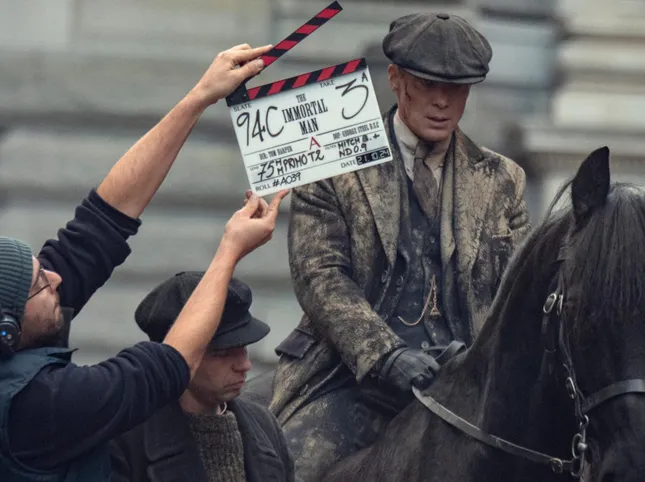
Behind the scenes of the Peaky Blinders soundtrack
It all started with “Red right hand” which accompanies the arrival on the scene of one of the most fascinating anti-heroes of the TV series: Tommy Shelby, the gangster who controls Birmingham at the beginning of the 20th century, told and accompanied by the words of Nick Cave. His story lasts six seasons and a film, in which he reaches the point of being a member of parliament, seeing friends and family grow up and disappear in the midst of violence, and dealing with the rise of fascism and Nazism. Always with a song to tell his story: Thom Yorke, Jack White, Arctic Monkeys, Iggy Pop are just some of the names that create the sound world of the series, up to Grian Chatten, whose voice resonates in “The immortal man”, the epilogue of the saga, released last week on Netflix. The singer was involved by Antony Genn, who is the Creative Music Supervisor of the series, as well as author of the original music together with Martin Slattery. We reached him via Zoom in his London studio to tell us how to tell a character’s story with songs, and how they convinced Nick Cave to re-record his most famous song for one of the most intense scenes of the film.
“Peaky Blinders” is set in England in the first half of the 20th century. How did you create a sound world with contemporary songs and music?
Choose “Red Right Hand” as the song to start a period drama it was a courageous choice by Otto Bathurst, the director. I started working on it from the fourth season and my task was also to take care of the creative musical supervision of the project and to choose the songs: that choice was a flag, so to speak, which guided the subsequent choices.
“The Immortal man” is a movie, not a season of a series. How has working on songs and music changed?
In this case it is a broader and more ambitious idea, the story is different. Tommy finds himself in the middle of History with a capital H, a war, a world war. It’s about the Nazis, it’s about the fucking end of the world…
The story shapes the world you create musically, and there’s a real narrative arc in this story: Tommy stays in hiding and lives as a recluse, wandering around an empty house, and then suddenly everything becomes vast and imposing. The whole point of the story is that Tommy comes back to save the day. Musically, this leads to us being able to go from being small to big with everything else in between.
At what point in the story does a song come into play, after a sequence has been written or in the process of being written? And how do you work with Steven Knight, the author, to choose songs and music?
There was only one song in the movie script, “Red Right Hand.” But when the time came, the original didn’t work. I spoke to Cillian and said: “You need to go to Nick (Cave) and ask him to record it again. It needs to be slower.” Nick Cave has experience in the film business and is also a great storyteller, and he understood the situation.
In “Peaky Blinders” there are already different versions of “Red Right Hand”, but only sung by other artists.
Yes, we had already done a slower version of it in Season 4 with Laura Marling, so we knew that idea worked. Nick kept his word, and re-recorded it.
In the series we drew more on archive songs, to be rediscovered, but in the film there is a different approach: original songs and an instrumental soundtrack.
We had already included covers specially recorded by Laura Marling, Iggy Pop and Jarvis Cocker in the series. When I started working on this film I spoke to Cillian Murphy about Lankum, and we included a couple of covers, but I already had some ideas in mind even before reading the script. With my long-time colleague, Martin Slattery, we started composing the music after reading the script. Music of various genres: piano and acoustic guitar, punk songs… All played with instruments, not in front of a computer. Our music is very physical, which fits perfectly with Peaky Blinders, which is an imperfect and very physical world. The characters that populate it have experienced traumatic moments, starting with Tommy Shelby, who is much more complex than a sort of evil gangster. This then gives us a chance to create nuanced music, to put the characters in context.
Grian Chatten has become the new musical voice of Peaky Blinders. At what point did you involve him in the project?
The idea was mine. I had jotted down some ideas with Carlos from Fontaines DC, we worked with Amy from Amy and the Sniffers, and then Grian arrived. At that point we had been working for a few months, we had a lot of sketches, but nothing that resembled songs. He arrived and took a liking to it: he is an exceptional narrator.
All the singers we brought in are great storytellers: Girl in the Year Above, who covered Massive Attack’s “Teardrop,” Lankum, Amy Taylor and Nick Cave, of course. Grian Chatten is incredibly powerful, he conveys authority.
TV series have become a powerful tool for rediscovering classic songs, including for the music industry. Have you ever felt pressured to include a “needle drop”, a stock song, or are the choices guided by the story telling?
I just think about what’s right for the scene. There’s some needle drop, there’s two Fontaines DC songs, there’s a McCluskey song, but they’re fine.
There are two Massive Attack covers: a powerful version of “Angel” sung by Grian Chatten and a rarefied version of “Teardrop”.
It was almost a coincidence, the result of completely independent thoughts, and in fact they were interpreted very differently, even if they both have a very Peaky Blinders atmosphere. Maybe it was talked about at some point, but my way around it was to have covers that had their own identity.
In the final scene there is a Lankum song, which however you re-recorded with the band and Grian Chatten.
I think Lankum is a transcendent band, and I think Radie Peat has one of the most powerful voices I’ve ever heard. In the first meeting with director Tom Harper, I suggested he listen to them, because I would really like to work with them. Tom had never heard of them, then he put them in that scene and it worked great. I told him, “Great, but I want to record it again. Trust me, it’ll work even better if I can put my hands on every single aspect.” So we recorded the strings at Abbey Road, because I wanted a more imposing effect, then Grian’s voice also comes in, at the end.
Looking back on the project, series and film, what was the most difficult musical decision you had to make?
In the end we removed two songs in two sequences: it was Cillian Murphy’s idea, a painful one, but in the end it works. Some of my favorite movies, like “The Godfather” or “Chinatown,” have very little music, and when it comes it’s beautiful. The fact is, there’s too much music in movies. I think silence is a beautiful thing.