Arctic Monkeys, believe the hype: 20 years of twists and turns
One might say “we’re still here”, but with a hint of sincere surprise, the one that comes when listening to a new song, while realizing that two decades have already passed since the band’s debut album. Arctic Monkeys. As the 20th anniversary of the release of “Whatever people say I am, that’s what I’m not”originally published on January 23, 2006, Alex Turner and company have indeed amazed the public with an unpublished one“Opening night“, which came to break the band’s recording silence that had lasted since 2022, the year of “The car”. Two temporal coordinates that touch almost by chance, but which together they tell a lotbetween an anniversary that forces you to look backwards and an unreleased song that reopens the conversation about the futurerekindling among fans the idea – or at least the hope – that this return could be the beginning of the journey towards a new album.
It seems like yesterday that four guys from Sheffield they photographed, with sarcasm and precision, the provincial English nights between sticky dance floors, DJ sets, pick-up attempts and sharp observations, transforming “Whatever people say I am, that’s what I’m not” into a generational manifesto. While now the responsibilities of adulthood are very present, but with a desire to mess around – forgive the French, but “loitering” does not belong to the vocabulary of “millennials” – which has never really gone away. “Millennial” is the generation of those who grew up with those songs as their soundtrack of leaving high school, of entering a restless youth, of the first disillusioned look at the world, and that today he finds himself listening to Arctic Monkeys with a completely different set of years, memories and expectations. The fact that, twenty years later, a new song by the band still manages to catalyze attention and questions says a lot about kind of relationship that Arctic Monkeys have built with their audience.
At the time Alex Turner his face was still marked by his immature age and it made the ordinary not just acceptablebut desirable, telling it with a lexicon that it transformed everyday life into stories, long before Tumblr made that aesthetic a global language. “Well, oh, they might wear classic Reeboks / Or knackered Converse Or tracky bottoms tucked in socks / But all of that’s what the point is not / The point’s that there ain’t no romance around there”: the first lines of “A certain romance” soon became a slogan, as did the chorus of “When the sun goes down”.
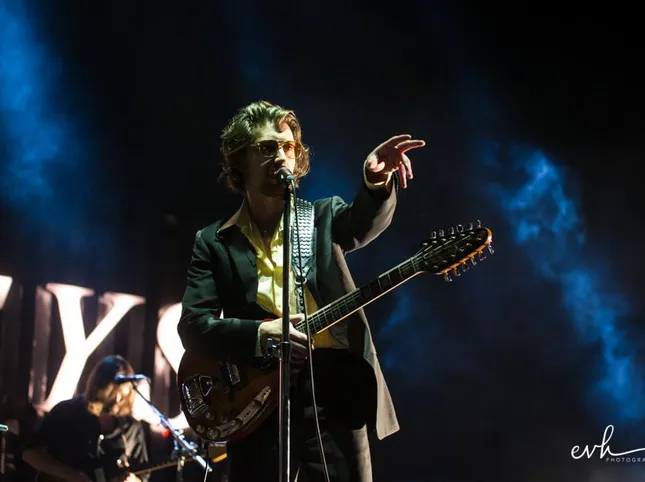
Then Turner grew up, and with him it is an artistic and aesthetic image has developed which has become increasingly conscious over timetheatrical, controlled (in 2018 he went so far as to confess in “Star Treatment” that “I just wanted to be one of The Strokes / Now look at the mess you made me make”). Or maybe not, or at least not entirely, because in the video that accompanies “Opening night” the frontman appears together with the band with a surprisingly relaxed attitude, surrounded by children, far from the iconography of the sophisticated and retro crooner. An image that deliberately contrasts with that chameleonic figure that over the years has alternated leather jackets, tailored suits, hair pomaded, studied postures and a charisma built on references ranging from Seventies rock to mature dandyism Matt Helders, Jamie Cook And Nick O’Malleya reminder that, despite the aura that often focuses on its frontman, Arctic Monkeys remain a band in the most concrete sense of the term.
Going back to “Whatever people say I am, that’s what I’m not” means going back to a moment in which everything seemed possible because it still lacked historical weight. “We’re Arctic Monkeys, this is ‘I bet you look good on the dancefloor’. Don’t believe the hype”, was the introductory phrase that Turner adopted at the opening of the video of his group’s first single, so much so that he also used it during the concert event on 7 June 2018 at the Royal Albert Hall in London. It was a warning and an invitation to tone down the intense media hype that surrounded the band at its debut. That expression functioned as a defiant, ironic and conscious reaction to the rapid, internet-driven fame they had achieved in a very short time. Twenty years later, “Don’t believe the hype” gives the title to an exhibition presented by the British Music Experience which, on view from 23 January to 22 March 2026 in Liverpool, explores the creation and cultural legacy of the cover of “Whatever people say I am, that’s what I’m not” to analyze the broader visual universe from which Chris McClure’s black and white photography was born.
Alan Smythe, one of the record’s producershe recalled to the BBC that he was “very proud” of that work, explaining that he immediately understood that they were working on “something really impressive”, underlining how the lyrics were “extraordinary”, especially considering that they were written by 17-year-olds. Smythe also described the then Arctic Monkeys as “excitable, funny, witty, charming and irritating”, exactly as you would expect teenagers to be, and recounted the speed with which the first songs were recorded, often four songs in two days, due to lack of time and budget. An urgency that can still be heard today in the tracks of the albumwhich became the best-selling debut ever for a British band with 360,000 copies sold in its first week, capable of establishing an immediately recognizable sound and narrative aesthetic.
Still the fastest-selling debut by a band in the UK, at the time of its release “Whatever people say I am, that’s what I’m not” was certified eight times platinum in the UK by the British Phonographic Industry, while in the United States it also became the second best-selling debut album ever for an independent label and was certified platinum by the Recording Industry Association of America for selling at least 1,000,000 copies.
Among those songs, “I bet you look good on the dancefloor” remains the most evident symbol of that energy. In an interview with NME in 2011, Turner said he found the lyrics to the song “scribbled on a piece of paper” and how there were several versions before arriving at the final one, ironically admitting that among the first attempts “there were a lot of things about cigarettes” and also “some rubbish”. In retracing the history of Arctic Monkeys’ debut single, the frontman also narrated how the band initially recorded the song in Sheffield, only to realize that they were playing “everything at 300 an hour”, deciding to return to the studio to refine it better. A chaotic but vital process, which cont helped transform a song born almost by chance into a single destined to stand the test of time more than many other songs on the same album.
From then on, the story of Arctic Monkeys was a sequence of conscious deviations. The following album “Favourite worst nightmare” arrived as an acceleration and consolidation, “Humbug” wanted to be a first real shadow cast on its sound, “Suck it and see” imposed itself as a brighter and more melodic parenthesis, while “AM” was a definitive break with the idea of a British indie band bringing the group into a global dimension, up to “Tranquility base hotel & Casino” and “The car”, works which shifted the center of gravity towards piano, orchestrations, cinematographic writing and a increasingly explicit reflection on the role of training itself. An evolution that has often surprised, sometimes divided, but which has kept a basic coherence intactwith the need not to repeat itself.
It is in this context that “Opening night” arrives, the first unreleased album since 2022 and a preview of the charity compilation “Help(2)” curated by War Child. Matt Helders – more inclined to expose himself than the more shy and reserved frontman, so much so that he more often became the band’s spokesperson – explained to Zane Lowe on Apple Music that the group felt “the need to do something together again“, clarifying that the goal was not to attract attention to oneself, but focus it on the cause:
“There will always be those who ask ‘what does this mean for the band?’, but we want it to be just for these people and for this project.”
The drummer talked about how finding himself in the studio was natural, almost immediate, as if the time that had passed had not created distance, and how the idea was to build something new starting from suggestions left pending over the years. “Opening night” does not provide answers about the future, it does not clarify whether it is the beginning of a new recording cycle or an isolated episode, but precisely for this reason it functions as a symbolic gesture becoming a beautiful song that exists in the presentwithout explicit promises, but capable of reactivating the collective imagination that has accompanied Arctic Monkeys for twenty years.
Twenty years later “Whatever people say I am, that’s what I’m not”, the Sheffield band continues to move in the ambiguous space between memory and possibilitybetween what was and what could still be. “Opening night” arrives like a light that turns on the stage againwithout telling us if the show is really about to start again or if it’s just an elegant greeting. But perhaps it is precisely this uncertainty, this ability to remain suspended, that explains why Arctic Monkeys are still here, and why we keep watching them waiting for the next move.