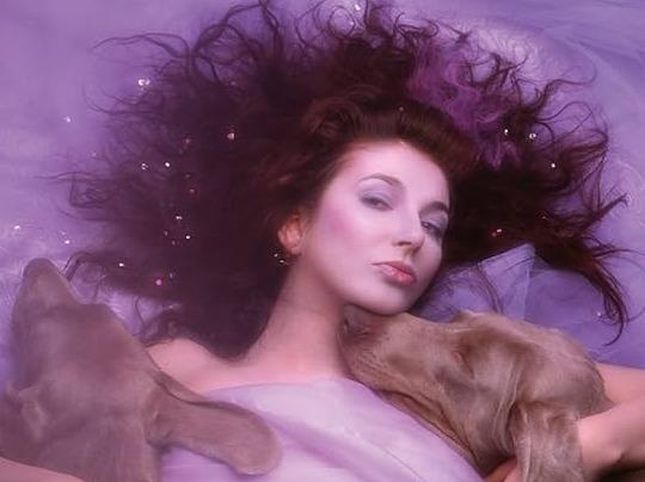
And Kate Bush dirty Madonna (thanks to a magical synthesizer)
There has been a time when the pops were produced in the pops, very busy and very ambitious records, real works of art destined to remain in history as the wonderful megalites. “Hounds of Love” by Kate Bush is one of these. It was the September 16, 1985 When the voice of “Wuthering Heights” interrupted a three -year record silence and returned to the scene with A job to say the least bold, poised between folk, progressive rock, art pop, psychedelia and electronicsmore than forty -five minutes long – to precision forty -seven minutes and thirty -three seconds – and structured practically like a double disc: a side a conceived as an album -album, with songs with a most pop shape and structure; and one side B imagined as one suitea concept starring a woman “who finds herself floating at sea observing the stars and who loses gradually lucidity”. Today such a job would encounter who knows how many difficulties even before going out, rejected in the bud by records interested only in profit. At the time, however, “Hounds of Love” conquered directly the first place in the weekly ranking of the best -selling records in the United Kingdom drawn up by the Official Charts Company, dethroning none other than Madonna and his “Like a Virgin”released in the summer of that year.
A three -year long silence
After the promotion of “The Dreaming”, his fourth studio album, released in 1982, Kate Bush had disappeared from the radar, making the apex of his popularity lose every trackby forcing EMI to send an EMI to send a series of gathering material to continue to exploit in some way the success conquered by the artist with works such as “The Kick Inside” (the debut album dated 1978, containing the Signature Song “Wuthering Heights”) and “Never For Ever” (dated 1980, containing “Babooshka”: he was the first Bush album to conquer the first place in the ranking of the ranking British). Then on August 5, 1985, a month before “Hounds of Love” arrived in the music stores, the singer -songwriter who grew up in East Wickham, in the South East area of London, re -emerged by the abysses with “Running up that hill“, A forerunner of his new record project: between Synth Pop and New Wavethe song told of a man’s desire and a woman to reineous himself to understand herself better. The single reached third place in the ranking of individuals, in 1985: only forty years later, thanks to “Stranger Things”, the series of generation Z generation set in the 80s, the architect of the revival of many of the hits of that magical decade, would have been rediscovered only forty years later. “Running up that Hill” fascinated the listeners because of those Electronic textures buttonswhich almost screeched with the warm and transported interpretation of Bush and with those stratified and reverberated choirs. The same sounds that they would then find in the other songs of “Hounds of Love”, almost all the result of Kate Bush’s experiments with a particular synthesizer: the Fairlight CMI.
The magic synthesizer used in recordings
The Syntheliteer-Digital Cami CMI Summer had been designed six years earlier by the founders of Fairlight, Peter Vogel and Kim Ryrie: he was based on a double microprocessor synthesizer, the Qasar-M8, designed by Tony Forse in Sydney. Grappling with the processes of his fifth studio album, the second totally self -produced, Kate Bush decided to experiment even more with sounds, compared to what has been done with “Never for Never” and “The Dreaming”. Peter Gabriel has probably probably discover the singer -songwriter.who already in 1979 had received a model from Peter Vogel himself: “Gabriel was completely electrified and immediately put the car immediately during the week when Peter Vogel remained at his house”, he said Stepehn Paine, witness of Peter Gabriel’s first experiments with the instrument. Usually it reluctant to reveal the secrets of its productions, in an interview granted during the promotion of “Hounds of Love”, about the production techniques Kate Bush confirmed that the Synth parts of the songs had been made with fairlight: “The strange effects of the song? I composed it with fairlight “. The synthesizers offered Bush an unprecedented creative freedom, becoming a real sound laboratory in his hands: the fairlight CMI allowed the artist, who played it firsthand in the sessions, to record and manipulate champions of real sounds, thus exploiting the potential not only to imitate the orchestra, but to create hybrid and new textures. On the B side of the disc, a suite entitled “The Ninth Wave”, the fairlight was essential to build the dreamlike and disturbing imagination at the basis of the concept: treated voices, watercase noises, manipulated choirs. Everything contributed to giving the story an almost cinematic breath. If the A side A was composed of songs yes pop but characterized by sound textures never felt first in the same pop, the B side was a true narrative and sound experimentation.
Author, composer, producer: simply artist
The songs of “Hounds of Love” took shape between November 1983 and June 1985. Bush chose to withdraw from the city frenzy to return to rural calm, where he can work calmly and inspired: a choice that inevitably inspired the atmospheres of the disc. The album was born mainly in the private study built by Bush in his country house in Welling, the Wickham Farm Home Studiowith additional recordings made between Windmill Lane in Dublin and Abbey Road in London. The voice of “Wuthering Heights” chose to have full control of the project, from writing to production, embodying the role of complete author: «Before” The Dreaming “I had never produced an album. And since he had received many unfavorable comments, I think it was thought that self -produce “Hounds of love” on my part was not a good idea. For the first time I met a sort of artistic resistance. But I didn’t care: I only thought about doing a good album », he would have said years later. This time, the criticism acclaimed Bush’s work, positively welcoming “Hounds of Love”, with those sophisticated melodies, those evocative texts and that futuristic sound, experiments never ends in themselves, appreciating the fusion between avant -garde technologies and traditional tools, In a balance between electronic precision and human heat. The Ellepì marked a sort of artistic rebirth for the singer -songwriter and it is emblematic that the suite “The Ninth Wave” was designed as the psychological descent of a woman in her existential introspections.
The impact
A week after its release, “Hounds of Love” directly conquered the summit of the ranking of the best -selling 33 laps in the United Kingdom, dethroning, as already anticipated, “Like a Virgin” of Madonna: the album of the future Queen of Pop was even in the standings for forty -five weeks. “Hounds of Love” spent seven consecutive weeks in the top ten of the Hit Parade degli Ellepì most successful in the United Kingdom, of which three at the top of the ranking. And all this without live performances and concerts to support its promotion: already, because after its first and only tour, “Tour of Life”, the one in support of its first two albums “The Kick Inside” and “Lionheart”, which lasted six weeks in 1979, Kate Bush had chosen to give up live activity, because “too exhausting”. He would have made only a few rare performances, like that of a few months after the release of “Hounds of Love”, in 1986, at the British charity event Comic Relief, singing “Do Bears …?”, A humorous duet with Rowan Atkinson. Forty years after its release “Hounds of Love” remains the most successful album of Kate Bush, with over 1 million copies sold only in the United Kingdom.