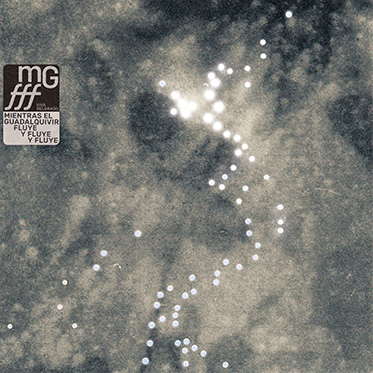
Review of ‘While the Guadalquivir Flows and Flows and Flows’ by Viva Belgrado
After the acclaimed “Songbook of the Heavens” (24) that Long live Belgrade It is remembered almost as a happy accident, an album made almost in the wrong direction, in full transition, now the band delivers a fifth album from a very different place and with other intentions. If on the previous album they took experimentation one step further and Cándido Gálvez’s lyrics looked inward, the present “While the Guadalquivir flows and flows and flows” embraces concision and luminosity in an optimistic album.
The initial idea was to make an album of singles, an album full of highly contagious melodies and phrases. And they achieved it without stopping ringing the Long live Belgrade as always, something that has quite a bit of merit when it comes to a band in constant movement, with Cándido as the only remaining component of the original formation. One of the keys is the perfect fit in the machinery of Jaime Acosta on guitars and Cristina G. Sánchez on bass, keyboards and backing vocals, two additions that make their debut in this work; without forgetting the role of musician and producer Ricky Falkner (Standstill, Egon Soda), who pushed the quartet completed by drummer Álvaro Mérida towards a cleaner sound and richer in arrangements.
The songs of this fifth studio work flow like the Guadalquivir River, converted at the same time into an emblem of its Andalusian roots and a metaphor for the passage of time. Start with the forceful “One more Andalusian”a piece that advances confidently (“this is the only way”) and without fear of fines from the “coherence police” that pursues them from the rupturist “Bellavista” (20), in which they found their own voice and explored spaces far from the “underground” where they were born. The song ends between drum beats and feedback, giving way to the luminous “And it flows”, something more leisurely and atmospheric. Cándido embroiders here a vocal melody that refers to his admired Gorka Urbizu (Berri Txarrak), while the lyrics return to one of the creative constants of the project: moving forward, growing, trying new paths without giving up its origins (“the same songs, the same old mud”).
They quicken their pace again “Too old”a piece of dreamy indie rock in which velvety voices and trademark screams alternate. In some ways, the lyrics function as a bridge between the band’s early stages (“I regret the time when sadness was something serious”) and the current moment of a formation that is going through one of its sweetest moments. The past is still present, but it no longer weighs as much. And that is why it is curious that the album continues with “Warm up as you go out”a song that returns the Andalusian group to the “spoken word” and the heartbreak of its beginnings.
The melancholic and electronic “Love at 136 bpm” It starts from an idea of Cristina’s and could be understood as an extension of that “Sadder than Shinji Ikari” that surprised so much in 2020. And the good vibes of the album continue to flow with “Love in Em”, an ode to brotherly friendship (“with you I feel so alive”) that finds its emotion in the warmth of a few minor chords and the piano arrangements by Falkner.
The second part of the album contains two sonic lashes like “Menquitofla”, with the stratospheric guitar of Alain Johannes (Eleven, Queens of the Stone Age, Them Crooked Vultures) as a luxury guest, and “The duty to offend”, just two minutes of protest and grunge noise. They contrast with delicate pieces like the melancholic “Several Demons,” which introduces a more fragile dimension, and a “Memorabilia” that delves into more avant-garde terrain. And in this game of extremes, the final touch entitled “Super future”, with echoes of Turnover or even Fontaines DC, surely the poppiest of the group.
The album may not be exactly a collection of “Skylights”one of their most chorus songs and celebrated in concerts, and it doesn’t need to be. After so many years, it is more interesting to see the band flow, flow and flow.