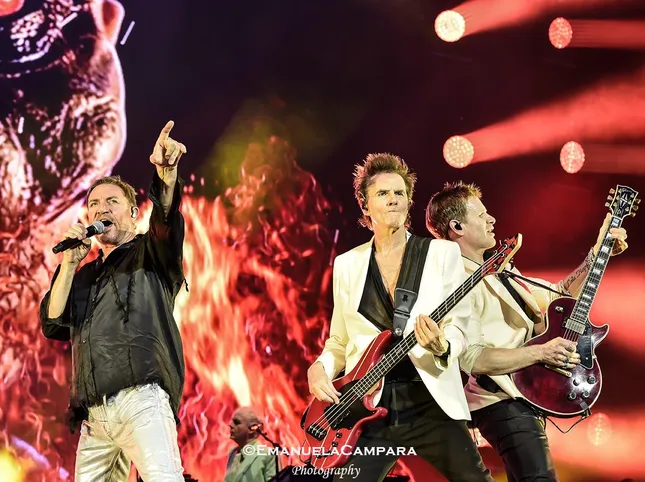
Duran Duran: “Our DNA has never been lost”
Duran Duran’s upcoming Italian tour is not just a sequence of dates on the calendar, but yet another chapter in a mutual love story that has lasted for over forty years. In view of their return – on 7 July at the Verona Arena, on 9 July at the Royal Palace of Caserta and on 11 July at Villa Manin in Codroipo – we spoke with the band’s legendary bassist, John Taylor, who opened his heart to what keeps this bond alive, revealing anecdotes about his past and the formula that makes their music still so current.
What are the reasons why the bond between Duran Duran and Italian fans still appears so visceral, after all these decades?
Tell me instead. You know how strong our bond is with our fans, in general; we’re the kind of band that connected primarily with a female audience when that audience was in its adolescent phase, and there’s something really special that happens at that time in life. You almost become a lifesaver for them, because we know how teenagers are: for them it’s all a drama, a continuous “Oh my God”, and music has always had an essential role, especially for audiences of that age.
I don’t think things went differently for you either…
Absolutely. I grew up listening to David Bowie, and I listened to him constantly because I felt that only someone like him could understand what I was going through. You are forever grateful to those artists who got you through your teenage years. So it’s a beautiful thing to realize that we too have contributed to this. Beautiful because, well, first of all we have always been able to get an excellent dinner in an Italian restaurant (laughs) but, apart from that, we have always been touched by the fact of being able to meet people who have been significantly affected by our music and in a particular moment of their lives. And this is an aspect of our work that we respect more than any other, perhaps. Because we too, as I was saying, felt protected by the music we loved most, and that’s what kids today can feel listening to Sabrina Carpenter, or Taylor Swift, as if it were a bit of a rite of passage.
The live dimension has always been central in a band like yours. What do you think are, in your case, the best songs to play live?
I always enjoy focusing on the highlights when it comes to our material. I love “Ordinary World”, but also “Come Undone” and, of course, also an old classic like “Girls On Film”. I also love “Free To Love” these days, because it’s some of the more recent stuff we’ve done. We also felt like including “What Happens Tomorrow” in the setlist, especially in the last shows, so as to give a different and fresher edge. For me, playing live is always evolving, because I usually ask myself how I could perform one piece rather than another, and therefore everything takes on a different form every time when we are on stage, but the concert situation is still always very exciting.
In the mid-nineties you went through a personal and artistic crisis that led you to a therapeutic musical interlude with the Neurotic Outsiders. What do you remember about that period?
For me, Neurotic Outsiders was and remains a story of sobriety. This is what they have always represented. I got sober thirty-one years ago, or something like that, and at that time I was very close to Steve Jones, the guitarist for the Sex Pistols. We were invited to play a charity event in Hollywood, at the Viper Room, and we did it with Matt Sorum and Duff McKagan from Guns N’ Roses, starting that night. We only performed a couple of songs, no originals, but that was enough for the owner of the club to offer us a residency at the Viper, every Monday night. It all happened at a time when, in my particular case, I didn’t really know what I wanted to do with my life, because with Duran Duran I felt I had lost my edge (John uses the expression “mojo” here), so I found the idea of committing to a residency quite attractive. Generally speaking, even for those just starting out, it’s always a great thing if you can find a venue that gives you the opportunity to perform on a regular basis, since you really learn a lot from similar experiences, in the sense that they help you better understand your identity as a performer and the songs you perform.
In short, the stage as a real therapy…
You see, today people, and I’m talking particularly about the younger ones, make music from home, then publish it on Spotify and allow themselves to be enveloped by the kind of global dimension that exists today. Instead, I think it’s always necessary to start from a stage if you want to be an artist. I have always looked with admiration at the Beatles’ performances at the Cavern Club in Liverpool, or at the Sex Pistols concerts in Soho, in London clubs and so on. With Neurotic Outsiders we started doing this Monday night thing and inviting special guests every week. We would start the show with “Planet Earth” by Duran, then abruptly stop and move on to “Bodies” by the Sex Pistols. This excited me a lot, and it was fantastic to see the astonished expressions in the audience (laughs). Gradually Iggy Pop, Billy Idol, Simon (Le Bon) would come on stage with us, and every time people would go home happy, knowing they had seen something great. We were a kind of musical about the history of punk: we remade the Stooges, the Pistols, but also the Damned, the Guns, and even Duran. It was exciting to be able to build on this big arc of things, until it became a day job. We signed a contract (with Maverick, Madonna’s label), then made an album, a video and immediately went on tour. It was at that point that I thought that if everything had to be reduced to a routine, I might as well do those things directly with Duran Duran.
In your opinion, what is the secret behind the evolution of a sound, that of Duran Duran, which has never lost its original identity?
As a band we have always had very clear ideas about our identity; the fact that there are still four of the five original members today is indicative of this, and whatever we do together our DNA has never been lost. We are certainly not jazz musicians, and to be honest we have always preferred to avoid going too far out of our comfort zone. But when it comes to composing, to thinking about the type of music we would like to make, we always imagine ourselves taking inspiration from someone like Grace Jones, or the Talking Heads, perhaps throwing in a Kanye West-style kick drum. You know, our orientation is always more or less the same, in the sense that we like to mix. For example, I remember the time when our first reunion took place: me, Roger and Andy hadn’t played together for about fifteen years, or maybe even more. And beyond that we were quite disoriented in front of the music scene, and we had several doubts about whether we could still count for something with our music. So Roger and I took this trip to Ibiza to capture some of the sound, because the whole club scene in Ibiza was really dope at the time. We were listening to a lot of compilations and picking up all these grooves, thinking, “Well, this might be something we can do.” In short, an experience that allowed us to find new stimuli to be able to create something new like Duran Duran.
Since I have the chance, I can’t help but ask you why, from your point of view, your album “Rio” still sounds so perfect today.
Well, look at it this way: I think the key to the success of “Rio” lies in its being, quite simply, a true masterpiece; and the intrinsic characteristic of masterpieces, if you think about it, is that, as such, they do not undergo the passage of time and never age.
In conclusion, I would like to ask you to list three essential records that you would ideally take with you to a desert island.
Oh God, this desert island record thing always gets me into serious trouble (laughs). I’d probably bring something by the Beatles with me. We say the “White Album”, because it’s the longest they’ve ever made. Then I’d probably get something R’n’B, an R’n’B record that makes you feel really good, yeah, maybe something like “Songs In The Key Of Life” (by Stevie Wonder), again because it’s a double album. And then, lastly, I would say something about classical music, like Beethoven’s Third Symphony. And that’s it.