How Also Eden breaks the rules of the music industry
In the contemporary scene, there are few bands willing to question the structural rules of the recording industry. Even fewer are those who decide to do so openly, taking on the economic, logistical and artistic risk of abandoning the dominant model. The Also Eden I am among them.
A historic Anglo-Welsh progressive band born in the early 2000s, Also Eden have gone through the entire evolutionary cycle of the modern music industry: from the era of the physical CD to the collapse of sales, from the explosion of streaming to the fragmentation of public attention, up to the crisis of the very concept of the “album” as the central unit of the musical experience. With their return to the scene in 2026, the band has decided to make a… radical choice: giving up the traditional “album + tour” scheme in favor of a trilogy of interconnected EPs, released at different times of the year and accompanied by targeted mini-tours. At first glance it might seem like a simple distribution choice; in reality, it is one structural criticism to the entire industrial system of contemporary music.
Who are Also Eden?
Also Eden were formed in 2005 by co-founders Huw Lloyd-Jones (vocals) and Ian Hodson (keyboards), who were soon joined by guitarist Simon Rogers. Their sound draws on the classic progressive rock — Genesis, Yes, Marillion, Rush — with contemporary influences ranging from Porcupine Tree to Opeth, but the band has always rejected the cage genre label.
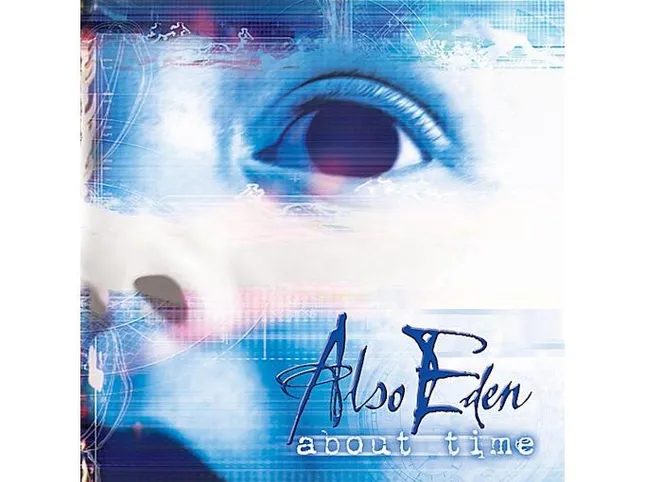
Their story is littered with interruptions: the near-fatal brain hemorrhage for Lloyd-Jones in the early years, his abandonment in 2009, a serious cycling accident for replacement Rich Harding, constant line-up changes. Four albums in almost twenty years of activity — About Time (2006), It’s Kind of You to Ask (2008), Think of the Children! (2011), (Redacted) (2013) — then thirteen years of recording silence. In February 2026, with the current lineup composed of the original co-founders plus bassist Graham Lane and drummer Guy Monk, the project’s first EP was released, Holy Books And Credit Cards.
Anatomy of the anomaly
The first level of breakdown operated by Also Eden is exquisitely compositional and musicological. The traditional recording industry has historically standardized the song form on the Intro-Verso-Chorus-Verse-Chorus-Bridge-Chorus-Outro model, optimized for FM radio plays and, today, for Spotify editorial playlists. Also Eden rejects this approach through a series of precise technical choices: torrential songs like A Thieving Knave or Think of the World with Love they well exceed double figures in terms of playing time. The band uses non-linear narrative structures which require listening time incompatible with the rhythms of consumption fast of today’s music.
In the ’90s and early 2000s, a band’s success depended almost entirely on a band’s budget.record label and from the filter of the artistic directors. Also Eden were born at the exact moment when this model was collapsing, and they understood how before others exploit the rubble to your advantage. The band understood that for a niche genre like progressive rock, major label support was not only utopian, but structurally harmful. The split costs of a major label would have cannibalized revenues. Also Eden therefore adopted a strategy based on specialized independent labels, crowdfunding before its time (i.e. even before platforms like Kickstarter or Patreon became the standard), through direct pre-orders from fans and a management of royalties in your favorinstead of leaving 80 or 90% of the proceeds to producers, publishers and distributors.
A homemade sound… literally
Another paradigm broken by the band concerns the economics of phonograph production. Historically, recording a high-fidelity album required astronomical budgets in high-end commercial recording studios. Also Eden capitalized on the music revolutionhome recording professional. Thanks to the democratization of DAWs (Digital Audio Workstation) such as Pro Tools, Cubase and Logic, and with the advent of affordable broadcast-grade AD/DA converters, the band moved the entire production process into their own private studios.
The band was thus able to spend hundreds of hours in the finishing of the arrangements, in sound design of Rich Harding’s (and subsequent members’) keyboards and guitar layering, without the financial pressure of the studio taximeter. The result is a sound product that competes with industrial productions, but at a fraction of the cost.
There community
The recording industry spends billions on marketing in an attempt to convert the passive listener into a buyer. Also Eden reverse this flow by working on quality of conversion rather than on the quantity of mass. Instead of chasing TikTok trends or the vanity metrics of generalist social networks, the band has built a closed ecosystem based on microtargetingparticipating for example in European niche festivals (such as Summer’s End or RoSfest) and cooperating with fanzines specialized paper and digital formats.
Despite the availability of their catalogs on streaming platforms, the band curates physical formats (CDs, special editions) with artwork complexes e booklet full of lyrics and production notes. The physical object is not a simple media, but a memorabilia that the fanbase buy to support the artistic act. An approach that transforms the fan from a mere consumer to a real one co-investor of the band.
Also Eden prove that breaking the rules of the music industry doesn’t necessarily mean operating in an amateur manner. On the contrary, it requires superior technical, managerial and technological expertise compared to those who rely on the protected structures of major. Their trajectory is proof that in the age of digital disintermediation, success is not measured on the scale of millions stream generalists, but on the ability to create a sustainable, autonomous and high artistic fidelity model.