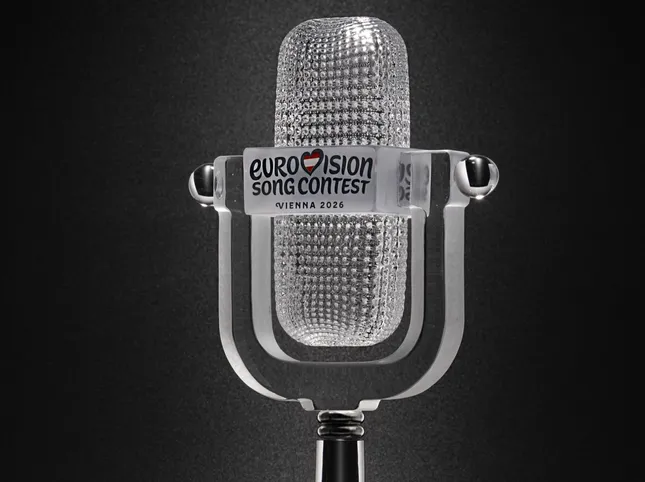
What happens (and what can happen) at Eurovision 2026
Anything: this is what can happen at Eurovision 2026, which officially starts tonight. And in part everything has already happened, because the production machine has been running for weeks. It could also happen that Italy places very well in one of the most controversial editions ever – who knows: what is certain is that, even if “Forever Yes” by Sal Da Vinci is not among the top favourites, our country, as always, is playing for it. But let’s go in order and understand what’s at stake and why this is an even more political and problematic edition than usual. No, it’s not just about the songs.
When, how, where, who is there
The facts: ESC takes place at the Wiener Stadthalle in Vienna, Austria, from 12 to 16 May 2026, following JJ’s victory with the song “Wasted Love” in the previous edition. It can be seen on RAI: the semi-finals of 12 and 14 May on Rai 2 and the final of 16 May on Rai 1 hosted by Gabriele Corsi and Elettra Lamborghini. It can also be seen on YouTube, where clips of the performances are then uploaded in real time.
Bulgaria, Romania and Moldova return to the 35 countries competing, but there are 5 significant absences: Spain (one of the “big five” countries that have direct access to the final as founders), the Netherlands, Ireland, Slovenia and Iceland, which boycotted the event. The reason is the presence of Israel: several countries had asked for its exclusion as happened for Russia in 2022, then confirmed after a highly criticized review procedure by the EBU (the broadcasters’ association that organizes the event). A decision that led to a split never seen in decades of racing.
The only “concession”, so to speak: a partial modification of the regulation. Already last year there was talk of Israel’s “borderline” practices, which had led the country to even come second despite the controversies and protests that were already taking place due to participation in the demonstration. Accusations relaunched yesterday by the NYTimes, which published an investigation into the methods used by the state and “a campaign orchestrated directly by the government to influence the vote” and “transform the stage into an instrument of soft power”.
The mechanism
The competition mechanism remains the classic one. 30 countries will compete in the two semi-finals, scheduled for 12 and 14 May, while the so-called Bigs (Italy, France, Germany, United Kingdom), together with the host nation – this year Austria, winner of the 2025 edition – are automatically qualified for the final on 16 May. 20 artists will pass through the semi-finals, 10 for each evening, bringing the total of finalists to 25.
The voting system has been partially revised. In 2026, in the semi-finals there will be both televoting and the vote of specialized national juries, who in previous years only voted in the final. The juries this year must have a broader composition and also include younger profiles, and both weigh 50%. The maximum number of votes per user has been reduced, to limit aggressive digital marketing campaigns such as the one attributed to Israel in 2025.
Politics, controversy
That of the partially modified regulation is the only concession that EBU has made to the “political” controversies that were already seen in 2025 and which this year exploded with the defection of 5 countries in controversy against the presence of Israel, considered unacceptable also given that in 2022 Russia was excluded with a decisive political choice.
Although EBU claims that ESC is an entertainment show where controversy and war must stay out, Eurovision Song Contest has always been a show with a strong political connotation: countries participate to present themselves, rather than songs and artists. So much in this field has already happened – for example a letter from great artists (from Paul Weller to Brian Eno, from Massive Attack to Roger Waters) asking to boycott the demonstration in support of Gaza – and much more will happen this week. It will be an edition that will be both subdued in some ways, due to these absences and boycotts which will lead to reduced media attention, and at the same time more problematic because it is inevitable that there will be anti-Israel and pro-Palestine activities that will take center stage.
Italy: Sal Da Vinci (and Senhit)
“First of all, this is a political issue, music has nothing to do with it, music covers all the pains of the world. I respect those who protest, but everyone does it for themselves. But I strongly wanted to participate”, said Sal Da Vinci last week at the Italian presentation of ESC, espousing the RAI thesis, namely that of the non-politicisation of the demonstration. “Forever yes” is currently 9th in the betting forecasts, with just 3% probability of winning, on the rise. Ahead of him, clearly favoured, are the Finns Lampenius & Parkkonen with 31%, followed by the Greek Akylas (16%).
The song will be brought to the stage by staging a wedding: who knows whether the hyper-pop, melodic proposal, strongly linked to an Italian national identity and at the same time very social and meme-like, will end up having an impact on the public.
There is also another piece of Italy in the race: San Marino, which returns for the fourth time with Senhit. The singer from Bologna is at her 4th participation: in 2021 she reached the final, accompanied by Flo Rida, this year Boy George will be at her side for the performance of “Superstar”.
The semi-finals and the lineups
These are the compositions of the two semi-finals:
May 12 – Italy and Germany will also perform outside the competition
Moldova: Satoshi – “Long live, Moldova!”
Sweden: FELICIA – “My System”
Croatia: LELEK – “Andromeda”
Greece: Akylas – “Ferto”
Portugal: Bandidos do Cante – “Pink”
Georgia: Bzikebi – “On Replay”
Italy: Sal Da Vinci – “Per Semper Sì” (out-of-competition performance)
Finland: Linda Lampenius x Pete Parkkonen – “Liekinheitin”
Montenegro: Tamara Živković – “Nova Zora”
Estonia: Vanilla Ninja – “Too Epic To Be True”
Israel: Noam Bettan – “Michelle”
Germany: Sarah Engels – “Fire” (out-of-competition performance)
Belgium: ESSYLA – “Dancing on the Ice”
Lithuania: Lion Ceccah – “Sólo Quiero Más”
San Marino: SENHIT – “Superstar”
Poland: ALICJA – “Pray”
Serbia: LAVINA – “Kraj Mene”
Second semi-final, Thursday 14 May
France, Austria and England will perform out of competition
Bulgaria: DARA – “Bangaranga”
Azerbaijan: JIVA – “Just Go”
Romania: Alexandra Căpitănescu – “Choke Me”
Luxembourg: Eva Marija – “Mother Nature”
Czechia: Daniel Zizka – “CROSSROADS”
France: Monroe – “Regarde!” (exhibition out of competition)
Armenia: SIMÓN – “Paloma Rumba”
Switzerland: Veronica Fusaro – “Alice”
Cyprus: Antigoni – “JALLA”
Austria: COSMÓ – “Tanzschein” (out-of-competition performance)
Latvia: Atvara – “Ēnā”
Denmark: Søren Torpegaard Lund – “Før Vi Går Hjem”
Australia: Delta Goodrem – “Eclipse”
Ukraine: LELÉKA – “Ridnym”
England: LOOK MUM NO COMPUTER – “Eins, Zwei, Drei” (out-of-competition performance)
Albania: Alis – “Nân”
Malta: AIDAN – “Bella”
Norway: JONAS LOVV – “YA YA YA”