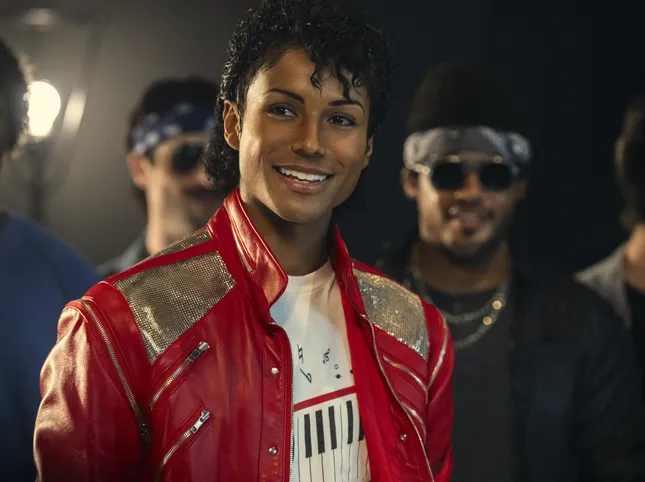
“Michael”, a biopic that lives in songs
Inside “Michael”, the biopic that wants to tell the musical myth and human fragility of Michael Jackson, by his music is especially exciting, in addition to the similarity of the protagonist Jaafar Jackson with the pop star he plays. A result that is testament to the effectiveness and success of the hits from the golden period of the king of pop: the film arrives in cinemas today, April 22nd, after the European premiere last weekend – The soundtrack will instead be available from April 24th in digital and physical format, together with some collector’s editions of Jackson’s LPs.
As we told you, Jaafar Jackson is in his first experience as a professional actor and dancer: lresembling his uncle MJ, a truly effective prosthetic make-up and excellent work on gestures and voice do the rest: his interpretation is successful and very fitting, it has something genuine about it, far from the trodden mannerisms of his colleague Rami Malek in the role of Freddie Mercury in “Bohemian Rhapsody”.
Musical biographical film that comes naturally to cite as a touchstone, because the producer behind the operation is the same and the result, at least from an informative point of view, is really very similar. The Michael Jackson of “Michael” is not even one of the many possible MJs that can be told starting from his story made up of music records, judicial news, gossip, endless controversies and the legacy that the king of pop left behind. It’s almost a fictional character anchored in our memory of the pop star, deprived of any conflict and therefore, consequently, devoid of depth. Which doesn’t mean the film doesn’t work, on the contrary: exactly like “Bohemian Rhapsody” is anchored to the strength of the singer’s songs, which is told as such from the beginning of the film. When he is in difficulty, “Michael” hides behind the music, so much so that when it becomes more difficult to avoid thorny issues, the number of pieces played increases dramatically. In the second part, both films almost slip into a live concert, gradually thinning out their narrative, hiding the weakness of their arguments behind the strength of their hits like “Bad”, “Thriller”, “Billie Jean” and other truly epochal pop songs, which in terms of sound and staging are as fresh as when they were released.
So much so that, cynically, one wonders if it wouldn’t have been better to focus on a “Mamma mia!” operation, create a fictitious story starting from the songs instead of telling a character who really struggles to become a person. Also because, from the first scene, little Michael (played by the talented Juliano Krue Valdi) is presented to us as the chosen one, the chosen one of the musical muse. Just like the fairy tale hero, he has a gift, a unique talent that is not even talked about as a generation (the classic “a voice like yours is born once in a generation”) but even without anything comparable before or after. This is then said by Quincy Jones played by Kendrick Sampson, who helps him begin his solo career by breaking away from the yoke of his father’s tyranny. To the poor (but always very good) Colman Domingo instead he plays the caricatural role of the cruel, violent and greedy manager dad, without the film really bothering to explain where it comes from or what fuels this craving.
The main flaw of “Michael” is in fact that of provide a series of answers but do not ask the questions, so much so that it is up to the viewer to understand what certain allusions left floating in mid-air refer to. It’s not that the film doesn’t touch on some controversial chapters in the singer’s life – see for example his obsession with cosmetic surgery and whitening his skin – but the common thread, the deep motivation, is missing. The entire enormous racial issue intrinsically connected to the American myth of the Jackson family is liquidated with a clean sweep, which in hindsight would answer many of the questions that the film does not ask but answers: the father’s eagerness to make it, Michael’s obsession with a more “Caucasian” appearance, his complicated relationship with the myth of Elvis (the white man who made “black music” popular). However, there is no mention of his relationships with his own community, other than recounting the making of the iconic “Thriller” video; a behind the scenes story that would deserve a film in its own right and that this biopic really fails to tell in its extraordinary nature.
The fascinating aspect is that this film, which sees in its crew an incredible number of people who actually knew Michael Jackson and has worked closely on it for years, gives back such a superficial image of the character (never about the person), explaining so little about his creative and musical process as to be partial even to those who, like us, have never met him and probably not even seen him perform. The Michael pictured here – a person who suffers the abuses of his father and the tragedies of his profession with an almost Christological attitude – is so partial that it has split the Jackson family itself in two. One side supports the operation, the other wants to have so little to do with it that it has banned it from being included in the film. Except that, as spectators, it is difficult to believe this Michael and the life that is told to us, from which a crucial figure was completely eradicated(even in the creative field, let alone human) like her sister Janetwhich does not appear here, nor is it ever mentioned. Due to a long and complex legal issue, the film cannot even mention the accusations of child abuse that were made against the singer, whose story is cloaked in such an aura of messianic predestination that it almost seems detached from the same dramas he experiences. Few, because this film is a frictionless rise to success, which experiences an abrupt fall with the accident on the set of the Pepsi commercial and then starts again, almost without friction, towards the next level of musical achievement.
So what does “Michael” leave behind? Exactly as happened with “Bohemian Rhapsody”, you come away from the film excited by MJ’s music and eager to listen to it again, which is the meaning and purpose of a good part of these biographical operations. It’s not even a really bad film in its simplicity, because it excites on a human level, makes you move your head in time and whisper the lyrics under your breath. However, it does not describe the man and the artist Michael Jackson in an incisive way, what made him extremely famous, unhappy and then controversial. Or rather, it shows some consequences by barely mentioning the causes, explaining so little of how and where the songs were born: legendary songs that seem like an inexplicable gift (because unexplained), an authentic musical miracle.