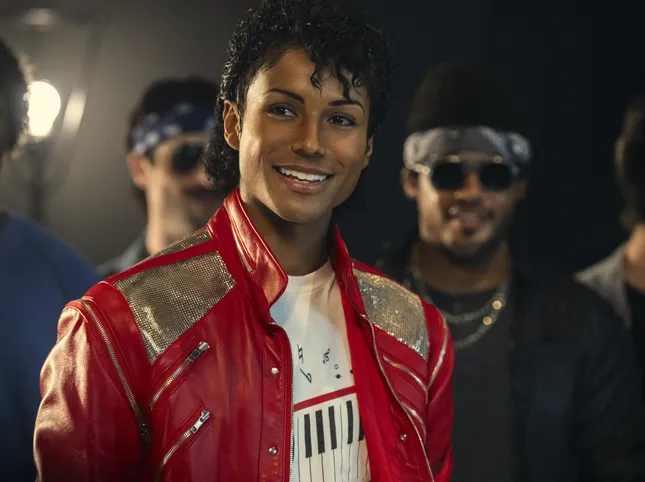
That Michael Jackson tells “Michael”
The first biographical film that aims to contain the musical myth and human controversy of Michael Jackson on the big screen could only be a family affair: so much so that the Jackson clan appears everywhere in the long process of making the film, not just on a narrative level.
Starting from Jaafar Jacksonnephew of MJ (he is the son of Jermaine Jackson, Michael’s older brother), chosen to embody on screen the uncle with whose myth he was confronted since he was a child. The physical resemblance is obvious, but Jaafar had never acted, sung, danced professionally or in public. Before revealing to his family that he had been chosen for the role, he says he had secretly studied acting and dancing for two years.
It was Graham King, producer of the film, who found it. After the success of “Bohemian Rhapsody,” the hugely popular Freddie Mercury biopic, is Antoine Fuqua turns to him expressing his desire to tell old fans and new generations about Michael Jackson with a dedicated film. The project has the support of the Jackson Estate, which also takes on the extra costs (between 10 and 15 million euros according to Variety) for 22 additional days of additional filming when the film has to be overturned in its approach, concluding much earlier than expected in terms of time and above all avoiding mention of the accusations of pedophilia leveled against Michael Jackson, with which the film was initially supposed to open (again according to some rumors leaked in recent months).
A “censorship” due to a legal proceeding: in the plea agreement with one of the pop star’s accusers, Jordan Chandler, andThe ban on mentioning him in any film adaptations was expressly mentioned. A paradoxical mistake (not realizing beforehand that the issue in the film could not be addressed for legal reasons) which led to changing the portrayal of MJ given in the film. It’s not the only absence: in the film the figure of Janet Jackson would be completely missing, that she would be against the project despite never having expressed herself publicly on the matter. The absence on the Berlin red carpet of the world premiere, where only part of the family showed up, spoke for her. He didn’t use half measures either Paris Jacksonmore than against the entire operation. Michael Jackson and Debbie Rowe’s daughter called the film full of “inaccuracies and lies.”
So what are the truths of this film about Michael Jackson, supported by brothers Jackie and Jermaine Jackson and sons Prince and Bigi Jackson, who walked the red carpet a few hours ago? While waiting for the embargo on the film to expire, I tried to understand what kind of portrait he wants to make of the king of pop by talking about it with producer Graham King, director Antoine Fuqua and protagonist Jaafar Jackson.
Why did you decide to tackle a figure like Michael Jackson after trying to tell the story of Freddie Mercury, achieving great popular success but also a lot of methodological criticism?
Graham King – Antoine called me and said: “I want to make a film about Michael Jackson”. He had that confidence. I knew Michael personally. We had been in contact since the early 1980s, and really knowing him, it seemed like a huge challenge to try to summarize him in a film. At first the idea of making a film about Michael Jackson wasn’t taken very seriously due to the scale of the undertaking, but when we worked on it seriously, at every step everything seemed to be going in the right direction. John Logan wrote a phenomenal script, which helped us a lot. There have been difficulties, but I always approach these biopics as a spiritual journey. Eventually the moment comes when you call someone and say: “Let’s have lunch together” and the project begins in earnest. After pre-production started, an extraordinary crew was formed: we had 415 technicians on set every single day of filming, all there for the love of Michael: you could feel the difference from a “normal” set.
Antoine, it was you who proposed making a biopic about Michael. Once the production was convinced, how did you put together a cast called to play such globally recognizable musicians and artists?
Antoine Fuqua – We always try to make the actors work together and create that type of dynamic that goes beyond simple musical professionalism, also telling the human dimension, but it doesn’t always work in a programmable way. Sometimes it’s the actors who have to find a way to make it happen. Graham and I prepare everything from a technical point of view, while they do their work. Sometimes, with great actors, you don’t understand what’s going to happen until you see them on stage. You hear them talk, you observe them, but then when they are really together, in that moment, then you perceive the closeness to the character they represent. In this case we had two interpreters for the child and adult Michael – Juliano Krue Valdi and Jaafar Jackson – who had never acted before, unfamiliar with acting: it was a gamble, but already from the first takes we understood that it had won.
Jaafar, you play the biggest pop star in the world, but also a figure who also has a personal and familial meaning for you, as Michael was also your uncle. How did this connection influence your work on the character?
Jaafar Jackson – Growing up I always felt very connected to Michael and trying to play him made me realize that even more. When I read the script for the first time, there were many moments in which I started to cry, I was very emotional, I felt a deep connection with the Michael depicted in the script. It took me back to my first childhood memories, when I was four or five years old: at the time I was already studying his work, how he moved and sang during the Dangerous Tour and the “Smooth Criminal” period, they were his favorite “eras” as a child: I watched those videos all the time, trying to imitate the movements. Reading the script, all those memories came back. That was the beginning, then there was the whole process of the following months and years.
Growing up immersed in the music and style with which Michael held the stage, how did it influence your growth as an artist?
Jaafar Jackson – It’s interesting, because when I started working on the movement with the film’s choreographers Rich Talauega and Tone Talauega (who had worked with Michael on it) I was very aware of how I moved, I felt strange in my body as I tried to absorb those movements that were familiar but not mine. As a child I had more freedom: I didn’t take it so seriously, it was more about being in the moment; doing it seriously, knowing that I was preparing for a role, was very difficult in the early stages, because I wasn’t used to moving at that level. Learning the meaning behind the movements was a completely new discovery for me. As I got deeper into the process, I felt I had unlocked something within myself, thanks to the constant repetition in training. Even if I felt like I had mastered a move, I still kept working on it for hours and hours until it was time to turn. Having grown up surrounded by that music from my earliest memories, I think it naturally gave me a push not so much to imitate or replicate, but to feel it within me. It had to come from my center, from my soul, not from trying to copy Michael. The most important thing for me was to capture the essence of it, but also make sure I really felt it. I watched all the videos and studied them in the smallest detail, but sometimes I also stopped watching them for two or three months and concentrated on memory work, even leaving myself the possibility of surprising myself. It was a very fun process. I just remember that on the first day I had accumulated so much energy, from all those years of preparation, that I couldn’t wait to release it. Starting there was the best way, because it broke the ice. It surprised me that I was so calm at the same time. I didn’t go onto set thinking: “I’m going to be very nervous”, I didn’t even know what to expect. It was my first time on a set. I learned new things every day.
Antoine, Michael changed the way we think about big stadium concerts forever. How did you want the concert sequences to be perceived by the audience in the room?
Antoine Fuqua – As much as possible as if the audience were at a Michael Jackson concert: this was my goal. We wanted a mix between Jaafar’s voice and Michael’s and our sound mixers were incredible, supported by great editors to work with. Compared to the experience of a live concert, in a film you build the crescendo. So when you see him put on his jacket and go on stage to perform, you know you’re looking at a human being, because we’ve already talked about his hopes and insecurities. In a film you can do it and you can feel closer, because you can give the feeling of knowing who he was, or at least intuiting who he was. We all love Michael Jackson but we wanted it to be understood that he was a human being, Michael: this is the truth. We wanted you to get closer to him, to get to know Michael Jackson more closely, to really get to know him.
What did it mean to film in the Jackson family’s actual locations?
Jaafar Jackson – It was really cool. Especially in his room. It was where I watched all of my uncle’s tours and movies, where we watched together the Charlie Chaplin films that he loved so much. Being in those rooms… I grew up there, I lived there for fifteen years, and the fact that we were able to film there brought back so many memories. When we filmed in certain rooms of the house, I stayed there even during the preparation, because I wanted to feel at home again, but also through Michael’s eyes. So sometimes I was there, we had to shoot in the morning, I would go down the stairs and then go to the set to get ready, but I wanted everything to feel as natural as possible.
Antoine Fuqua – This guy was sleeping on the floor during preparation. I offered him a mattress and he said: “No, no, I’m fine like this. I sleep on the floor.” Incredible.