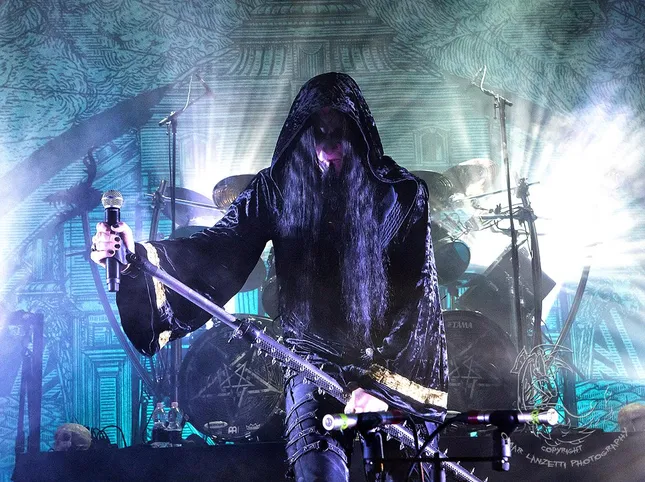
The return of Dimmu Borgir, in the sign of continuous balance
After a recording silence that lasted almost a decadeDimmu Borgir return with “Grand Serpent Rising”, tenth studio album to be released on May 22, 2026. The album presents itself since the announcement, and from the first single “Ulvgjeld & Blodsodel”, as a point of synthesis between past and present of the Norwegian black metal formation, while in the background it also takes shape the return to European stages along with Behemoth and Dark Funeral.
Where had we arrived?
Eight years separate “Grand Serpent Rising” from “Eonian,” a interval which is not only temporal but also structuralbecause in the meantime the band has gone through profound transformations, redefining its internal structure and returning, at least in part, to a more essential dimension. The exit of guitarist Galder (Tom Rune Andersen) in 2024, who left the band to dedicate himself to his musical project Old Man’s Child, marked the end of a long phase that began in the early 2000s, bringing the creative core back into Shagrath’s hands (Stian Tomt Thoresen) e Silence (Sven Atle Kopperud), the only remaining custodians of a vision which, although changing over time, has never stopped oscillating between orchestral theatricality and black metal rigor.
What to expect from “Grand Serpent Rising”
The Dimmu Borgir they recorded the comeback album at Studio Fredman in Gothenburgwith producer Fredrik Nordström, already behind some of the most representative chapters of their discography, “Puritanical Euphoric Misanthropia” (2001), “Death Cult Armageddon” (2003) and “In Sorte Diaboli” (2007). Now, “Grand Serpent Rising” takes the form of a layered but coherent work, built around a lineup that sees Shagrath and Silenoz as official members supported by now consolidated collaborators. The six-man lineup is therefore completed by Daray (Dariusz Brzozowski), Gerlioz (Geir Bratland), Victor Brandt and Damage (Kjell Åge Karlsen).
In an interview granted to “Metal Hammer” exclusively to present the album, Silenoz described the band’s new album as a work that “covers a large part of our catalogue”: “There are more essential things, but the epic elements are still present“, explained the guitarist: “We also have more modern aspects and others more linked to the past”. When asked what makes this record “more old-school”, Silenoz said: “The way in which the riffs were constructed. I was having fun playing, and before I knew it, I was thinking, ‘Oh, wow, maybe this is something we can use later!’ Then I would even record it on my phone. Compared to typical black metal standards, those recordings were almost too good! I had to add dirt and imperfections to make them sound dark enough!”
The guitarist then also explained why “Grand Serpent Rising” took eight years to make after “Eonian”, which in turn was released eight years after 2010’s “Abrahadabra”: “The writing process proceeds in cyclesessentially. Some days you are very creative and get a lot done. Other days, weeks or months, you barely do anything,” he said: “It’s a continuous balance”.
Dimmu Borgir’s next album also marks their first studio effort since 1999’s “Spiritual Black Dimensions” do not include Galdertherefore leading to a more intimate dimension during the writing phase. Regarding this, Silenoz stated: “We made four or five albums before Galder joined the band, so we just continued with what we had done in the beginning, regarding the writing process. It was almost a return to origins: just me and Shagrathbasically. I’d say it went pretty smoothly.”
The return to Italy
If the new album marks a starting point on a creative level, 2026 brings Dimmu Borgir back to Italian stages toowhere they had been missing since 6 December 2018, when they stopped at Alcatraz in Milan during the “The European Apocalypse” tour in support of “Eonian”. The return of the Oslo-born band is set for October 13, 2026 in the same Milanese club, as part of the “In League With Satan Tour 2026” which will see them share the stage with Behemoth and Dark Funeralin what promises to be one of the most compact and symbolic tours for contemporary European black metal, not only for the historical weight of the three bands involved but also for the way in which this return seems to close a circle, bringing Dimmu Borgir back exactly where we left them.