Megadeth’s lesson for emerging bands: “Study”
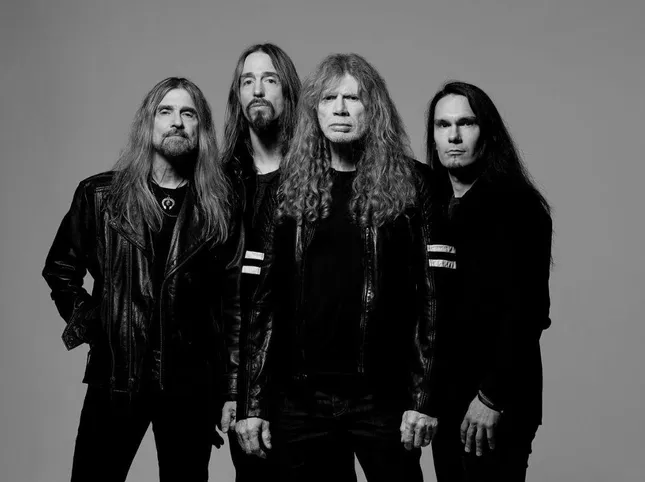
We met Dave Mustaine, the one who changed the rules of metal, for an unfiltered conversation. In this interview, the leader of Megadeth proudly and passionately looks back on a legendary career, revealing the background to the band’s final chapter and reflecting on the weight of his legacy.
The new album sounds great. From your point of view, what are the advantages and disadvantages of current recording technologies, especially in heavy metal, compared to the more traditional methods of the past?
The disadvantages versus the advantages: well, the advantages that there can be today mainly concern the speed with which you can make a record. The disadvantages, however, have to do more with the actual quality of the sound; however, if you are a talented engineer, are lucky enough to work with a capable producer and have a band that has a lot of experience behind them, you can make everything work and have everything under control. The problem arises when you find yourself having to use older equipment and techniques and you don’t have to put in all this effort “after the fact” to make the record sound like it was recorded on tape or with an “old school” approach.
The album cover depicts your historic mascot, Vic Rattlehead, engulfed in flames. Is this a way of suggesting that the band’s legacy will burn forever?
It seems like an analogy I relate to, although to be honest, I wasn’t directly involved in the creation of the artwork, which is the work of Blake Armstrong. We basically just gave him some ideas on what we wanted to achieve in broad terms. We wanted a result that had purification as its central theme — the fire of purification, to be more precise. This is also because many songs on the album have their own symbolism, a bit like what happened with “Youthanasia”. Let’s say that we have been lucky enough to always have particular artwork for our albums over the years; I’ve always been thrilled by the idea of working with great visual artists to create covers, from the first Vic Rattlehead to the modern era, where CGI and artificial intelligence reign. We have always tried to do everything possible to stay up to date with the most cutting-edge technology. We were among the first bands, if not the first ever, to have an official website.
Is there something about the energy of the current lineup that brings you back to the ferocious determination of Megadeth’s early era?
I feel very lucky to have a band like this, and it excites me every time I think about it. They are all magnificent musicians, as well as fantastic people. This means that being with them makes our relationship even better, even when it comes to recording work. It’s really difficult for me to go to the studio knowing I have to deal with people I don’t like. I’ve already experienced enough controversial situations in my career.
With today’s awareness, how do you see your role in relation to the birth of Metallica and thrash metal as a whole?
I think each of us in that scene had a really fundamental role, in a certain sense. As for my personal role, whatever it was, today I feel above all honored to have been able to be part of that history and that important moment for music.
Your decision to reread “Ride The Lightning” was surprising. What made you want to revisit that material now? Do you see it as a way to close a chapter in your story?
Yes, I really think that’s the case, it seems like a very appropriate way of describing this choice. I decided to take up that song first and foremost because I personally contributed to writing it, and I felt it was the right time to reclaim that connection. Furthermore, I consider it a fundamental piece in which extremely intricate guitar runs dominate, requiring the use of particular techniques such as the Spider Chord, which has always been a trademark of my style.
How has your connection with the guitar changed now that you’re preparing to hang it up?
I would say that nothing has changed, perhaps. But the relationship I have with the guitar is certainly something very profound; it’s a part of me. One thing that perhaps not everyone knows is that I am not in the habit of exercising constantly. Simply, when I know I have to play it, I pick it up. But one thing I do is listen to the Megadeth songs that we will perform in the set list before going on stage, just to review the lyrics, riffs, solos and various passages. Everything I have achieved I truly consider a gift, a miracle for which I cannot take any credit.
After “Rust in Peace”, you made another classic with “Countdown To Extinction”, proving that Megadeth could dominate the mainstream without losing their aggression. How vital was that record in proving that you could evolve while remaining as fierce as ever?
When we made “Countdown”, a lot depended on the producer at the time. For the previous “Rust In Peace”, several producers had worked on the record and for this we went through a series of difficulties. Initially we started with Mike Clink, producer of UFO, and Dave Jerden, already with Jane’s Addiction; our manager was convinced that Jerden would be phenomenal, while I was aiming for Clink, but in the end it turned out to be a failure. In fact, the first one we sent away was Jerden after just two days, because he started smoking in the control room: something unacceptable for us, given that none of the Megadeth had a smoking habit. We finished the recording with engineer Micajah Ryan and handed the mix over to Max Norman. I liked his work so much that I asked him to produce “Countdown”. His was a totally different approach: extremely serious; he was a note taker. On “Foreclosure Of A Dream”, for example, he explained how to modulate the parts according to the tone of the voice; I wasn’t used to asking myself certain technical problems. “Countdown” was the result of that unique chemistry between the production team and the band.
With the Netflix documentary on Megadeth and your new autobiography, you chose transparency. Do you think this is the right time to reflect on your legacy?
I really think so, and I imagine that the reason is mainly because of the time I have available today and the phase of my life I’m in. Everything is going swimmingly, really, so this could only be the best time to open up to the fans. It is important to be able to share this intimacy with them.
If you had to choose one song that represents the genetic code of Megadeth’s entire history, what would it be and why?
I think I would probably choose “Psychotron”, from “Countdown To Exctinction”, because it’s about an unstoppable mechanical organism, totally dedicated to its mission. That piece was inspired by a film with Jean-Claude Van Damme that I had seen, “Timecop”. It had a certain impact on me. Another song I would choose, in addition to “Psychotron”, would be “Dawn Patrol”, from “Rust In Peace”, whose lyrics originated precisely from the suggestions of “Psychotron” and the film I mentioned. If you think about movies like “Robocop” or “Terminator”, or movies with Schwarzenegger or Stallone, they were all about these antiheroes blowing everything up in flames and explosions. At the time, a lot of the inspiration for Megadeth’s lyrics came from the movies we watched.
You have survived industry changes and countless personal challenges. What is the most important lesson life has taught you so far?
Well, I would say there isn’t just one lesson; there are too many. When I meet people, a question I often hear is, “What’s the most important thing an up-and-coming band should do?” I always answer: “Studying”. What I mean is that you need to acquire the necessary skills to manage yourself as an artist. You can’t think of staying in this industry without caring about what’s happening around you just because you’re enjoying success.
In “The Last Note”, the song that closes your latest album, you sing: “I came, I reigned, and now I fight.” When you imagine Megadeth’s final show, what’s the one message you’d like to leave in fans’ minds as the lights go down?
Most likely a concise message: “I love you all.” I would like them to know that I have always tried to give my best and that I will wait to meet them all in the afterlife, sooner or later.