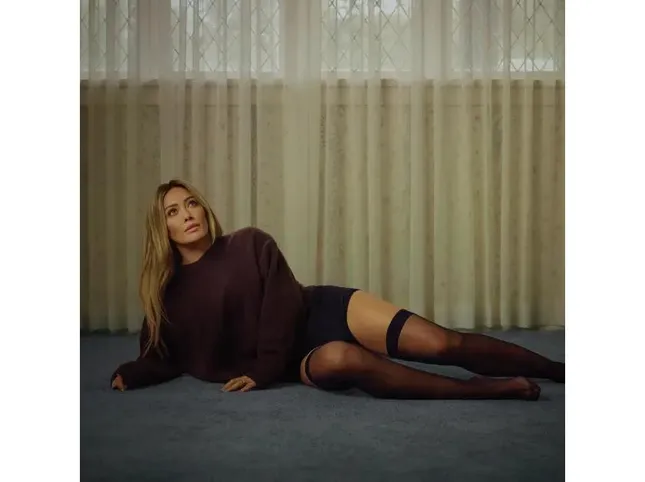
“Wake up, wake up”, Hilary Duff is back and it’s 2000 again
Little by little we started talking about Hilary Duff again. And also in the musical field. It first came to our attention thanks to Netflixwhich during the Christmas period, when we were looking for lightness, relaunched the TV series “Younger” among its recommendations, initially released between 2015 and 2020. Then we realized that the former Lizzie McGuire had decided to pick up the microphone again when video footage of his live performances began to circulate on social media. Official confirmation came with the announcement of the new studio album, “Luck… or something”, out on February 20th, eleven years after the previous “Breathe in. Breathe out.”. And as if to put a firm point on this return, yesterday February 12th, the singer also announced the dates of the new world tourbaptized “The lucky me tour“.
Hilary Duff’s return to music
Hilary Duff’s public presence has never really stopped, focused on acting, writing and family. Music has therefore remained waiting for a new form and a new meaning. That sense now takes shape in “Luck… or something“, sixth studio album, released for Sugarmouse Inc. and Atlantic Records, the label with which Duff signed in September 2025, ten years after the last album.The project was born in close collaboration with her husband Matthew Komathe album’s main producer and co-writer of the songs with Madison Love. The singles “Mature” and “Roommates” anticipated a work that Duff herself defined as introspective, built on a dialogue with the past and on a reflection on her own personal and professional trajectory.
“Mature” addresses the memory of a relationship with an older man and turns into a conversation with the adolescent version of himself, reversing the expression “so mature for your age” from a formula of flattery to a tool of awareness. “Roommates”, a midtempo synth-pop song, instead tells of the emotional stagnation of a couple who slips from passion to cohabitation without momentum. The entire album moves between pop production and personal content, between memory and definition of identity.
The concrete return already took place with a return to the stage on 19 January 2026 at the O2 Shepherd’s Bush Empire in London, the first date of the “Small rooms, big nerves tour”, Hilary Duff’s first concert series since 2008. The singer’s own words, published on Instagram, told the meaning of that moment: “Eighteen years later, and I still can’t really make sense of it all. I imagined what it might be like to return to the stage, but last night was something completely different. The love, the community, the energy has reached me in a way I wasn’t prepared for. Thank you for walking with me all these years, for celebrating what was while embracing what is becoming. I know that I am exactly where I need to be.
To seal the return, the announcement of “The lucky me tour“, a world tour that will start in June and cross North America, the United Kingdom, Ireland and Oceania until 2027. An international calendar that transforms the comeback into a structured project and not an isolated episode.
Where were we?
To find the thread again, we need to go back to 2015, to the release of “Breathe in. Breathe out.”, a record which then marked an attempt to repositioning in contemporary pop but which, as she herself would admit years later, left a question of artistic identity and creative control unanswered. After that album, Hilary Duff’s public trajectory has (re)found stability, especially on the television side playing the role of co-star Kelsey Peters in “Younger”, a comedy-drama series created and produced by Darren Star (author of many successful TV series such as “Sex and the City”, “Beverly Hills 90210” and “Melrose Place”) and based on the 2005 novel of the same name by Pamela Redmond Satran. Television represented a place of continuity and consolidation for Duff, while the music remained in a dimension of declared but never definitive pause. In this context, they also continued to circulate rumors about a possible return of “Lizzie McGuire”a symbolic character of a generation, a sign of how that imagery had never been completely archived. In parallel, in 2021 and 2023, Duff published children’s booksalso inspired by the experience of motherhood and the birth of her daughters from her marriage to Matthew Koma.
Hilary Duff in the return of the 2000s
Hilary Duff’s return is not an isolated event but it fits into a broader cultural context, that of Y2K revival. The acronym, pronounced “why to key“, is today the identifying cultural symbol the popular aesthetic typical of the 2000sprevalent between 1997 and 2004, recalling one futuristic, optimistic and cybernetic stylemade of bright colors, shiny materials, flared trousers, baby tees and accessories inspired by the early years of the web.
Theories about twenty-year fashion cycles explain part of the phenomenon: every two decades, symbols and languages return to the surface. But in recent years the process has accelerated. The pandemic has fueled a need for comfort and familiaritypushing towards memories and references of an era perceived as simpler. Streaming platforms they put back into circulation series and films of the early 2000stransforming them into a permanent archive accessible to new generations. Social media, with TikTok in the lead, have multiplied the circulation of songs, looks and cultural fragments, making immediate what once required temporal distance. In this framework, music occupies a central role. The rediscovery of songs like “Potential breakup song” by Aly & AJ, which has gone viral again and is the subject of a new recording, and the affirmation of artists like Olivia Rodrigo, who recover pop-punk and emo sounds from the early 2000s, demonstrate how that language has become a shared heritage and a matter of reinterpretation. The references to Paramore and Avril Lavigne, the citation of films such as “Jennifer’s Body” and “Pretty Princess”, build a bridge between memory and the present.
Hilary Duffwhich after being one of the most popular Disney stars thanks to the series “Lizzie McGuire“, broadcast between 2001 and 2004, in the 2000s she was the protagonist of that season with songs such as “Wake up” And “So yesterday“. The singer returns today not as a simple nostalgic icon but as a conscious subject of a journey. Her new album and world tour are part of a cultural movement that looks to the past to redefine the present. It is not just a revival, but a rereading. And in that rereading, between stage, streaming and social media, the echo of the 2000s is no longer just a memory, but a lesson. Sometimes not to be repeated.