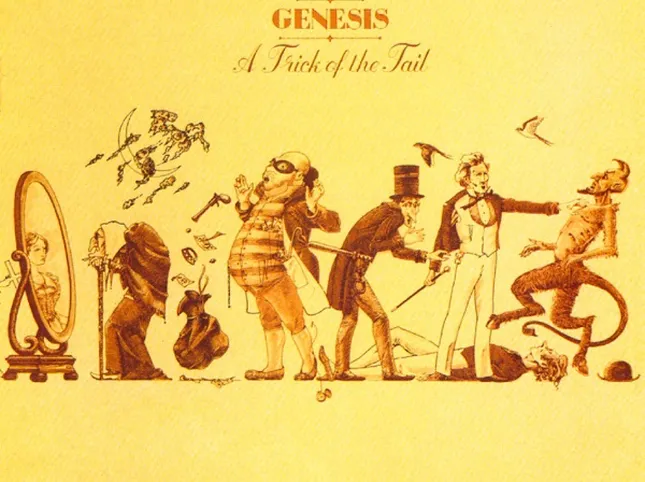
Is it Genesis’ bravest album?
Fifty years ago, on February 13, 1976, i Genesis they weren’t just releasing a new album: they were walking on a tightrope ten meters in the air with no nets to protect them. After Peter Gabriel’s farewell, the press already had the epitaph ready (we told it here). Instead, “A Trick of the Tail” gave new life to the band, which redefined (once again) the canons of progressive rock.
The “Hentschel Sound”
The transition from John Burns to David Hentschel (who had already worked on Elton John’s “Goodbye Yellow Brick Road”) marked a radical sonic turning point. If “The Lamb Lies Down on Broadway” was dense, dark and layered, “A Trick of the Tail” shines with crystal-clear instrument separation.
For the first time, Phil Collins’ drumming becomes a commanding presence. The use of natural environments and skilful compression (anticipating the “gated reverb” of the 80s, which you can learn more about here) makes the snare drum a supporting element and not just an accompaniment. Tony Banks abandons organ saturations to embrace more orchestral textures, making the most of the potential of the Mellotron and ARP synthesizers.
A breath of fresh air
The album is an arranging manual for rock quartet. Without Gabriel, the empty spaces are filled by a dense network of interactions between twelve strings and keyboards. Tony Banks is the architect of the album: in songs like “Mad Man Moon”, the piano acts as a classical backbone, onto which ARP stratifications are grafted. In “Entangled”, the Mellotron choir combined with the synthesizer creates an ethereal effect that simulates a real orchestra, eliminating the “grainy” nature typical of previous records.
AND Steve Hackett? Although he felt a little limited, his contribution is masterful. In “Entangled”, the mix of 12-string guitars creates a harmonic carpet in which the frequencies add to generate an acoustic “wall of sound”. The use of swell volume and tapping (a technique he pioneered along with Van Halen) in “Dancing with the Moonlit Knight” and finished here in “Dance on a Volcano” adds a textures almost cello-like.
For its part, Mike Rutherford massively introduces Moog Taurus pedals. These sub-bass frequencies (which drop below 50 Hz) allow the band to maintain a huge sonic impact even when Rutherford switches to 12-string guitar, guaranteeing that low-end which will become the trademark of Genesis live.
Here is a special on the album with all the songs told one by one.
Some highlight
Dance on a Volcano
Keywords: polyrhythm and odd times. The main riff oscillates between 7/8 and 4/4, with an interaction between bass and drums that borders on jazz fusion.
Squonk
The Led Zeppelin sound inspired by “Kashmir” leads to a heavy, lilting drum tempo, rare in British prog of the time.
Robbery, Assault and Battery
What a spectacle Banks’ keyboard is. A solo-monument of synth solo progressive.
Los Endos
A masterpiece of thematic revival that blends jazz, rock and references to previous songs on the album.
Kudos to Phil
Technically and vocally, Collins did not try to imitate Gabriel. Its range was higher and the tone more “soulful” and cleaner. The real challenge was breath management: Phil had to learn to sing extremely long melodic lines (originally written for Gabriel’s theatricality) while maintaining the rhythmic precision that only a drummer can have. The result is a precision in intonation that has allowed the band to explore more complex vocal harmonies.
“A Trick of the Tail” is a record brave and complete. It proves that prog can be accessible without losing an ounce of structural complexity, and it’s the album with which Genesis ceases to be a frontman’s backing band to find a collective and symbiotic musical identity.
Curiosity. The video of title track is an early example of a “promo film” with (albeit rudimentary) special effects in which Phil interacts with miniaturized versions of himself, anticipating the MTV era.