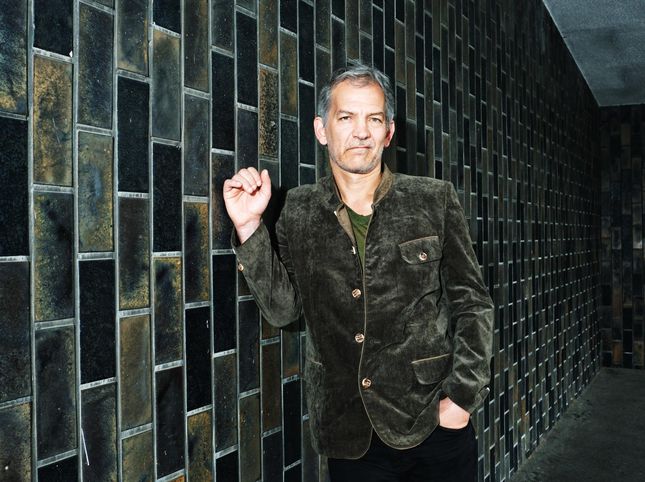
Brad Mehldau, when jazz helps to rediscover rock
At the end of the 90s Brad Mehldau did something that, at the time, seemed almost an anomaly in the rigid jazz codes: next to the standards began to play songs from Radiohead, the Beatles, Nick Drake. The pop -rock song entered the jazz piano repertoire with a naturalness that we take for granted today: Mehldau has built a varied career, which includes only, trio, orchestral compositions: but those “covers” – improper term – have made it unique and have become a model for many other artists.
After the album dedicated to the Beatles of 4 years ago, and in the midst of several other projects, Mehldau returns with “Ride Into the Sun”, coming out on August 29 for Nonesuch Records: a record entirely dedicated to the songs of Elliott Smith, a great American singer -songwriter who died suicide in 2003, just 34 years old.
Central figure for Indie-Folk and for the American songwriting of the 90s, Smith is celebrated and reinvented: Mehldau enhances its writing, the harmonies, with a disc that puts together, orchestral arrangements and the sound of a band: there are Chris Thile at the voice and mandolin, Daniel Rossen (Grizzly Bear) to the guitars and voice, Matt, Matt. Chamberlain on drums. In the lineup, in addition to classics such as “Sweet Adeline”, there are also “Thirteen” of the Big Star (already played by Smith) and “Sunday” by Nick Drake, a tutelary god of the entire project.
We met him in Milan: it is a rare opportunity to talk to one of the most fascinating and inclassable musicians of the last decades.
The pop-rock repertoire in a jazz key has been attending for a long time, and you played songs by Elliott Smith in the past: why a complete album dedicated to its repertoire?
In part it is due to a very personal experience: about four years ago I was the victim of a deep depressive episode. I had already had to do with this problem in the course of my life: when I met Elliott and his music for the first time, I was going out too since a dark period. I had to stop everything, I took some free time: I felt I understood his music even in a deeper way, given what he had passed. I told myself that perhaps the time had come to make a record to honor his inheritance.
Compared to the Beatles, Radiohead, names that are part of your repertoire, Elliott Smith may seem like a niche name.
I have never stopped listening to his music in the last 30 years: he has had a great influence on me, on how I write it and also on how I sound the plan. If we talk about texts, the experience of four years ago prompted me to listen to his songs in a different way. But musically it was not a simple songwriter: I like his harmonies in particular – it is something that has always moved me immediately from the first time I have heard it.
It may seem strange that a simple author of songs can influence a jazz pianist like you.
Yes, but it is quite complex. He has a way of playing the unique guitar, like Neil Young, or as Nick Drake or Joni Mitchell. There is an almost orchestral approach, there is a depth in harmony that is more than three simple agreements.
The disc includes your original compositions, based on its music: how were they born?
The first orchestral arrangement I made was “The White Lady Loves You More”, which is located in the middle of the disc. After the arrangement, I continued to write something that looks like a tail. Then he continued to go on. It is something that I have done other times with pop songs in a context of only floor: I play the song, then I go ahead for 10 minutes: it is an emotional inspiration.
The album is not a simple collection of songs by Elliott Smith: in addition to your compositions there are “Thirteen” of the Big Star and a song by Nick Drake. How come?
That of Big Star is a song that I have always loved. Just 3 years ago I discovered the version of Elliott Smith: it has a particular meaning in its history, it tells the loss of innocence, something that perhaps has been even more painful for him. While Nick Drake was a great influence on Elliott Smith, also in the harmonies. Until not long ago Nick Drake was not so known, then he was rediscovered thanks to a spot of a car …
“Ride Into the Sun”, the title of the disc, comes from a phrase of “Colorbars”. Why this in particular for the title?
I think it’s a wonderfully ambivalent message between love and sadness: it is not clear whether we talk about saving or dying. It is in this space that his music has lived. And that’s what attracts me in a song, whether it is a song, a Schubert or Wagner sonata or as Thom Yorke sings: you have this feeling of beauty but also of fear and fragility.
In your career you went from rereading from Massive Attack to Soundgarden, Radiohead, in fact. What does you attract you in a song?
Sometimes I love a song but I can’t find something that is interesting for me: when you play a song you have to bring the audience to a sort of another universe. I am looking for something where I can express my voice and I can do something new.
When you started doing these covers it was new: jazz was linked to the standards, to the great American songbook. Yours was a way of saying that pop and rock were also rich in great compositions. Didn’t it become a fashion today? Have you changed your approach?
Perhaps one thing that has changed is that I appreciate different things. When I engraved the disc dedicated to the Beatles 4 years ago I discovered that not everything must be enormous, Wagnerian. Sometimes 3 minutes are enough and there is not even a improvisation or a solo: it is also nice to distil, look for the essence of the song. In jazz you are often too tied to the fact that you have to improvise … maybe we just have to play a beautiful song.
Is there your reinterpretation that you are particularly linked to?
I don’t know how to choose. But it is interesting because people react to different things and today the songs become viral without you realizing it. Many associate me with my version of “Blackbird” of the Beatles: it is beautiful, but not that it has become something that defines me. For me, what I did is beautiful but it is not the only thing I did: I also played and engraved Bach …
Live often Bruno Martino’s “summer” sounds: how did you discover it?
It is an interesting song, it is in fact a jazz standard, which I listened to in New York by people like Tom Harrell and Kenny Barron and then there is the incredible version of João Gilberto. One of my best friends is an Italian boy who told me about the story and showed me the original. It is a wonderful song because it is a sad song: it is what makes it really different from other songs that speak in summer.
In your career, pass from the trio to the plane only, to orchestral and complex projects.
It is only that I have an excellent manager with whom I have been working for decades: we have these meetings where we look at the next two years and plan what to get out, what to play and when, without exaggerating. Also going from one project to another is not easy: I have some friends who are classic pianists of great level, I listen to them and I look at them because he is crazy as they can go to play Rachmaninov a month and Prokofiev the one after …