50 years and not hearing them: “The Tower of Babel” by Edoardo Bennato
Fifty years and not hearing them. Or perhaps hear them all for how prophetic they were. The year was running 1976 When Edoardo Bennato was printed The Tower of Babelhis fourth studio album. Today, in 2026, we look at that record not only as a cornerstone of Italian rock, but as a sociological treatise on music that anticipated the communicative fragmentation of the digital age.
The disenchantment
In 1976, Italy was still immersed in the years of lead. Author’s music was dominated by explicit political messages and committed folk ballads. Bennato chose to break the mold: with his image from one-man-band (guitar, harmonica, kazoo and pedal tambourine), introduced an aggressive, ironic and blues rock aesthetic deeply skeptical against every dogma, whether right-wing or left-wing.
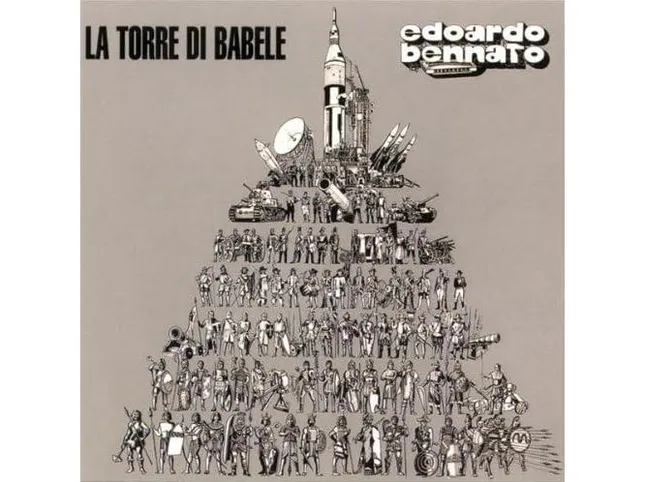
The opening track, the title trackit’s a manifest. It is based on a pressing riff that mimics the frenzy of construction, while the text uses the biblical metaphor to describe technological and military progress which, instead of uniting humanity, creates linguistic barriers and misunderstandings. The “tower” is the bureaucracy, it is the arms race, it is the inability to communicatewell represented in the iconic cover, designed by the Neapolitan singer-songwriter himself.
One of the album’s poetic peaks follows, I will sell. The text is by his brother Eugenio, and in Edoardo’s hands it becomes a hymn to artistic integrity. A frontal attack on the recording industry and the market of feelings, made even more bitter by a melancholy but firm arrangement.
Raffaele is happy
He never graduated
But he studied and heals people
And he tells me: be careful
Which takes you out of the game
If you have nothing to offer
At the market
I will sell my anger
To all those good people
Who would like to see me in a cage
And maybe then
He would find me funny
Everything has its price
But no one will know
How much does my freedom cost
In How many good people the irony with which Bennato disguises social criticism emerges: the song describes the conformism of the “silent majority”, following a blues trend. But it’s in Fandango that the singer-songwriter’s irony is at its best: a provocative song that uses nonsense to criticize respectability, South American dictatorships and the connivances of Western governments, to mock clichés and political rhetoric, defined by the author himself as an over-the-top “madness”.
From 1976 to 2026
From a technical point of view, The good guys and the bad guys And I who am not the emperor they had already defined very high quality standards – e The Tower of Babel continue this sonic ascent. Bennato’s guitar is never just accompaniment, it isn’t just in his approach, which is percussive. The presence of musicians of the highest level – Tony Esposito and Lucio Fabbri, to name two – gives the album solidity, but also freedom to range from funky to jazz to rock to blues.
Half a century later, the “tower” has not collapsed – it has only turned into one digital infrastructure. Bennato’s criticism of mass communication and extreme specialization (which makes men incapable of understanding each other despite speaking the same language) resonates today more than ever in the era of algorithms and echo chambers of social media; indeed, the information chaos and the reckless use of artificial intelligence only confirm the album’s thesis. A criticism of blind humanity and the arrogance of power which, unfortunately, continues to tell us who we are.
He thinks so too Giuseppe Scarpatoguitarist, producer and arranger of Edoardo Bennato:
Even today it has great topical value for us too. I’ve been playing with Edoardo for thirty years, and as a producer and arranger I feel like I’m involved. “La torre di Babele” is the song with which the band always goes on stage, it’s the first slap we give. Sometimes we alternate with “Thank goodness Nero isn’t here now”, but it’s almost always “The Tower”, because – especially now, with the new arrangements – it gives a nice boost of energy.
Edoardo always says that it took him more time to design the cover than to make the entire album, to write the songs and record it. They are all miniatures drawn by him by handthe evolutions of man within the war: from this alone we understand a lot about the album and how it is still – alas – current.
Even though Edoardo unfortunately never does it live, one of my favorites on the album is “Franz is my name”, a manifesto – especially if you consider the year in which this song was released. It talks about divided Berlin, but if you listen to it now, you will understand that it can be adapted to many walls that still exist today and which continue to be built by humanity both physically and metaphorically.