We chat with Steven Knight, responsible for the new documentary about Oasis
Over the last few years we have tended to label the relationship between the Gallaghers, not without some humor, as a soap opera. A tug of war between brothers that surpassed the musical barrier to become the quintessential brawl of contemporary rock.
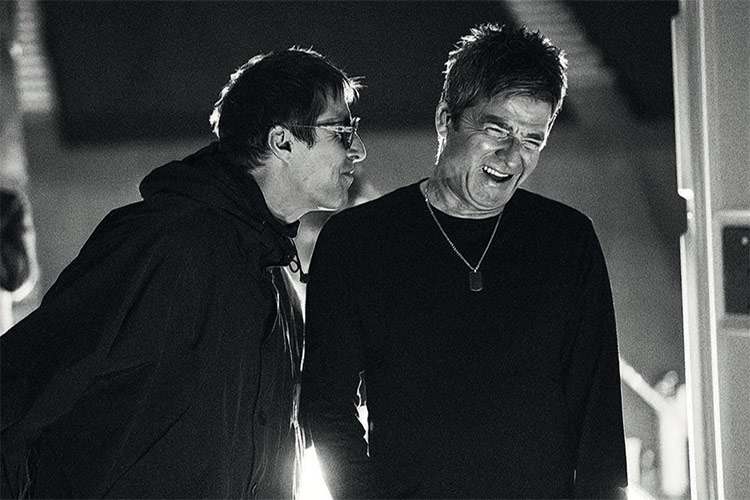
For this reason, their meeting, collected in “Don’t Look Back in Anger” (available on Disney+ starting September 11), has meant much more than the simple return of a band: it is the hopeful repair of a bond that seemed unsalvageable.
Steven Knight“Peaky Blinders”, “Guinness House”, “Taboo”), creator and main screenwriter of “Don’t Look Back in Anger”consider this as “a documentary with a plot”unlike other audiovisual chronicles that merely record the object in question. He and his team retraced Liam and Noel’s steps throughout 2025, aware that behind this comeback there was something truly beautiful to tell. “The breakup of Oasis was an extra-musical event,” Knight points out. “We are not just talking about a band that simply dissolved or stopped playing, but about two brothers who, deliberately, stopped speaking for sixteen years. During that time, they even had children who did not get to know each other and things happened in their lives that they kept away from each other out of pure pride. Any clever filmmaker would see a movie in them.”
“The main theme of this documentary is not only Oasis, it is hope”
To shape this, Knight counted on Dylan Southern and Will Lovelace (director tandem of “Shut Up and Play the Hits” and “Meet Me in the Bathroom”), who recognize “They were his first choice to make the film” for his vast knowledge of music. He finishes the play with the splendid photography of Haris Zambarloukos, with whom he already worked in ““Locke.” (13), although the director assures that they did not exaggerate or embellish anything more than necessary. “Every place we went we looked for the best local cinematographer, gave him a camera and told him ‘Make your own movie’. That’s why the concert images are so intimate and real and you ultimately get the feeling that the audience is the true protagonist of this documentary.”
The team also limited itself to placing ten fixed cameras in the band’s rehearsal environment to capture the reactions and impressions of those involved in the most natural way possible.. “We were clear that the idea could work, but also that it could go catastrophically wrong,” comments. “When rehearsals began there was an absolutely real possibility that it would blow up, that’s why we haven’t tried to hide anything. Pure reality already left us with magical moments in the footage. Like the sequence in which Liam enters the rehearsal room for the first time and bumps into Noel. As they are British and working class, there is no great emotional outpouring in their reactions. There are no words, just looks and small gestures, but in the film we appreciate how, little by little, that relationship goes away. rebuilding until they rediscovered each other, sixteen years later.”
Before starting filming and in order to test the waters, Knight fulfilled the dream of any music journalist: interviewing Liam and Noel together for the first time in twenty years. “When you talk to them face to face you discover that their talent and eloquence are innate”he points out. “Practically everything they said in that interview could become a quote that you would print on a t-shirt. They are, as you know, two very honest people, but also, throughout the conversation, you discover that they have matured and that they have completely turned their relationship around, to the point of joking and realizing how absurd they have been. In the documentary, without a doubt, there is a very emotional story to tell, but when it comes to them it was impossible that there would not also end up being a very funny movie behind.”
Knight insists that the value of “Don’t Look Back In Anger” It lies not only in documenting the meeting, but in something more special. He speaks of reconciliation, the key word of the project, which he considers definitive to understand the true meaning of seeing them on stage again. “The reconciliation between Liam and Noel, in a way, also says a lot about the world we live in today. We need stories like that. Making this documentary I have met people from all over the planet, many of them from quite difficult places, for whom a simple Oasis song has meant something special. The reason we made this film was not only to pay tribute to the music of these guys, that too. It is because the return of Oasis, by all accounts, has been a fairly representative beacon of our time. There are people that, after finishing watching the film, the first thing he did was think about that person he hadn’t spoken to in a while and he began to understand to what extent perhaps this is the time to break that stupid cadence and take the first step. And if that can happen on an individual level, it could also happen on a larger scale, right? Because the main theme of this documentary is not only Oasis, it is hope.