The narrative universe of Liberato at the Maradona Stadium
“How the hell is it, Diego Armando Maradona stadium”
A few words, pronounced in dialect, pronounced slowly, in front of 45 thousand people. In a project built for years on subtraction, no interviews, no personal exposure, an identity kept in the shadows, are enough to give the sense of a long-awaited evening and to establish direct contact with the public who occupy the stands of the temple of Neapolitan football.
Almost ten years after the release of “Nove Maggio”, the Maradona concert shows how the question of who Liberato is has progressively lost centrality. Attention is now focused on the songs, on the universe built over time and on a repertoire capable of supporting a stadium-sized show on its own. It is not the first time that Liberato has stepped onto that lawn: it had already happened during the celebrations of Napoli’s third and fourth championship. But then it was the artist who inserted himself into an already existing collective celebration. This time the relationship is reversed: the concert is entirely built around its musical and visual universe.
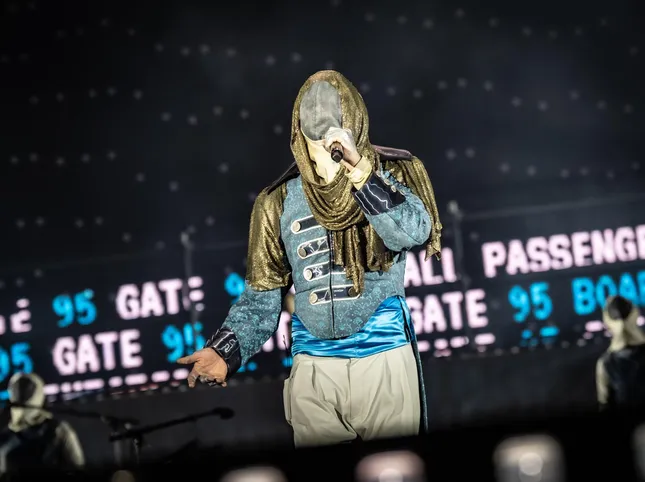
The transformation also emerges immediately from a scenic point of view. The black aesthetic that had accompanied much of the project’s history leaves room for a new chromatic dominant. Blue invades the stage, the costumes and the images: Liberato appears with a light blue circus-style jacket embellished with golden toggles and details, while the musicians abandon the traditional hoods to wear masks that recall those of fencing. The faces remain hidden, but the visual language changes radically. Blue is not just an aesthetic choice: it is the color of the sky, the sea, the city, but inevitably also that of the team which, more than anything else, represents the collective Neapolitan identity today.
From the opening with “Guagliò” and “Turnà” the concert develops as a journey into a narrative universe that has acquired its own autonomy over time. “Tu me faje asci’ pazz'”, “Anna”, “Niente”, “Te amo bene assaje”, “Lucia”, “Nove Maggio” are not welcomed as simple hit singles: they are fragments of a shared memory, chapters of a story that the public, in the front rows of fans who arrived at the gates from the previous night, together with spectators from other cities and abroad, recognizes as their own. Liberato’s repertoire works with a serial narrative logic: each song refers to images, characters and places, recalling the previous episode in a chain of references that closes on itself.
However, one of the most relevant aspects of the evening concerns the musical dimension. Considering Liberato’s productions, strongly linked to electronics and studio work, one might have expected a live performance built mainly on bases and sequences. In contrast, the Maradona concert puts the band’s performance and work on the arrangements in the foreground. The electronic components remain central but are integrated into a fully concert-like structure, and Sara Gioielli and Fabia Martone play an important role in this balance, whose voices run through much of the show, giving depth to a repertoire that appears more sung and played live than one might imagine listening to it in the studio. The acoustic parenthesis and the piano performance of “Gaiola Portafortuna” temporarily interrupt the monumental dimension, bringing the attention back to the writing and the melodies.
In this context, the gigantic LED wall takes on a central narrative role, not as a simple backdrop. The images alternate cosmic references, religious iconography, popular culture and cinematographic suggestions with a visual richness that recalls large international productions rather than the traditional format of the Italian concert. Among the most significant sequences is the one in which the figure of Masaniello is progressively transformed, through digital morphing, into a character that recalls Julius Caesar dressed in blue. It is not a historical quote: it is a mythological operation. Masaniello, Cesare, Naples, football and the sea coexist in the same symbolic story, and Liberato continues to do what he has been doing since the beginning: transforming real elements of Neapolitan culture into figures of a new pop mythology.
In this picture, what is missing is also striking. In the era of large concerts built around guests and surprise appearances, Liberato chooses a different path. No parade of celebrities, no colleagues called to share the stage. Even Calcutta, an important presence in the recent history of the project and present behind the scenes of the evening, remains off stage. The concert relies solely on the songs and the world built around them.
The final part passes through “We come from Napoli”, “Partenope”, “Si ‘ttu”, “Essa”, “A’ photography”, “Tu t’e scurdat’ e me” and “O’ core nun tene maestro”, clearly restoring the coherence of a project that over the years has built a recognizable language through music, images and layered cultural references. The Naples told by Liberato never completely coincides with the real one: it is a city transformed into a symbol, into a shared memory, into a space of desire that exists simultaneously in the past and in the future, in tradition and digital culture.
Almost ten years after “Nove Maggio”, the most interesting fact is not that we still don’t know Liberato’s face. It’s that we continue to immediately recognize the world he built. And to Diego Armando Maradona, for one evening, that world seemed big enough to contain an entire city.