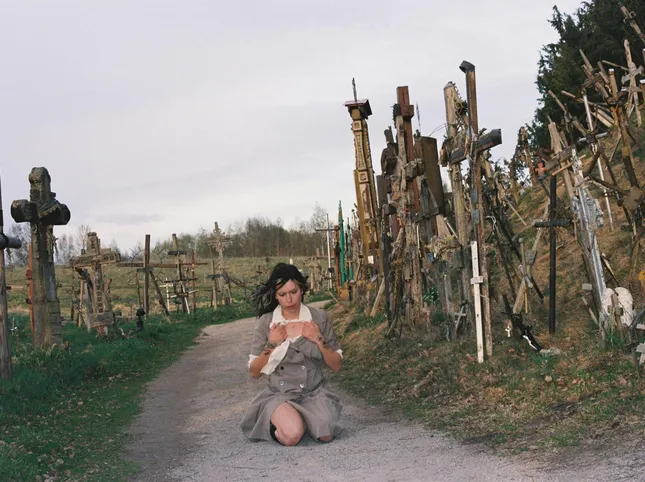
The lover, one step after the pain
“Non dire addio”, after her debut “In memoria di”, is Lamante’s second album, written entirely by her and produced together with Taketo Gohara. The singer-songwriter says that, after the publication of that first album released in 2024, something breaks: words stop being enough. Then images, visions, recurring symbols emerge that inhabit dreams. It is Gohara himself who recognizes the red thread that will then bind all the material born from those visions: a mourning experienced and never really faced. A mourning that is at the center of this album, together with themes such as motherhood, memory and the future. It is not a work that drags the listener into an abyss of pain, but one that takes place one step beyond that abyss. And this is precisely why it is so precious, the free and daring son of one of the most exciting new generation pens.
A few days ago, speaking with Francesco Motta, we were discussing the importance for an artist of staying one step ahead After the pain. Not to drag the listener into an abyss, but to allow him to look beyond. Was the album born like this?
Yes. I don’t know if I completely managed to stay one step “after”. Motta is one of my great advisors. I also played the album to Capovilla, he was one of the first to discover me when I was 16, and he, starting from the title track, told me: “the people must be elevated through music, not sunk”. And he’s right. Art can have a great function not only for those who create it. With this album I tried to stand aside to try to resolve my pain, but also to allow others to resolve theirs.
What else did Capovilla tell you?
That I should have called this record “Mamma”. I’m proud that he said it, it means he understood everything, but I’m equally proud that he didn’t (smiles, ed.).
You’ve always said you grew up with CCCP. Did you go to visit Giovanni Lindo Ferretti?
There wasn’t the opportunity. But when I met him in Turin, not too long ago, he gave me wonderful advice: “untie yourself from what you want”. I was complaining about the fact that the electric guitar no longer stands out in the new songs. And I wondered: but why? And he answered me like this.
In the album you talk about a personal loss, but you never become didactic. Can anyone get into this album, even without knowing your personal wounds?
For me it is essential that the songs have multiple lines of reading. When I started listening to the album, before the release, some people told me that the songs sounded like love songs. And this was a great relief for me. A song is successful when it holds a mystery.
Did you have to remove elements that were too close to you?
No, on the contrary. On several occasions Taketo told me to be more direct, which for me means expressing yourself, not exposing yourself.
Was the first album “In memoria di” a sort of prequel?
The first album was a dive into the family archive, a retrace of the lives of the women in my family. With this album, in the story, I arrived.
There was further research into instruments, such as the organ, harmonium and an entire string section.
They are instruments that recall the figure of the mother, around whom the entire album revolves. The instruments recall the woman. For me, the organ actually represents a uterus. The violet is the body of a woman. In the first album there are many wind instruments, which evoke war, they are phallic instruments. This time around I needed to go elsewhere.
What was it like recording in the deconsecrated church in Schio?
It is consecrated.
Consecrated?
Yes, it wasn’t easy in terms of permissions. It took months of bureaucracy and the Vatican had to read the texts first. Before arriving in that church, we had recorded in the studio, but I was pissed off at everyone, not satisfied with the result. At that point Taketo understood what the record was about and told me: “we have to record in a place where the cycle of life takes shape, from baptism to funeral: a church”. So we looked for churches around the Veneto, without realizing that I had the right one, the one linked to my family, at home.
Because you say: “at that point Taketo understood what the record was about”. Weren’t you direct? Didn’t you tell him about your loss right away?
No…two years ago when I released the first album I lost all the words I had…I had nothing left to say. Then the tour linked to that first project began. I had suffered a loss before releasing the first album, but I had never faced it… this second project forced me to look those images in the face. Images, including crosses, red birds, walls of hair and umbilical cords, which I also found in my dreams and which then fueled the videos of these new songs. Only with time did I put everything in order and understand what I really wanted to talk about in these new pieces. The book “I’m Not Saying Goodbye” by Han Kang played a fundamental role. Taketo slowly started to understand where I was going, what I was talking about in the songs and he made it clear to me too. Among other things, he had recently lost his mother. But when we met in the studio he hadn’t listened to anything, he didn’t know anything. This took some time. And a church.
In “Governatevi” you sing “Memory is like a belly that empties and fills up”. And then you invite them to disarm. Is it an anti-war song, but also about liberation from fears in telling one’s story?
Yes, it has a double meaning. I wrote it at night, in the midst of my delirious dreams, dreams that I tried to govern with the sounds of my keyboard, which takes me back to childhood. They once told me: “How can we stop the wars out there if we can’t stop the ones at home?”. Here, that “govern yourselves” is an invitation to resolve those internal wars. And before doing so it is necessary to let go, “disarm yourself”.
Are you ready to talk directly about your grief?
Whoever listens to the album will understand. For the rest I don’t want to add anything else. When I’m ready, I will. I spoke with Appino. I asked him: how did you manage to communicate why you wrote “The Testament”? He replied that at the beginning he said that the piece was only dedicated to the figure of Mario Monicelli, to his suicide, without immediately revealing that it concerned one of his family members. He decided to do it later.
Are you afraid of the exploitation of pain?
I don’t want such bullshit headlines about painful issues. I wrote this album for myself, and for those who perhaps live or have lived something similar. I’m interested in this.
Is “I don’t say goodbye” the heart of the record?
It is the piece of revelation, it is the piece with which I put the two great themes at the center: motherhood and mourning. It’s the piece that I have difficulty singing, so it took me a lot of practice.
“A magic stronger than death”: are you a bit of a witch?
Jodorowsky and his sense of magic are my strongest sources of inspiration. After reading “When Teresa Got Angry with God”, in which she transforms family tragedies into myths, a world opened up to me. I saved my life.
Do you have faith?
Yes, I have faith. But God has nothing to do with it. I love the phrase: “I believe what I don’t see”. Which is the opposite of what we are experiencing today.
We talked about memory and pain. But this album also puts the future at the center.
“When the man of the future comes, he will erase the shadow of the past.” I have always been conservative in my memory, but here for the first time I use verbs in the future tense. And then we also talk about children, that is, about what is yet to come, they are tomorrow.
Where does Lamante fit into the music industry?
I ask myself questions, but I don’t let them influence me. When “In memoria di” was released in 2024 there wasn’t the female singer-songwriter scene that there is today. And this is interesting: today there are the first real networks between new generation female artists. It happens because there is also a request from the public in this sense: they want to listen to a female point of view more. At the Premio Tenco we found myself, Emma Nolde, Anna Castiglia, La Niña. We haven’t seen something like this in a while. Then, I am also aware that this rush “to women singer-songwriters” must be taken with a grain of salt because it is clear that there are interests in being seen as open to certain new courses. When you capitalize on a struggle, that struggle ceases to exist. We must be careful not to be exploited.