Oneohtrix Point Never’s digital mirror game
What is the musical director of a Super Bowl halftime show and producer of one of the biggest pop stars in the world doing in a small Milanese auditorium?
He is Daniel Lopatin, aka Oneohtrix Point Never, and the place is Inner Spaces, the electronic music festival at San Fedele, a few hundred seats and one of the best sound systems in Italy. A situation that attracts Depeche Mode’s first record producer, Nicolas Jaar, Italian excellences such as Marta Salogni and Donato Dozzy, or avant-garde names known only to fans of the genre. “What a place you have,” says Lopatin. “Playing here almost feels like making a record on stage.”
Miracles that can happen in an electronic music festival that has international relevance, and which has as its artistic director a father who listens to electronic music, Father Antonio Pileggi. OPN, as it is abbreviated, should have come here years ago, when it was already one of the reference names of the American electronic avant-garde. Then, as co-curator Gaetano Scippa says at the beginning, while he was traveling he broke his foot: a neighbor on the train dropped a suitcase on him. He tried for years to return: but in the meantime he became co-author and co-producer of The Weeknd, and took care of the musical direction of his Half Time Show. And he also has a career as a soundtrack author: the latest is that of “Marty Supreme”. Finally, here he is, with the show linked to “Tranquilizer”, his latest album in which he fused sounds that come from sound libraries of the 90s, looped tapes and digital processes.
From OPN to The Weeknd and back
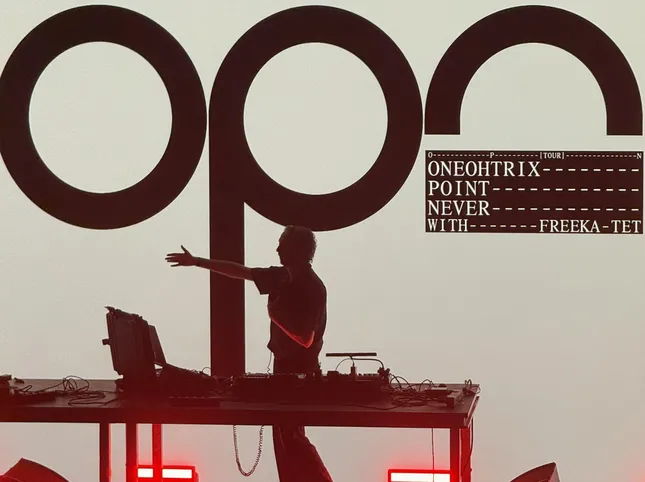
It’s reductive to reduce Daniel Lopatin to his work with The Weeknd or his soundtracks. OPN has always been his main project, around ten albums, many of which were published for Warp, which is an institution in the genre. It moves away from the most common musical forms, fusing electronics and music played in a more traditional way, blurring the lines between digital and analogue. On the San Fedele stage he appears with various machines on the table, as is customary in “live electronics” performances, a screen behind him and another, square, smaller one hanging on an upright like a digital painting. Behind it lies Freeka Tet, a visual artist, who creates the images that accompany the performance live, combining visuals and footage of a physical microenvironment that he has on the table, a small room on screens where other images appear: everything is projected behind OPN.
The result is a game of digital mirrors, with OPN “playing” and reworking pieces of its repertoire, while the images that lead into a world made of glitches, pixelated environments, rooms that seem to come out of video games from decades ago, overlapping screens. The perfect visual representation of OPN’s music, made up of broken rhythms, fragments of melodies, sonic assaults and moments of stillness. At the center of the setlist is “Tranquilizer” and pieces like “Rhodl glide” with its ballad start and sudden electronic change perfectly represent the mood of the evening, which ends with “Chrome country”, from “R Plus Seven”, the 2013 album: “In the end we slow down a bit”, says Lopatin.
A total immersive experience
The concert, organized by Inner Spaces with Kadmonia and Slam Jam, sold out within hours of the announcement. Upon leaving there is the feeling of having witnessed something unique: OPN had already passed in Italy, with an outdoor concert, but in such a context its musical and multimedia artistic idea is enhanced and expanded, giving life to a total and immersive listening experience, a fusion of genres and styles. “Perhaps the best thing ever seen at Inner Spaces,” a friend who has been attending the event for years tells me – and that’s a lot considering the level of things that have been seen in these parts. One of the most intense musical performances seen in Milan this year, I might add: the “live” demonstration of the caliber of one of the most important musical figures of recent years, in a place that is “sacred” in its own way.