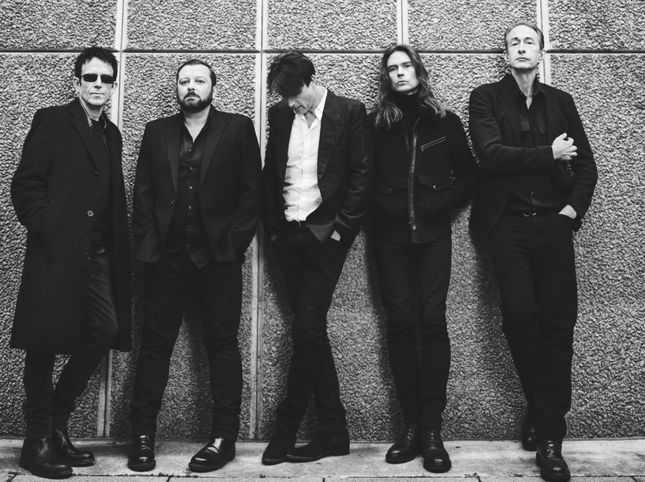
Suede: “Always were outsiders, far from the Brith scene”
Of the publication of ‘Antidepressants’, the new Suede album to be released on September 5 for Sony Music, the keyboard player and guitarist Neil Codling spoke to us. Very kind, the right arm of Brett Anderson, has let himself go to arguments that suggest how suede are more than ever a British musical treasure to be kept.
“Antidepressants”, your new album, aims to capture the tensions that afflict modern life: paranoia, anxiety, neurosis – a concept that seems to be connected with the title of the album.
I believe that the current way of communicating, the constant use of the cell phone screen implies being perpetually connected, but not necessarily in the most appropriate way. Because of this, there is a level of disconnection from the real world and by the people: it is here that the role of music is necessary, since the connection that must be created through it remains insurmountable and genuine. Towards the music that you love most it is necessary to express loyalty and respect, something that often realizes with the desire to see your favorite bands perform live. On our side, that of the musicians, we have a duty to recognize a certain responsibility that is to continue creating the music for which people have always loved us. And the suede are part of those bands that when appreciated, you appreciate them maniacally. For this it is always necessary to keep expectations high in those who listen to us. “Antidepressants” can be seen as an inner window on all of us individuals: on the way we constantly change in the modern world, while we look at the changing nature of connecting and together with the disconnect. Of this, the opening song, “disintegrated”, where in the introduction you hear a recorded item, recite the phrase “Connected/Disconnected”, gives a reading.
“Antidepressants” could be almost a sequel to your previous album, “Autophication”, not only for references to a genre like post-punk, but also for its gloomy.
What you mentioned is a musical area that, needless to deny it, we had already started to explore with “Autophic”, since it adapted to our nature and the lyrical universe explored by Brett (Anderson, frontman and leader of Suede). Let’s say it would have been difficult to express more complex concepts by combining them with a lighter and more carefree type of music. Hence the need to make our sound darker, to better accompany those same dark concepts.
In the album there seems to be more than a hint to the cult of the “Dreamtime” period. Do you agree?
The sound of the cult of that period was characterized by a certain type of darkness and a certain impetuosity, and it is undoubtedly stuff that we have engulfed during our training years, especially Mat (Osman, bassist) and Brett. If I remember correctly, among other things, the first concert to which Brett assisted was precisely that of the Southern Death Cult (the first incarnation of the cult), and this point I think that on him that concert must have left a impacting one.
In the press release of the album, it reads that “Antidepressants” was recorded direct, is that so?
It is largely, but there has been some additional retouching. However, we have each performed its parts together, in the studio, and no use of the computer was made in the production of the final sound. What you can listen to the album is the fruit of the real union between our tools and in the songs there is nothing, that you want, of artifact. No tricks, nor artificial intelligence of any kind.
Do you think that and Buller, your longtime manufacturer, has played a role in the construction of the suede sound, as well as the new album?
Certainly, because he has always been part of our team and thanks to his competence and his ability to be able to guide us, we were able to make our best records. However, I would say that his presence proved to be essential particularly for the last two albums, “Autophic” and “Antidepressants”. That perhaps he would not properly define as “post-punk”, as “new wave”, which from my point of view is a more American term, which has little to do with what we do. With and has always been discussed a lot on the definitions to classify the genres, let’s say, but he still remains an important part of our history and our sound.
You and Pulp, recently reappearing on the scene with their first album in almost twenty -five years, are still relevant. In the nineties, both were labeled as “Britpop”. But the suede had nothing to do with groups like Oasis …
I think the term “Britpop” has always been a very youthful way to describe a certain type of music dominated by the guitar. In any case, suede were formed in 1989 and I don’t think that at the time a term like that was already in vogue. Let alone in 1978, at the dawn of the Pulps. Keep in mind that in the period in which Britpop began to be talked about, we were on tour in Europe to grind kilometers on a bus. According to England for the most of the time, we were not too attentive to what happened in those parts, musically speaking. It could happen that in the context of our television appearance, in Great Britain, we came across some of the so-called “guitar-banand”, but I think we really did not hit anything with their stereotyped way of playing and performing. I think they were convinced that they approved they would sell some more disc. As far as we are concerned, we have always been part of a scene that saw a single band as protagonist, that is ours, and never went on the mind to behave as “friendly” with some of those groups, perhaps finding ourselves with the same to drink in a Camden pub. We have always considered ourselves outsiders, and we never liked that scene. Certainly it is to be appreciated that certain formations are today because the public asked for it. But as far as we are concerned, we have always kept away from the idea of conforming ourselves.
You are united in Brett and others in time to record “coming up”, to date the greatest commercial success of suede. What memories do you have from that period and the album tour?
I have excellent memories of all that period in store, which was particularly happy and creative for us of the group. The album also served to silence the many gossips that now gave us for deaths, despite our part we feel more alive than ever. We were against the world, eager to make us listen, to demonstrate who we could be. And this will is basically what has always animated suede.
I think essential to maintain a special relationship with our fans, because like many of them we have always felt outsiders. Fans are a great tribe who loves to gather in our shows, and I think it is positive that community are created – at least in this the digital world makes everything simpler -, thus giving those who listen to us the opportunity to never feel alone. I say this because I too, as a teenager, I knew I could count on those who, like myself, were animated by the desire to become a professional musicians, people with whom I would find a safe connection.
You and Simon Gilbert, the suede drummer, are cousins. What is the relationship between you two and among the members of the band in general? Do you attend, I ask you concluding, when you don’t play?
We tend not to attend, also because of the fact that we live away from each other. At one time it was different because good or bad we all lived in the same area of London, but today it becomes more and more complicated to meet us, being more scattered. However, what binds us, even at a distance, is the passion for what we do, that determination that we all observe in creating music, exactly like when the years we had were many less. And you cannot make good music, whether it is rock or other, if you do not believe in the spirit of youth and in the strength of that certain ease of which pop songs are permeated. When we find ourselves in the rehearsal room, or in a study to record, we are always the same people as always, eager to make music and to make it to the best of our possibilities. As for Simon, with him there is a certain relationship, which is dictated in part by the typical dynamic ones that can intercept between blood relatives. Simon will always be Simon for me: the oldest cousin of me with whom I play.