Some good reasons to adore My New Band Believe
In the musical landscape of South London’s prolific and ingenious “Windmill scene”, August 2024 marked a decisive watershed: the announcement of the indefinite hiatus of Black Midi. If volcanic frontman Geordie Greep channeled the band’s theatrical schizophrenia into his solo debut The New Soundthe bassist and guitarist Cameron Picton chose a diametrically opposite path, giving life to My New Band Believe.
Who are I My New Band Believe
More than a band, My New Band Believe is vast and ambitious musical collective edited and directed by Cameron Picton, in fact. Following the discontinuation of Black Midi’s activities, Picton began performing live as a soloist and released some self-produced mixtapes under the pseudonym “Camera Picture” (as 44m50s And 36m33s). This strategy allowed him to finance future recording sessions and test new musical ideas without the immediate pressure of the general public.
According to rumors close to the band, the eccentric name of the project was conceived by Picton during Black Midi’s last Asian tour, following severe food poisoning, and draws inspiration from the works of literary authors Gary Indiana and Dennis Cooper. Although Picton is the mastermind, lead singer and guitarist (a return to his roots on the instrument), the record involves a rotating cast almost 40 musicians. The lineup welcomes key figures from the British indie and avant-garde, including members of Carolina, Charlie Wayne (Black Country, New Road), Josh Finerty (shame), and instrumentalists from the London improvisation scene such as Kiran Leonard, Caius Williams, Seth Evans and Steve Noble.
The style
The sound of My New Band Believe clearly and voluntarily distances itself from the aggressive math rock, noise and punk that had made Black Midi famous, orienting itself towards significantly more introspective. The musical fabric moves fluidly between art rock, chamber pop, avant-folk and progressive rock. It is predominantly a sound ecosystem acoustic and bucolicenriched by intricate orchestral parts. However, there is no shortage of more exotic and warmer digressions: singles like Numerology (song unrelated to the main tracklist) showcased clear jazz, sophisti-pop, disco and even tropical influences.
The recording of their debut album followed a singular and risky technical approach: The musicians did not work based on pre-recorded demos. Instead, they spent long hours verbally discussing and conceptualizing the essence and direction of the piece before even picking up their instruments (an approach derived from collaboration with members of the aforementioned band Caroline). The songs were recorded “live” multiple times over the course of 29 days, located in 11 different studios in London with the help of nine sound engineers. In the process of post-productionPicton and co-producers (Mike O’Malley and Jasper Llewellyn) patiently stitched together the best fragments of the various sessions to create the definitive masters, in a painstaking work of deconstruction and reconstruction.
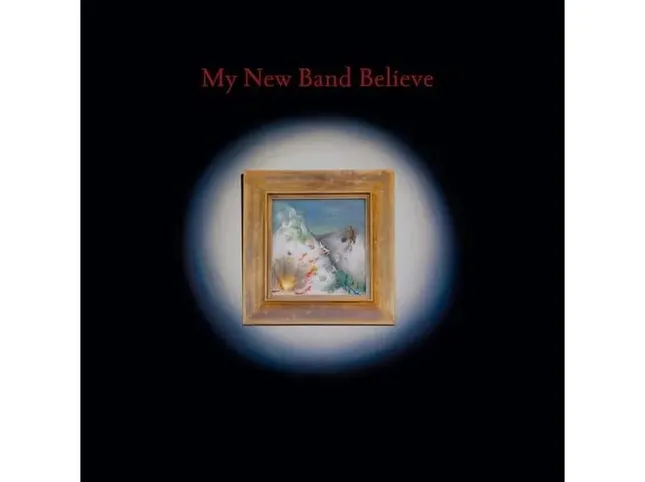
The culmination of this massive logistical and creative effort came with the release of their self-titled debut album. This is the tracklist, for a total of 36 minutes and 38 seconds of music:
-
Target Practice
-
In the Blink of an Eye
-
Heart of Darkness
-
Love Story
-
Pearls
-
Opposite Teacher
-
Actress
-
One Night
“Warm-up” singles like Lecture 25 and subsequent experiments such as Numerology they do not appear in the standard set list of the album, configuring themselves as separate entities from a promotional perspective or for deluxe versions.
Why are they interesting?
My New Band Believe represent one of the most fascinating evolutions of the contemporary British scene for several reasons. Listening to this project allows us to understand in hindsight the alchemy of Black Midi: if the distorted, crazy and theatrical soul belonged to Greep, Picton’s album reveals that the compositional elegance, the sensitivity for the softer arrangements and the melancholic component of the band (as demonstrated in the past on songs like The Magician) were the fruit of his pen.
Despite the more accessible sound, the album rejects traditional canons. The songs constantly change rhythm and dynamics (like the suite Heart of Darkness of more than eight minutes), preferring one rhapsodic development. They may recall the dilated compositions of the latest Black Country, New Road or the phrasing of King Crimson, but stripped of any radio pop ambition in favor of an instrumental purism. Textually and vocally, Cameron Picton moves away from his old superstructures. His voice guides the listener no longer into neurotic delirium, but within an intimate and vulnerable acoustic narrative, addressing themes of emotional tension, failures and human reflections with a previously unseen delicacy.