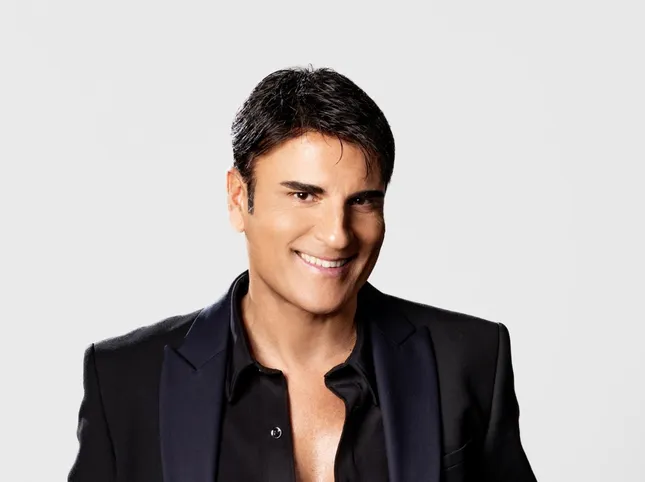
Sal Da Vinci: “Am I among the favourites? I make superstitious gestures…”
When we heard “Per semper Sì”, the piece with which Sal Da Vinci returns to the Sanremo competition after 17 years, at the press listening, many of us thought: this song goes straight among the favourites. Consider that it is an edition without an announced winner and, it must be said, with a weaker cast than that of recent years, but “Per semper Sì” has all the characteristics to repeat the success of “Rossetto e caffè”: (neo)melodic, pop(ular), with viralizable phrases and a powerful sound.
Accompanying the Neapolitan singer, in writing and production, are – in addition to his son Francesco Da Vinci – Alessandro La Cava, Eugenio Maimone, Federica Abbate, with the production of Merk & Kremont. He plays it down, makes superstitious gestures, says he doesn’t understand the mechanisms of virality and defines himself as a “man of the people”: rather than from the press room and radio, he will be rewarded by televoting, which in the current regulation makes the difference. While waiting for an album and a tour (leaving on 7 October 2026 from San Marino), Sal Da Vinci talks about his return to Sanremo.
Last year you were on the Sanremo stage with The Kolors with “Rossetto e caffè”, but this year you return alone, after several years of absence from the competition. Your name had already been circulating a lot in the previous weeks.
It is certainly a great satisfaction to return to the Festival after 17 years. Sanremo is one of the events that represent the music that travels in our country, and through Sanremo there are songs that make immense rounds. What better opportunity for those who make music than to appear on that stage?
In 2009 you came third. What memories do you have of that Sanremo?
It was a totally different Sanremo compared to those of recent years. I remember a city that experienced a lot of elimination and even repechage: it was a very daring Festival, really until the last breath. Thanks to the popular vote I got to the podium and it didn’t seem real to me. I never take anything for granted in life: everything surprises me.
When did you realize that “Lipstick and coffee” was making that “immense tour”?
I didn’t notice it through the streams, because I didn’t understand anything about it then and I don’t understand much about it now either. The mechanisms, virality, how platforms work: I learned more through hearsay. I noticed it when I went down the street and heard the song in the cars, when people stopped me to talk to me about it. Then I saw the explosion on YouTube and TikTok: ten videos, then twenty, then thirty, and so on. There I realized that something was changing. But if you ask me why it happened, I don’t think anyone really knows: there are magic that happen.
TikTok takes a piece of the songs and turns it into something else, often a meme, in a 15-second snippet.
We know that platforms generate this mechanism, but in my case it converted into something else. I wasn’t born as a stream singer: I’m a singer of the people, I come from popular theatre, I’m part of pop music, not a niche. I was born in a city whose music has been around the world, Neapolitan music, and I drew a lot from there, writing new melodies.
Did this model of success influence the writing of the song you bring to Sanremo?
I have never written music on commission. I always rely on a higher light than us, something you can’t explain. When I wrote “Lipstick and Coffee”, who would have imagined it? Even for this song we let ourselves go, without thinking about replicating anything. We didn’t start out saying “let’s make Lipstick and Coffee 2”. Songs are a kind of summary of the possibilities you have: if they reach people’s hearts and minds, they can do a lot.
However, there is also a method to writing. For this song you collaborated with important names such as Alessandro La Cava, Federica Abbate, Merk & Kremont and others. How did this collaboration come about?
It was born thanks to a Warner A&R, Filippo Gemignano, a very good guy. One day he calls me and tells me that some authors wanted me to listen to a song. I am a melodist, but I have always been open to collaborations. I listen to that song – which wasn’t the one from Sanremo, but another one that will end up in a future album of unreleased songs – and I really like it. I ask to meet them. From there we started working together, other songs were born and one day the Sanremo song was born. When I brought it to Warner to listen to it, I immediately saw a positive reaction, a contagious enthusiasm. At that point I understood that it was the right song to propose to Carlo Conti.
I and other colleagues noticed a passage that recalls “If the city burned”. Is this a suggestion from us or have you thought about it?
I’ll tell you the truth: we never thought about “If the City Burned”, which is a masterpiece, but it wasn’t a conscious reference. But it’s inevitable: we grow up with a musical DNA that is passed on to us, certain melodies are in the air. There are seven notes, one rests on the other. We didn’t set out to copy anything.
After the first listen to the songs you are considered among the favorites. How do you live this expectation?
While you’re talking I’m making a superstitious gesture… Look, I’m going to the Festival to have fun and to enjoy that stage. After 17 years, being back in the race is already a lot. In such a painful moment for the world, I wanted to bring a song that talks about promises, about building our journey. It’s not a light song in the superficial sense of the word. Today making promises and not keeping them is easy; for me the promise is something sacred, true, serious. This is the message I bring.
Earlier you mentioned a new album.
Yes, we are working on it. I come from a theater tour, I stopped for a moment for Sanremo, I’m finishing some songs. We will announce the release date soon: it will be an album full of beautiful things.
Does this broader attention, even with its negative sides, please you?
My grandmother used to say: “Either they speak well or they speak badly, the important thing is that they speak”. The worst thing for a human being is to be invisible.
Have you ever felt invisible in your career?
Absolutely not. I have always followed my own path, I have had great satisfaction and important collaborations. I’m happy with what happened in my life. “Lipstick and coffee”, like other things, started from the bottom: not from the big media, but from the public. You can push a song as much as you want, but if the public doesn’t carry it in their hearts, it lasts fifteen days. In the end it is always the public who decides the fate of a song and an artist.