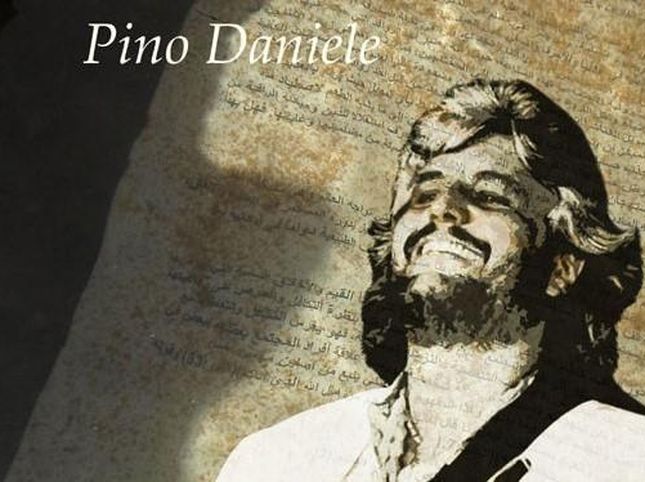
Pino Daniele: trip hop suite and a guitar given by Clapton
It arrives in all Italian bookstores on January 17th. “FEELING. Pino Daniele”, book by journalist Gianni Valentino, a sonorous and passionate storypublished by Colonnese, which comprises – through 12 “indispensable” songs (one for each month of the year), – a particular jukebox linked to the Neapolitan musician and songwriter who passed away ten years ago. The focus of Valentino’s book is multiple: Pino composer, Pino producer, Pino pacifist, Pino author of soundtracks, Pino interpreter of parlesia, Pino reporter and Pino fan of poetic swear words. The author investigates background and lyrical errors, bringing to light mysteries of albums, songs and artistic curiosities, also with the complicity, comments and declarations of a series of artists, professionals and youth friends of the singer-songwriter who passed away on 4 January 2015. Courtesy of the author and the publishing house, here is an excerpt from the volume, whose presentation is scheduled for Wednesday 22 January at 6 pm at the “Diaz” Institute in via Tribunali, in Naplesin the classroom dedicated to a very young Accounting student Pino Daniele.
From the chapter “’O FRA. December”: this part of the book is dedicated to parlesia, the coded language of Neapolitan musicians. A sort of self-defense from strangers, between dressing rooms and public places. “’O fra” is a memory song contained in the album “La grande madre”, Pino Daniele’s latest album (2012), focused on this linguistic experience.
The word Bagaria is an iconic expression of metropolitan parlesia already used in the liner notes of the album La torre di Babele by Edoardo Bennato, in 1976. In a sort of classification of operational roles and responsibilities, the Phlegraean guitarist-singer orders his organizational chart in following way: n.1 Maurizio Rosselli, sound engineer. n.2 Renato Marengo – bagaria. n.3 Gaetano Ria, sound engineer. n.4 Giorgio Bennato, external recordings. Among the exceptions that characterize ‘O fra in live performances there is, on the one hand, the fusion/psychedelic transposition, and on the other, the interpretation given by Raiz or Awa Ly. The parlesia lesson bids us farewell. Goodnight. Farewell to another sensorial dimension. Be careful, Pino recommends to his childhood friend Vincenzo Avitabile. ‘A serpe, i.e. parlesia, allows this emotional elastic between the two artists who, although physically distant, are in each other with the groove.
“This piece is Pino’s bullshit,” says Fabio Massimo Colasanti in the basement he took over after the death of Daniele, with whom he had a twenty-year collaboration. In the room, the mandoloncello from Terra mia, the Paradis guitar from Dimmi cosa happens on earth, the battente guitar from Un desert di parole (the africanite shared with Jovanotti) and, here and there, a series of vintage amplifiers survive. Even a Fender Twin received as a gift from Eric Clapton: “Pino goes from there into the second room of our studio and records the piece. At first it lasts about half an hour; the song is open, and he says whatever in that linguistic code. Then you file as you go, selecting, reducing, drying. Let’s clearly remove the little things that can’t be worn. Laughing. It’s all parlesia. It’s really better not to feel – said in a thoughtful and conscious way – the things we give up.” Enough, of course.
“He teaches me, so I punish him. Especially with the English, this tool of defense and conversation comes into play. “Pin ‘a jamma. It’s very cool”, says Pino. There’s a lot of funk-jazz in this song. Pino is exactly the one in this song. It is the real and concrete will. In Rome, a word to describe him would be cazzarone. He likes to have fun with music, with the sound of slang. Everything that has musical potential – words, voices, fragments, details, timbres, guitars – Pino takes and manipulates it to make it into his own matrix. And another content emerges. It all comes from his sense of fun. In the album there is no rhyme “c’avite rutt’ ‘o fuck!”. No, there isn’t. And how he laughed and we laughed in the studio during the recording.”
‘O fra resembles a trip hop/smooth jazz suite. Pino on electric guitar. Enzo Maestro Cenz on the saxella (set of sax and shawm, built specifically for him). The two of them enjoy it. Pino raps, he evokes the cave near the Ossario delle Fontanelle a few meters from the tavern where kids stop for food. This song concerns Pino Daniele’s discography like few other linguistic gems: from Tarumbò – for the Pope – to Mo Basta, from Just in mi to I Buoni Eccedi. The first two – Tarumbò Caribeño then becomes the title of the album of Caribbean-style Hispanic covers created by the Descarga Lab group, produced by Claudio Poggi: there is even El es un bueno guaglione – are included at number 4 and number 6 of the setlist of Bella ‘mbriana (1982). Tarumbò has a ballistic value because to all intents and purposes it is a letter that summarizes the sonic perspective of the guitarist from Santa Maria la Nova. On one bank there is the tarantella, opposite there is the blues. For most, this photograph illuminates an anti-papal criticism:
What a great jam, but you won’t understand
The boat appears and I don’t even hear it
Tarumbo, tarumbo
Don’t make us suffer any more
Tarumbo, tarumbo
We get only a smell to know
(…) And this bacon doesn’t give a damn about anything
Here we are crazy, we always love it, uh-uh-uh-uh
Yes, you know, I was there too
but I’m not going to do anything about it
no more simmo ‘and I’m off
we couldn’t do it anymore