
McCartney, “RAM” turns 55. The album, the history, the criticism
Registration ended April 15th
If “McCartney”, the 1970 solo debut, had been published in conjunction with the announcement of Paul’s departure from the group but had been made with the Beatles still formally united, “RAM” instead collected all the tensions accumulated by McCartney in the aftermath of such a difficult decision.
For the recordings of the album McCartney went to New York, where he arrived on 7 October 1970. The mini-band assembled for the recordings included two of the most active session men on the New York scene: Denny Seiwell (drums) and Dave Spinozza (guitar), who however was replaced after just one week by Hugh McCracken, whose work on the guitar would decisively characterize the sound of the album.
The album sessions took place first at Columbia Studios (October 16-November 20, 1970), continuing at Phil Ramone’s A&R Studios (January and February 1971) where string and brass overdubs were added to three songs (“Uncle Albert/Admiral Halsey”, “The Back Seat of My Car” and “Long Haired Lady”, arranged by George Martin) and “Ram On” was recorded.
In March Paul and Linda moved to Los Angeles, to Sound Recorders Studios, where they finished work on April 15, recording other songs (including “Dear Boy”), overdubbing instruments and vocal parts and taking care of the mixing.
The sessions were the most prolific of McCartney’s entire career with twenty-six songs recorded. In addition to “Another Day” and “Oh Woman, Oh Why?” – already released as a single on February 19th – and the twelve songs included in RAM, the sessions left several unreleased songs on the field.
From a stylistic point of view, “RAM” is characterized by a multiplicity of references and imprints, almost as if McCartney had no intention of being cataloged in any way. The tendency towards fragmentation became excessive in some episodes, and McCartney often resorted to the medley as an expedient to give vent to otherwise unusable ideas. If in “Abbey Road” McCartney had succeeded in merging the essence of pop music by combining it with the form of symphonic music, “RAM” also adopted
the same technique, but without the necessary discipline. The lyrics of some songs on the album seem to contain references and allusions to the Beatles affair. This aspect generated a lot of controversy and Lennon provided a polemical interpretation of the entire album.
Publishing, sales
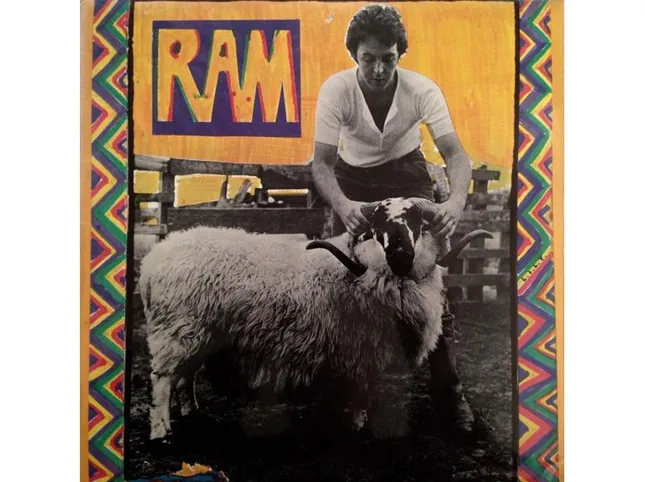
“RAM” was released on May 17, 1971. For the cover McCartney personally developed an artwork with motifs and drawings prepared together with Linda. Among these stood out the acronym LILY (i.e. “Linda I love you”) and the photo (placed on the back cover) of two cockroaches caught in the act of copulation: this was unanimously interpreted as symbolic of the unfriendly treatment Paul received from his ex-mates. For the main photo Paul had himself portrayed on his farm grappling with a ram (“ram”, in fact); a country image which did not help the good press of “RAM” and which, a few months later, would also tickle the imagination of Lennon, who would make a parody of it with a postcard included in the “Imagine” album.
As soon as the album appeared on the market, the public declared it a huge success. “RAM” reached No. 1 in England, even displacing the Rolling Stones’ “Sticky Fingers”. In America it stopped at number 2, blocked by Carole King’s “Tapestry”, but remained in the charts for thirty-seven weeks, obtaining platinum status, with approximately one million and 400 thousand copies sold. In Europe, overall sales of the album stood at around one million and 300 thousand copies.
The criticisms
Critics were generally neither enthusiastic nor in agreement about “RAM”. The opinion expressed by Jon Landau of “Rolling Stone” remains famous, as he wrote: “‘RAM’ is the lowest point in the decomposition of Sixties rock”. In the New Musical Express Chris Charlesworth gave it a hot review: “It’s a good album by anyone’s standards. The problem is that you always expect too much from someone like Paul McCartney.” Ike Legerwoods of “Disc & Music Echo” was far-sighted, but his was an almost isolated voice: “My first impression of ‘RAM’ was one of confusion. It seemed like a complicated, over-produced record when I listened to it in Tony Barrow’s office (…) In extremis, I put on headphones… the result is astonishing. Paul, you made a splendid album!”
McCartney’s former bandmates were extremely disappointed. Lennon did not half-measure: “It’s a terrible record! At least in McCartney there were some beautiful melody like ‘Junk’…”. Ringo was equally frank: “Paul is a brilliant and incredibly creative artist, but he disappointed me on this record. I don’t think there is a single good melody on RAM…”
Paul, however, was proud of it and commissioned the tribute album “Thrillington”. Recorded at Abbey Road between 15 and 17 June 1971 (and released in 1977 under the name Percy Thrillington, a fictional character), the record was an instrumental rendition of “RAM” in jazz/big band style. The cast was first rate: Richard Hewson (arrangements), Tony Clark and Alan Parsons (engineers), Herbie Flowers (bass), Clem Cattini (drums), Vic Flick (guitar), Steve Gray (piano), Roger Coulan (organ), Jim Lawless (percussion), the Dolmetsch (recorders) and the Swingle Singers (vocals).
The revaluation
Over the years, the opinion of the most astute critics has widely re-evaluated the qualities of the album, which today is almost unanimously considered one of McCatney’s best solo works.
However, the embarrassing reception obtained at the time of its publication by “RAM” somehow accelerated the process of establishing a new group, which McCartney had already had in mind for some time: the criticism therefore gave a further boost to Paul, pulling him out of isolation in his Scottish refuge. McCartney would contrast the elaborate style and sound stratifications of “RAM” a few months later with a more rustic and rough album, recorded almost directly with his new band Wings, a quartet made up of drummer Denny Seiwell, his wife Linda on keyboards and old friend Denny Laine on guitar. “Wild Life”, released in December 1971 under the name Wings, would mark Paul’s return to a band for the first time since the Beatles.
It wouldn’t have been an easy start: but McCartney’s project was designed to last over time. And in fact it still continues today.
Tracklist:
“Too Many People”
“3 Legs”
“Ram On”
“Dear Boy”
“Uncle Albert/Admiral Halsey”
“Smile Away”
“Heart of the Country”
“Monkberry Moon Delight”
“Eat at Home”
“Long Haired Lady”
“Ram On (Reprise)”
“The Back Seat of My Car”
HERE ALL THE SONGS ONE BY ONE
