John Lennon, what’s in the documentary about the last interview
Tomorrow evening at the Cannes Film Festival, Steven Soderberg’s documentary “John Lennon: the last interview” will be screened, created in collaboration with Meta and with the use of artificial intelligence (we have already written about it here).
In essence, the documentary illustrates in images the interview given by John and Yoko to RKO Radio on the morning of December 8, 1980, the same day as Mark David Chapman’s assassination. It is therefore the last interview given by Lennon while alive. Present were journalist Laurie Kaye, RKO music director Dave Sholin and sound engineer Ron Hummel, as well as Bert Keane from Warner/Geffen representing the record company.
The interview is already well known, both because it is available in audio on YouTube and because Keane wrote about it in her book, “Confessions of a rock’n’roll name-dropper: my life leading up to Lennon last interview”. The interest of the documentary, therefore, does not lie in its “historical” content but mainly in the curiosity to see what use Soderbergh made of artificial intelligence.
In the interview, about an hour and a half long, Lennon (and Ono) touch on many topics. Below, an extensive summary of John Lennon’s “last interview”.
John begins by describing a typical day:
“When we’re not making records and we haven’t stayed up too late, I get up around six. I go to the kitchen. I have a cup of coffee. I cough a little. I smoke a cigarette. The papers arrive at seven. Sean gets up at 7:20, 7:25. I watch his breakfast — I don’t cook it anymore. I get tired of that. But I make sure I know what he’s eating.”
He then explains that Sean can watch cartoons but not commercials (“Because it hypnotizes you — I don’t want him asking me for junk food every ten minutes, because his basic diet is quite oriented towards healthy food, even if I don’t make him suffer, you know? He can have his ice cream — preferably Haagen-Dazs, maybe once a week”).
And answering the question “How do you think the two of you — you and Sean — have grown from your extremely close relationship?”, John explains:
“I consider myself lucky to be able to spend so much time with him. But I took that time. (…) I don’t buy it, that ‘my career is so important that I’ll take care of the kids later’ thing. I already did it with my first marriage and my first son, Julian — and in a way I regret it. And now Julian and I have problems. God willing, I won’t have problems with Sean — or we won’t have any, Sean and I, later on. Or maybe we won’t. I know.”
And later he says:
“One day we were just sitting, lying on the bed together. Maybe we were watching ‘Sesame Street,’ or something. And he sat up and said, ‘Do you know what I want to be when I grow up?’ I said, ‘No, what?’ And he looked me straight in the eyes and said, ‘Just the dad.’ And I thought, ‘Ah, um, you mean you don’t like that I’m working now, right, and going out a lot?’ He said, ‘Right.’ I said, ‘Well, I’ll tell you what, Sean: Making music makes me happy. And I could be less… I could have more fun with you if I’m happier, right?’ He said, ‘Uh-hum.’ And it ended there.”
Sean’s theme continues for a while, talking about nursery schools, about English or American education (“I’m just trying not to impose really heavy discipline on behavior, just: ‘Don’t be rude; don’t hurt other people. And yes, you have to brush your teeth after you eat. When you eat, you eat. Then you play after. Not both at the same time.’ And regular bedtimes.”), and then Laurie Kaye moves on to the central theme: “I want to ask you about the moment when the desire to do things came back music…” (when Lennon and Ono released “Double Fantasy” more than five years had passed since the release of John’s previous album, “Rock’n’roll”).
John replies:
“All of a sudden I had, pardon the expression, a ‘diarrhoea’ of creativity. And in fact we went into the studio and cut about 22 tracks, which we then whittled down to 14. So I couldn’t wait to get back” (from Bermuda, where he was with Sean) “and start. Suddenly I had all this material. After five years of not really trying… but I hadn’t even tried. I had been very confined in the domestic environment and had so completely changed my way of thinking, that I didn’t really think about music. My guitar was hanging behind the bed — literally, and I don’t think I took it down for five years.”
Sholin hints at a possible creativity block, and Lennon explains:
“Ten, fifteen, almost twenty years under contract, and having to produce at least two albums a year – at least in the early days – and a single every three months, no matter what the hell else you were doing, or what your family life was like, or your personal life; it was like nothing mattered: you just had to get those songs out.
And Paul and I came up with a lot of songs in those days. And it was easier because it was the beginning of our business… you know, the relationship and the career. Paul and I developed in public, so to speak. We had done a bit of rehearsing in private, but mostly developed our skills in public. But then it became a format. And in a way it wasn’t the pleasure it had been.
That’s when I felt I lost myself. Not that I was on purpose, deliberately, being hypocritical or false, but… it took something away from what I set out to do. I had started rock and roll because I absolutely loved doing it. That’s why I ended up making a song like ‘(Just Like) Starting Over’. It’s a bit ironic. You know, it’s ‘weeeelllll, weeeellll-l’. It’s a bit Elvis-esque and stuff; and I hope people accept it that way. I think it’s serious work, but it’s also ironic, you know?
I mean, I went right back to my roots. The whole time we were doing it, that song, I was calling it ‘Elvis Orbison,’ you know? And it’s not about going back to being the John-Beatle of the Sixties, but about being John Lennon, the one whose life was completely changed by listening to American rock and roll on the radio as a child. And it’s that part of me that’s coming back, and that’s why I’m having fun this time. I’m not trying to compete with my old self, or with the young new wave kids, or anything like that that’s coming up. I’m not competing with anything. I’m trying to go back and enjoy it, like I enjoyed it in the beginning. And it works.”
At this point Lennon recalls the beginnings of the Beatles, the meeting with Paul McCartney, the arrival of George and Ringo. Then, requested by Laurie Kaye, he recounts the meeting with Yoko Ono at the Indica art gallery – without adding details to how we know the story, until the fateful night of “Two virgins”.
John:
“‘Two virgins’ was the start of the whole mess. ‘What are they doing?!?!? This Japanese witch drove him crazy, and he went out of his mind!’. But all she did was bring the crazy part of me out of the closet, you know, the one that had been inhibited on the other side. It was a real total relief to meet someone else who was as crazy as me, you know?”
The interview continues exploring the mutual artistic influence between John and Yoko, the equal collaboration in “Some Time in New York City”, the joint initiatives for peace.
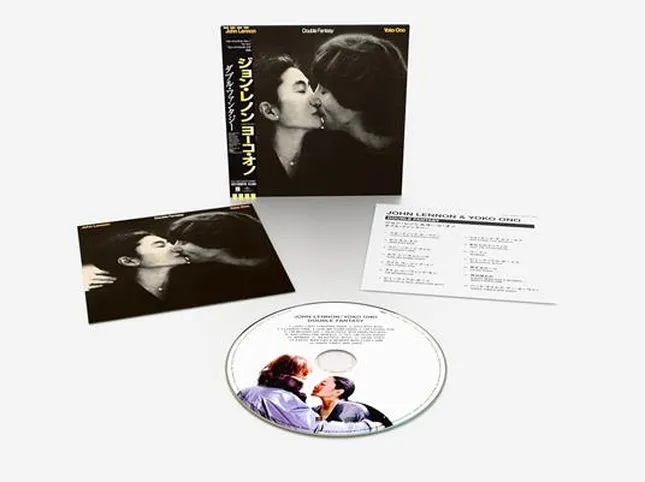
Then we get to “Double Fantasy”, the couple’s album that had been released a few days ago.
John:
“We feel like this is our first album. I know we’ve worked together before; we’ve even made albums together before. But we feel like this is the first album. I feel like… for us… nothing has happened before today.”
Dave Sholin: “The album title?”
John:
“We were in Bermuda, at the Botanical Gardens for lunch, at an Italian restaurant, because I could get an espresso and Sean could have some junk food. And I was just walking, and I looked down and in the botanical garden it said ‘Freezier Double Fantasy,’ and it was flowers.
And I just thought, ‘Double Fantasy — that’s a fantastic title!’ Because it has so many meanings that you can’t even begin to think about what it means, so it means whatever you can think of. I mean, it’s a double team. It’s real life but it’s still fantasy because now it’s in plastic and in photography. And it’s fantastic! It just seemed perfect as a title for the album. And there are two of us. And somehow it says it all — without really saying anything, it says everything. And it’s a flower, actually.”
Lennon then explains that the ringing of a bell at the beginning of ‘Starting over’ is the optimistic reflection of the death knell that opened “Mother” on the album “John Lennon – Plastic Ono Band”: “And the eighties are like we had a new chance, you know?”
John recalls the separation from Yoko (“It’s Yoko who kicked me out. I didn’t leave saying: ‘I’m going to be a rock and roll bachelor’. She literally said to me: ‘Go away’. And I said: ‘Oooooh, ok! I’m going!’”), talks about the album “Walls and bridges” made during the infamous “lost weekend”, about his reconciliation with Yoko, then he returns to “Double Fantasy” talking about the song “Woman” and the importance of women.
John:
“The song is for Yoko, but it’s for all women. Because my role in society — or the role of any artist or poet — is to try to express what we all feel. (…) It’s like this is the artist’s job in society: Artists have to reflect what we all are. That’s the point — artists, or poets, or whatever you want to call them.
And that’s what I try to express on behalf of all men to all women, through my personal feelings about women — when it became clear to me: ‘God! They are the other half of the sky’, and without them there is nothing. And without us there is nothing. There are the two, together, who create children, create society.”
We discuss at length present and past history and literature, the Sixties, Idi Amin and the Ayatollahs and Margaret Thatcher, George Orwell and Aldous Huxley, current music (John: “Even new wave will be old one day”), and the possibility of a tour:
“I want to make more records before I go on tour. So I would like to make at least one more album before I actually make that… that final decision to call up those very expensive studio musicians and take them on tour, you know? (…)
But when we were playing in that studio… and then, I don’t know if it was Tony, the bass player, or the drummer, after we had done ‘Starting Over’, he said: ‘Can we do it again? I mean, let’s take her on tour!’ And I… it was the first time it occurred to me, ‘My God, that would be fun, right?’
And if we can do it the way we did the album, which is having fun, enjoying the music, enjoying the performance, being accepted like John and Yoko, then I’d be happy to go out there.”
Unfortunately, it wasn’t possible for him.