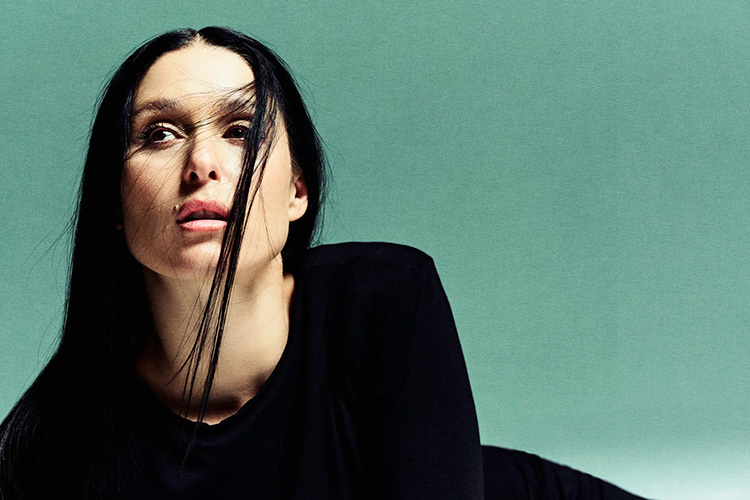
“It’s a domestic album, but violent”
There is something deeply optimistic about bringing a life into the world. Also something strange about discovering that, while a person begins to exist, the one who already existed has to learn to recognize himself again. Between those two shores it moves “Damned” (Frantastic Records, 26), the seventh album by Francisca Valenzuelawhich will be presented in a few days in our country.
(Check the dates of his tour in our country at the end of this interview).
Francisca Valenzuela He has been writing since he was thirteen. His first collection of poems was prefaced and recommended by Isabel Allende, and the second, a volume of short stories, ended up published by Plaza & Janés. Many of his texts became songs, and those songs became number ones. You now have two notebooks. In one he writes down ideas. The other began as a log in which she noted what time she had breastfed her daughter, how much she had drunk, what had happened, what was next. “It’s my breastfeeding log, and I had no idea that this topic was so complex. Suddenly I started writing down all the things, and the notebook was filled with that neurosis, that incessant loop”explains to us:
Friday March 7.
1:30 AM, 90 ML, extraction.
5:20 AM, diaper change.
5:30 AM, 70 ML, extraction.
7:00 AM, 50 ML, formula.
7:20 AM, poop.
(…) Difficult day with sleep.
“You have to read this out loud,” his producer told him. Francisca began to do it and, when she finished, the proposal arrived: “What if I edit it?” This is how “Extraction” emerged, one of the most particular compositions of “Damned”. In it, influenced by the analog textures of Wendy Carlos and the spoken word of Laurie Anderson, Francisca speaks, recites, accumulates words, turning that log into a piece that she herself defines as “an uncomfortable listening experience.” There is no shelter for the listener because there was none for her in the middle of the night. “I showed it to very few people, and they told me that people were not going to understand it, but it was my way of showing desperation.”
“Anything that can be provocative or critical of motherhood seems to make you a bad mother.”
On the album, that need to find a way for what he was experiencing returns again and again. “How can I illustrate this?” he wondered. “I am not a filmmaker, I am not a painter, but writing is my tool to connect, understand and organize my internal dialogue. It allows me to get out of a feeling of suffocation, giving it language, form and meaning”. A refuge to return to when everything else seems uncertain and to which it refers, with a mixture of seriousness and naturalness, as “a tool of prayer.”
Behind that count of milliliters and sleepless nights lies the weight of disappearing as a person when you become a mother. “I feel like it’s very romanticized and told in a very one-dimensional way,” comments Francisca. “As a woman is always left behind her motherhood. This album vindicates the woman behind her.” Talking about exhaustion or discomfort breaks the idyllic image and immediately activates external judgment. “Anything that can involve something provocative or critical of motherhood seems to make you a bad mother, someone who should be ashamed, who is problematic.”
From there the different themes that run through the album appear. Francisca wants to be with her daughter and, at the same time, there are moments when she wants to escape. She wants to care and also work, be present and be herself again. “Being with my daughter fascinates me and gives me life, it nourishes me. And at the same time it exhausts me and I don’t want to,” confess about that duality. “It’s like: I want to be with her and I don’t want to be with her all the time. And then all I want is to get out there, do my job, do my life and be with me, it’s something new, beautiful and challenging. And in my case I speak from the privilege of having a chosen, supported and cared for motherhood.”
Music ended up functioning as a way to recover that own space. “It has given me the opportunity to count on myself, count on my value and my identity as an artist.” The songs were born within that new reality, while the baby slept and the producer worked by her side. “We integrated the studio at home, and I also speak again from the privilege of having a caregiver come for a few hours and the producer having a flexible schedule. We stole hours here and there. For example, “Bugambilla” we wrote and recorded in two hours.”
In this album he explores his fears, but also his securities. One of the most complicated topics to discuss was “Don’t Get Bored of Me,” in which she was overcome with panic that her upbringing would end up devouring her desire and complicity with her partner. “It’s a total fear”he admits bluntly. “A fear that they will regret being with you. That you will feel that you are no longer desirable, that you are not someone interesting because you are hidden under this loop. The other person goes out into the world and comes back with new things, and you are still exactly in the same place where they left you.”
Right from this topic there is a change of direction within the journey of “Damned”, a structure designed to begin in one place and end in another. “I appreciate that you notice. That is the structure that I put together in the order of the songs, precisely. That that was the hinge,” confirms Francisca. It is the passage from shadow to light, which she herself defines as “cursed/blessed.” A territory where they coexist “the unusual and the comforting, the beautiful and the brutal, the terrifying and the luminous. It is a domestic album, but violent. It has that duality and, at the same time, it is very free, very artistic.”
The music then opens to tenderness and reunion. The complicity of “I was born needing you” appears, the shared pulse of “New Year”, written in four hands with her partner on the girl’s first birthday, or the serenity of “Komerobi”, that Japanese term that describes the sun’s rays filtering through the leaves of the trees. The song relies on the trip hop textures of Massive Attack, Air or Sneaker Pimps. Francisca does not seek heroic redemption, but rather a truce with fragility. The artist recognizes herself in the reconstruction: “More than trying to be an album with songs that everyone is singing on TikTok, it has to do with a photo of a moment, a context and a process. It is a personal journey, but also very universal. It is the story of collapse and rebirth.”