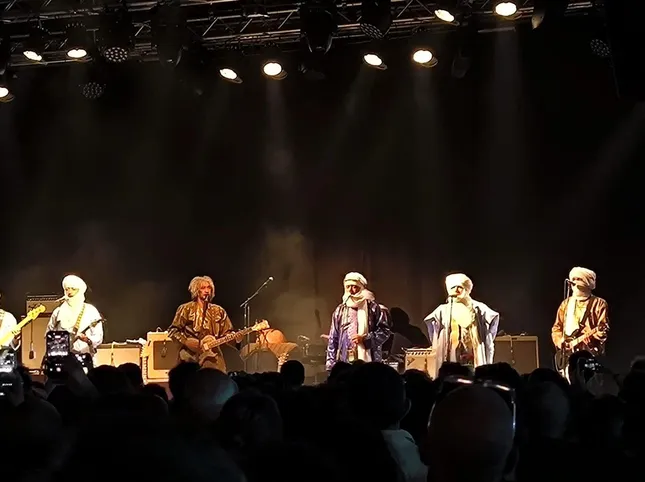
Getting out of your comfort zone with Tinariwen
More than a world music listening experience, a master’s lesson in applied ethnomusicology. A form of sonic resistance. Let’s talk about the concert of Tinariwen – the Malian band pioneer of Assouf (the nostalgia of the desert) – which they bring to the stage ofAlcatraz of Milan an acoustic ecosystem where the Western electric guitar is completely decolonized and put at the service of age-old metrics.
The fingerpicking of the Sahara
The beating heart of the performance lies in the intertwining of the guitars. Unlike Delta blues or psychedelic rock, to which they are often lazily compared, Tinariwen uses a modal and hypnotic. The guitars never move on the classical lead/rhythm hierarchy we are used to; on the contrary, they build a carpet of circular riffs that fit together perfectly, creating an induced trance effect.
The use of minor pentatonic scales is enriched by microtonal inflections typical of Tuareg traditionrendering the phrasing alien and familiar at the same time. The sound is not distorted, rather the focus is on reverb, to simulate the breadth of the open spaces of the Tassili n’Ajjer (in Berber it means “Tuareg Plateau Kel Ajjer”, it is a mountain massif in the Sahara desert).
The audience is part of the band
One of the most complex technical aspects for a Western listener to internalize is the time management. Let’s imagine the movement of a camel, which seems limping but is actually constant and unstoppable: well, the rhythm at Tinariwen concerts is more or less like this.
The bass and percussion (reduced to the essentials: a darabouka, a calabash and hand clapping) create a constant rhythmic tension which pushes the audience to dance, without ever exploding in the liberating climaxes typical of rock. Clapping is not an ornament, but an orchestrated added percussion, which defines the strong beats and guides the choral response. The leader – who changes, there is not a single frontman at the center of the stage for the whole concert, even if the founder Ibrahim Ag Alhabib he is clearly the leader of the group – he launches the verse and the choir responds with vocal harmonies reminiscent of nomads’ songs around the fire.
This collective dimension is fundamental. The concert wants to be (also) a ritual dialogue in which the audience stops being passive observers to become an integral component of the band’s sonic architecture. This participation is not expressed through the usual sing along of Western pop rock – also because it is hindered by the language barrier of Tamashek – but through a rhythmic and spiritual synchronization.
Audience participation is a catalyst for transcendental dimension of their music. The more the audience abandons themselves to the flow of the guitars, the more the band tends to expand the instrumental sections, transforming the set list into a continuous flow where linear time dissolves.
A political cry
Tinariwen’s latest album, HoggarAnd necessarily politicallike every one of their performances. Ibrahim Ag Alhabib was only four years old when he witnessed his father’s execution at the hands of the Malian army during the 1963 rebellion. Growing up in exile, he built his first guitar with objects picked up on the street: a tin can – or, depending on memory, a plastic bin – a wooden handle and a bicycle brake wire. When this is your past, your present and your future can only dedicate themselves to claims.
Erghad Afewothe third track of the album, explicitly curses the Wagner group for the political instability of the quadrant, of which the Tuareg population is one of the silent victimsforgotten by the media and the rest of the world. In October 2024, the Tinariwen were forced to leave Mali and temporarily find refuge in Algeria. Now Ibrahim is almost 70 years old, but he still looks great on stage, and he doesn’t intend to stop making his, their land, still tormented by violence, known.