David Bowie: practical guide to the non-exhibition in London
A room with nine noticeboards containing objects linked to different phases of David Bowie’s career, a LED wall that reproduces clips of historic performances or videos of the White Duke’s hits, a series of clothes and costumes – twenty in total – hanging from the ceiling, kept in special bags. This is how the section presents itself to visitors V&A East, London which hosts the exhibition-non-exhibition dedicated to the rock star who passed away in 2016. And one immediately wonders: “Is that really all there is?”. Of course not. There is a misunderstanding basically, in the way in which the media presented the imposing project hosted by the branch of the Victoria and Albert Museum located in the not exactly central Queen Elizabeth Olympic Park in Stratford, an hour’s journey by public transport from the center of the British capital: the David Bowie Centerwhich was inaugurated last September 13th, it’s not exactly an exhibition like the “David Bowie Is” one that toured the worldfrom London itself to New York, passing through Toronto, Sao Paulo, Berlin, Chicago, Melbourne, Tokyo and even Bologna (over 130 thousand visitors between 14 July and 13 November 2016, the year of the disappearance of the voice of “Heroes”). The title itself says it: is a center dedicated to David Bowie, designed for fans, enthusiasts and scholars.
It’s not an exhibition
Moreover, the term “exhibition” does not appear anywhere in the official descriptions of the V&A East, which instead speaks of “permanent archive“. Theentry is freebut tickets must be booked on the official website of the V&A East: they are released every six weeks and sell out within a few days, such is the curiosity that, almost ten years after his death, continues to surround David Bowie, especially in the United Kingdom. Last Tuesday, those allowing you to visit the David Bowie Center from 26 October to 1 February 2026 were released. The little that is shown on the nine noticeboards, such as the Aladdin Sane red jacket with the lightning bolt designed by Freddie Burretti for David Bowie on the occasion of the “Ziggy Stardust live tour” in 1973, that teal color worn by the musician in the video for “Life on Mars?”musical instruments such as Korg keyboards and synthesizers, lo sheet music of “Fame” and the handwritten lyrics of “Fascination”.is actually only a very small part of what makes up this archive.
But where are the objects stored?
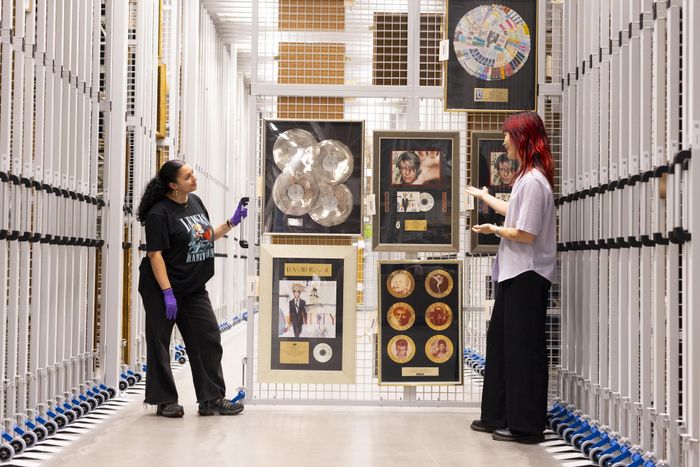
The objects, 90 thousand in totalare stored in the V&A East warehouses: visitors can request “close encounters” with the objects by making a request, obviously weeks before the visit, by filling in specific forms which must be examined by the staff of the London museum. The most requested item, the organizers say, is the iconic jacket reproducing the theme of the United Kingdom flag that David Bowie wore on stage at Madison Square Garden in New York for the concert organized to celebrate his fiftieth birthday, designed by Alexander McQueen. Among the objects preserved are the first musical instrument David Bowie ever owned (a saxophone given to him by his father in the early 1960s), iconic costumes, sets, life-size puppets made by Jim Henson which reproduce the various characters played by Bowie for an unpublished music video, a vast collection of writings, sketches, storyboards, handwritten and unpublished texts, digital works of art, sheet music and private letters from Bowie that bring out interesting sides of his creative process and the ideas behind some of his epochal projects.

The unreleased musical
Among the unpublished projects revealed to the public thanks to the operation resulting from the collaboration between David Bowie Estate, Blavatnik Family Foundation and Warner Music Group, there is also a musical on which the rock star continued to work until his death, which remained unfinished: entitled “The spectator”, was set in Covent Garden in 1700 and opened with the dramatic, real-life public execution of the infamous criminal Jack Sheppard on 16 November 1724. Tristram Hunt, director of the V&A, underlines: «We’re thrilled to be curating Bowie’s incredible archive, revealing new insights into his creativity and legacy, and making it accessible to all at the V&A East Storehouse». Madeleine Haddon, curator of the V&A East, adds: «Bowie was a multidisciplinary creative, a pioneer – musician, actor, writer, performer and cultural icon – who worked in a way that many young creatives work today, moving fluidly between disciplines. Works such as “The spectator”, among other projects hosted by the archive, reveal his ongoing drive to experiment with boundary-defying ideas and creative forms throughout his life and career, as well as his meticulous creative process, which visitors can delve into».