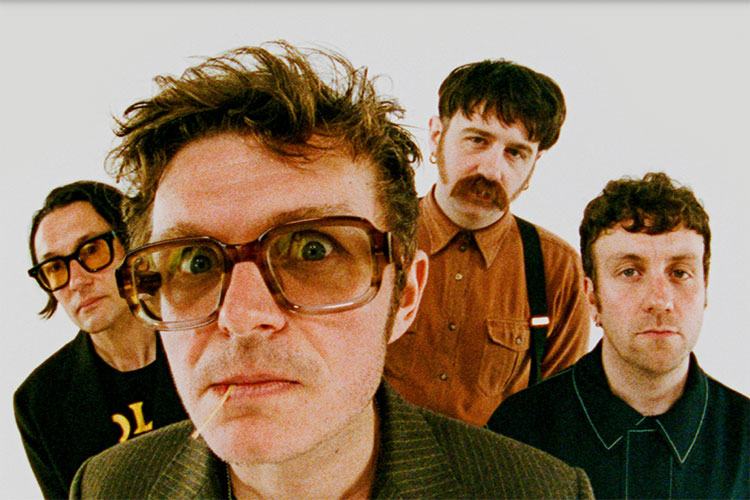
“A lot of the rock music you hear today has nothing rebellious about it”
“You’re Gonna Need A Little Music” (Island, 26), the third album by the Leeds band, shows a band strengthened by their mastery of live performances, but with a renewed jovial spirit. Yard Act They will play in Barcelona and Madrid this October.
(You can check their dates in our country at the end of this interview).
The quintet’s new album came out in the summer without making much noise. About to embark on the second part of the North American tour, an always charming James Smith talks to me from his home about the new LP, his relationship with live music and… Goya’s Black Paintings.
“There are people who have commented on the connection between the new album and the first, but I don’t see it as much.” -he tells me-. I guess the recording process was simpler than the second one. And we committed to the ideas earlier, rather than revisiting everything, because we all did it together. All of this meant that we had to make decisions in the moment. That feeds a different drive. After all the hours we spent layering and remixing the second one, we needed this, and I think it works in our favor.”
Becoming such a solid group live has been key. “The first one couldn’t have sounded like that, because we did it essentially in lockdown. We hadn’t played as a group, we were learning how to play it. I don’t regret anything and I can’t go back, but it’s a shame we couldn’t capture that then. A record captures a moment, then you move forward, and I can’t complain. The second one caught us constantly spinning, and that’s why we started making so many demos. Now, after four years of playing and being pretty good, we had the time and energy to do it like that.”
“We are too self-critical to be true rockers”
Produced by Justin Meldal-Johnsen (Beck, Nine Inch Nails) between the group’s studio in Leeds, a church converted to record in the same city (The Nave), and Los Angeles, for James it was “a real luxury. We had never spent more than two weeks in a studio, so at first it seemed like we were going slow. But making the decisions at the beginning led us to finish it much faster.”
The very direct title is “cheeky, a bit of our thing. I would go so far as to say that music has saved my life. It has changed me, of course: it has forged friendships, loves… it is the soundtrack of breakups too. It has the power to remind you of the past with complete clarity, and to give you hope for what is to come when it hits you at the right time. Music and laughter create the strongest bonds. Food is probably the third most important thing. It is good for the soul.”
By the way, the post-punk label hasn’t done them justice for a long time, and this album sounds more to me…”rocker”I tell him. Is it a heresy? “If someone who doesn’t know us asks what we do, at my son’s school or wherever, I always answer “rock.” It’s funny, because you could think of Guns’N’Roses or Led Zeppelin, and it’s not that – although Sam (Shipstone, guitarist) loves Led Zeppelin. Now we have some slightly bluesy riffs that are also a little Zeppelin. Rock has a certain braggadocio in which, if we fall into it, it is with irony: we are too self-critical to be true rockers. The fantasy of rock is to be the mold of a rebellion, and the reality is that a lot of the rock music you hear today is not rebellious at all: it is essentially pop with bright guitars.
That said, the singer admits that the guitars may be more at the forefront on the new LP than on the second, in which there were more beats and keyboards. “Each record has been led by a member, and I think this is Sam’s record. The first was Ryan’s (Needham, bassist), and the second was mine and Jay’s (Russell, drums).”
The (musical) darkness, in relation to what is so volatile that is classified as “post-punk” is not something that keeps you up at night. “I’m not afraid to take on the darkness – not the group The Darkness, let’s be clear (laughs) – but for me things don’t work if you stay in one tone. An album is not complete if it doesn’t have a little hope. The same with a novel or a movie. If it’s all desolation, it’s difficult to revisit. An entire album can do it. And this album has ups and downs in a dramatic way, like a kind of ping-pong.”
And it is that “Super powers are changing, there are imminent nuclear and climate threats, all of that is there. But at the same time, humans find ways to have fun. On your cell phone you see kids blowing up, but then you get a meme and you laugh. I think humanity is at that point, which is twisted. But there we are.”
The pressure they felt at the beginning, when they had to “try something and make everyone happy” It is no longer so pronounced for them. I also say this because of the number of (good) albums that come out every week and with which, whether they want to or not, they compete. At least at the attention level.
“You have to pay salaries and sell tickets, but the idea of competition is in the rearview mirror. I struggle with new releases because I don’t think records can be discovered right away. The only thing you can do is commit to your ideas and put them out. We’ll see if they stand the test of time.”
“The choreographies limited us in terms of repertoire”
The singer claims to have “A strange relationship with this album, because we are playing it and promoting it, but it ended in January. The world can hear it now and it will find its time, whether now, next year, never or in twenty-five years if we are still here. You can’t compare yourself to what anyone else does because it’s irrelevant. And it’s not healthy.”
On this imminent tour that takes them first to the United States – where they will complete the second part of the tour – and then to Europe and the United Kingdom, they will not have the singers who animated their previous live festivals. “The choreographies and all that were great, but they limited our repertoire, and we wanted to be very loose again. We have 38 songs and we change them every night. That way, the group stays fresh. It’s very difficult for me to always do the same thing. I find it very monotonous. There was a certain skepticism about changing so much, but when we started doing it we saw that it was going better for us. There are moments that can be a downer, but when it’s cool, it’s much more effective.”
Smith is surprised that “There are groups playing the same set for years. You see them and realize that they did the same one two years before at another festival. How do they not bang their heads on the floor of the stage? That drives me crazy, but it’s my problem. They get paid and have a good time.”
The best of spinning “It’s the gig and when you have time to see something great. The last time I was in Madrid I had time to see Goya’s Black Paintings (he shows me a reproduction of the mythical painting of the semi-sunken dog). When we play in Minneapolis we are going to visit Paisley Park, (the home and studio) of Prince. The worst thing is being far from home, and traveling is very tiring. But it’s the price you pay. I have a fun life. I’m not complaining.”
If there is one union that Brexit hit hard, it is musicians. How do they handle it at this point, once the disaster has stabilized, when they face a tour of this level? “One of the reasons we signed for a major is because we needed money in advance. Right now it’s not an option to tour Europe without the backing of a label. You have to get fucking ID cards at the airports. I don’t know if you’ve experienced the trauma of being stopped at the border and having your list of things checked to make sure you’re not smuggling things…it’s something that takes a lot of effort. You have to wait hours at the borders. But we can’t control it. It’s not something any musician would want. that rotates, because it makes things more difficult.”