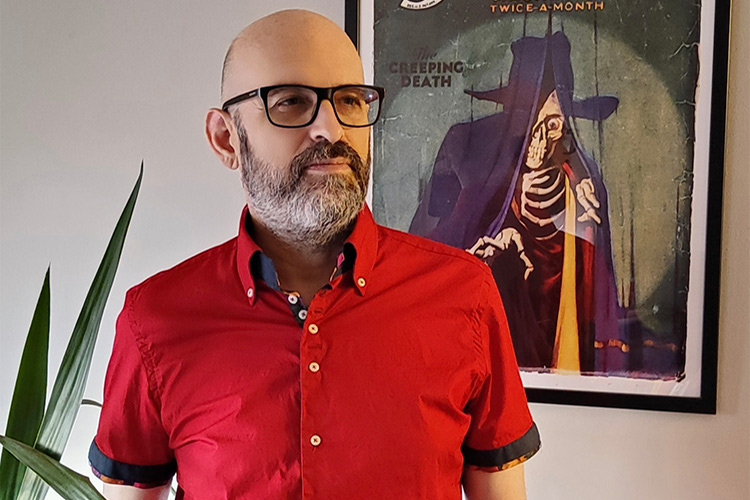
The albums of my life by the comic artist Luis Bustos
Born in Madrid, although settled in Barcelona, Luis Bustos He is one of the most prominent comic authors in our country.
To make a statement of that caliber you need evidence, and that is something we can demonstrate with titles like “Endurance” (09), the adaptation of “Fariña” to graphic novel (19) or the various volumes of “Garcia!” with Santiago García. But it turns out that Luis is also a great fan of that music that he likes as much as, at times, it makes him uncomfortable.
Taking advantage of the launch of his comic “Plateau” (Astiberri, 26), we asked him about those albums that, in one way or another, changed his life. This has been the result:
Sputnik – “Flaunt It” (1986)
What child isn’t going to like a cyberpunk baptistery? In the Frankenstein tradition of building a virtual band, a simulacrum and direct vehicle to the charts, SSS They have a special place in pop music and in the heart of a kid who loved that ultra-technological, cheeky and futuristic romantic image. Suicide with commercials, go-go sampling, space glam-rock, port skies tuned to dead channels and fifty-foot geishas projected on screens. The future is not what it was.
The Clash – “London Calling” (1979)
It’s not very original to say that at the age of fourteen my entry into punk was the Sex Pistols, Ramones and the self-titled debut by The Clash. Urgent and youthful music. In that period of search and self-knowledge I discovered the London band’s third album by a renowned music magazine that ranked it as the best album of the eighties, and yes, that was something else. A true giant leap and a journey through the history of popular music. On its double vinyl at a regular price, it combined political denunciation, rockabilly, internationalism, soul, social portraiture, ska, pop and, of course, punk. And as a gift, “Train in Vain”.
Big Black – “Songs About Fucking” (1987)
I met Big Black through the comics of Miguel A. Martín in the middle of the grunge drift in the nineties, when my body asked me for a more “Ballardian”, visceral and nihilistic approach to punk. The combination of guitar, bass and drum machine had its great farewell on this album and would open the door to new projects by Steve Albini such as Shellac. Raging, accelerated, heartbreaking, viscous and mechanical. Its fourteen violent post-punk songs, including “The Model,” the magnificent Kraftwerk cover, would shape the so-called “industrial rock.”
Lou Reed – “Magic & Loss” (1992)
At a time when I had recently lost my father, what would ultimately be the last great work of the curmudgeon of Lou Reed. “Magic & Loss” It is an album about struggle, loss, farewell and acceptance. A mortuary journey and elegy for a friend who died of cancer. A beautiful conceptual album that impacted me in such a way that years later I have not been able to listen to it in its entirety again. In him there is a maturity and a perspective on what gives you and takes your life as only the years of a chronicler in a state of grace can give them. It is not a happy album, but it is hopeful. “There’s a bit or magic in everything and then some loss to even things out.”
Godflesh – “Selfless” (1994)
With the passing of Kurt Cobain, something broke in the independent scene and, personally, I was already navigating other territories. More experimental, more extreme, recovering some of the old taste for metal and fusing it with avant-garde electronic proposals. It fits there godflesh and this contradictory album (the cover: a cell growing on a microchip). Ethereal and earthly, dense and simple, spiritual and nihilistic, but, above all, forceful. It is not the best that the band released, as they were trying to make concessions taking advantage of the success of artists like Ministry or NIN. Still, this almost schizophrenic duality made me fall in love instantly.
VV. AA. – “Isolationism. Ambient IV” (1994)
Despite listening to all kinds of genres, little by little I was leaning towards electronic artists and projects on the margins of the industry. This forgotten compilation produced by Kevin Martin introduced me, as another compilation would “Strategies Against Architecture II” by the Germans Einsturzende Neubauten, in a wasteland that is sometimes evocative, sometimes terrifying, through a parade of ambient pieces, industrial dub, Cronenbergian pop and apocalyptic noise by artists who, if you tell them they make pop, they look at you strangely. The 20th century was ending and we were playing to guess what the 21st century would be like.