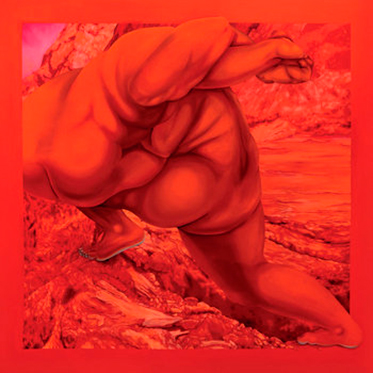
‘Dja Dja’ is Marina Herlop’s masterpiece
The last time I set foot in the wetlands of Punta del Fangar, at the northern end of the Ebro Delta, I decided to sit on the top of one of the dunes, shaped by the wind and at the mercy of the waves, whose remains of ancient living beings stand today in fragments. What a surprise I was when I noticed that its physiognomy—liminal space, halfway between land and water—exerted an influence identical to that of the desert described by Saint-Exupéry in “The Little Prince” (43) works on the aviator: hours, minutes and seconds are suspended.
I then had the idea of giving sound to my loneliness by playing the fifth album of Marina Herlopoblivious to the state of trance to which it would ipso facto induce me. Because “Dja Dja” (26) It is the work of an artisan determined to slowly forge the impalpable genius of her mind; offering to the god Apollo endowed with the ability to open a gap in the space-time of whoever listens to it. That is, taking the listener on a journey to a fantastic realm where the physical environment in which one chooses to enjoy it makes all the difference. Basically due to the high level of concentration required to absorb the energy released by its fifteen songs. Which, in my opinion, equal the pleasure that literature provokes when we open a book for the first time and it unlocks access to a new world.
In fact, “Dja Dja” It is so magnetic that it captivates you from minute one. When “Flower of the cliffs” It inaugurates it by caressing us melodically, reducing cortisol and displaying a mental map of the dimension in which we will find ourselves from now on: a kind of infinite grove where symbols are multiple and at the same time concrete and abstract. Here, audience and author—heroes of the journey—seal the pact with which both renounce their old self to welcome the transformed ego, highlighting that, then, the majority of harmonic progressions will dialogue with each other, trying to structure the album in a similar way to what Extremoduro proposed in “The Innate Law” (08): an uninterrupted symphony. In this regard, Herlop reveals very soon—with “Frost”— its morphology, which appears to have been designed with the pretext of imitating the mechanism of dreams. Since, as we progress, the pace accelerates and the abstractions, sound or imaginative, intermingle. Hence “As meigas” replace the initial tone with a more violent one as a result of the percussion that comes into play, accompanied by choral screams. The whole set unleashes the Babylonian concatenation of themes that continues with “Vas volant”; digitally processed sounds that suggest the image of chimeric organisms playing conventional instruments.
Maybe that’s why, from “ツラ” bucolic instrumentals take center stage; Marina links them, raising a spiral that ascends and descends before announcing the beginning of the conflict between antagonistic forces that covers the second half of the album. Especially in “The two wolves” and “Average Evil”. Something noticeable thanks to the emergence of winds, castanets and bass drum, swords and guns ready to reinforce the idea of danger simultaneously with that of rage or injury. Be that as it may, “Lilit”, “You’ve Lost Your Muchness” and “There are angels” They then appear interspersed with the purpose of playing with the listener’s emotions by projecting the melancholy and introspection that complete the experience. Finally, and prior to “Bliss”, “Thálassa!” anticipates the surrender to the dream as a way of transit towards reality, our reality, which culminates in “Very Frosty”. So, by the time we realize it, we wake up from the coma that has managed to keep us fully alert for almost an entire hour.
That said, I only need to develop my mention of Punta del Fangar. In addition to being the place that I chose to give myself to Marina, it is a corner of the planet that, in my opinion, illustrates in a very graphic way what it is. “Dja Dja”. Since, comparable to what its fifteen pieces raise, the Ebro Delta is a natural stronghold with the Mediterranean as its archenemy that fights tirelessly to stay afloat. Which means that it perfectly symbolizes the opposition between opponents that Marina materializes in the defense of her own principles. At this point, I conclude by assuring the reader that Herlop has signed his masterpiece. And from afar.