
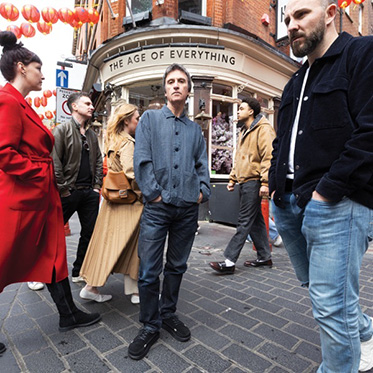
We review ‘The Age Of Everything’, Johnny Marr’s new album
Johnny Brown He will go down in history as the inspired guitarist and compositional half (along with Morrissey) of The Smiths, clearly one of the most personal and essential bands of the British alternative scene. A high title that no one would dare to dispute, in the hands of an artist who, after a discreet first approach to what could be considered his solo career – disguised under the signature of Johnny Marr & The Healers in “Boomslang” (iMusic, 03) – took a decade off (beyond a good handful of collaborations), before finally taking off with the notable “The Messenger” (New Voodoo, 13).
The adventure in question included few surprises (beyond hearing the musician’s voice definitely unleashed with agility) with indie-pop of (of course) guitars and a typically British style, at the service of a good set of songs. A formula that the Mancunian has been repeating in subsequent releases, divided between an additional target with respect to that premiere – in the case of its continuation, “Playland” (New Voodoo, 14) – and the subsequent displacement towards innocuous sensations and inert waters concretized in the warm “Call The Comet” (Sire, 18) and “Fever Dreams, Pts. 1-4” (BMG, 22).
English now presents a continuous work with respect to the latter, reaching with “The Age Of Everything” which is already his fifth studio album. A work that, in practical terms, looks as impeccable in form as it is repetitive and inconsequential in substance. With an eye on the circumstances that define the current social scene on a lyrical level, Marr focuses on his proposal with such stubbornness (or lack of additional ideas) that only his always valuable guitar lines seem to be able to rescue him from that somewhat comatose state that a good part of these forty-five minutes induce.
“The Age Of Everything” It is, above all, a predictable album to the maximum degree, in which nothing ever ends up happening despite the fact that there is room for a handful of good songs like “Beyond The Rain”, a “It’s Time” with echoes to the mother band or “In And Out Of Love.” Pieces that are all simply solvent, placed within a decalogue that, together and interspersed with companions of reference that are much grayer, easier and, ultimately, obvious, seem too poor to awaken any kind of euphoria. An album far from a major disaster, in short, but one that will be difficult to remember in a year.
