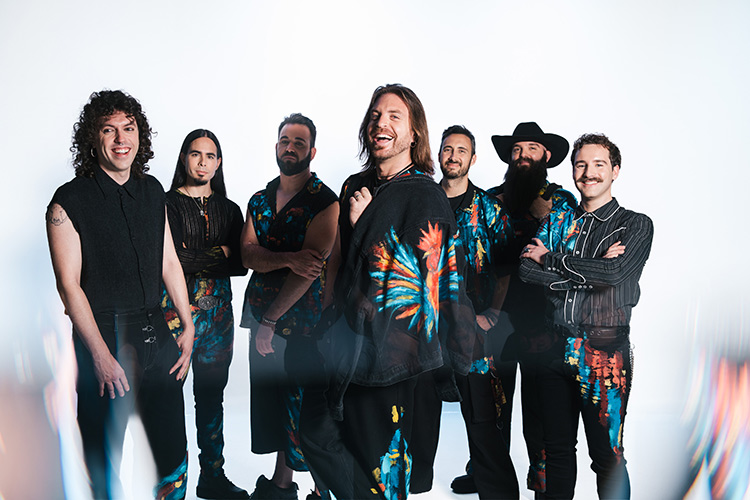
“We like partying, but we are also a protest band”
Continuing with its tireless pace of releasing a new studio album every almost two years, Lepoka they return with “Animal rebellion” (Calaverita, 26).
Conceptually, these thirteen cuts are inspired by “Animal Farm”George Orwell’s classic. Musically, they continue to fuse folk with elements of urban rock, metal and punk, always in their characteristic festive tone. We will have them back on stage soon. Meanwhile Jaume, the drummer of the Castellón band, answers our questions.
We can see them in Ludiente (October 9), Madrid (October 10), Pamplona (December 19), Bilbao (January 23, 2027), Barcelona (January 30), Valencia (January 31), Valladolid (February 5), Vigo (February 6), Seville (February 13), Málaga (February 19), Murcia (February 20), Madrid (March 6), Alicante (March 13) and La Vilavella (April 24). In the middle of the tour, this October they will visit Mexico to perform in Guadalajara (October 23), Mexico City (October 24 and 25) and Monterrey (October 28).
Between spring and summer, your tour La Última Ya Casa 2026 took place. When was “Animal Rebellion” recorded?
It began recording well before the La Última Ya Casa tour. In fact, the tour comes because it was the first single we released as a preview of “Animal rebellion”and since there was still a little bit of production time left, to finish recording and working on the songs, we decided to start a tour presenting the singles, the previews of the new album, but in the meantime we were producing and recording “Animal rebellion”so we could say that it was a fairly long process that lasted over time and that, well, the truth is that we have given it all the care and affection that we could.
It is a concept album, based on the classic novel “Animal Farm” by George Orwell. How are some themes connected to others?
The idea of it being a concept album came from Zarach, the band’s brass. It occurred to him to make a song called “Animal Farm,” which in the end ended up being called “Animal rebellion”just like the disk. In fact, it comes from the fact that the original title is “Animal Farm”. Originally, the idea to base the album on Orwell’s novel came from Zarach having done that song. It seemed to us like a theme or a starting point that could be used to give that context to the album. The album does not narrate exactly the novel, but we are in a somewhat dystopian moment today with the whole issue of wars, politics, everything very polarized, and it seemed to us that Orwell’s novel was very much in line with the times we live in. In the end, when writing the lyrics, we decided to link the songs to certain moments or situations that occur in the novel.
You divide the composition tasks among the members of the group, both in music and lyrics. Do you do them together at the premises?
The truth is that we don’t usually work together at the venue, but the creative process is a bit joint and, well, we participate in the songs as we find that motivation, that is, the seven of us in the band are not focused on each of the songs, so each one feels free to participate in the composition of those songs that motivate them. There are always several people involved in the composition of a song, and then once they are composed, once we have the skeleton of the song in the production together with Tato Latorre, the entire band does participate. But that is a later process, when the screening of which songs we are going to work on in that process has already been done.
What does Latorre contribute to your sound?
Working with Tato is wonderful, because you practically don’t have to give him any guidelines. We connect very well in terms of the type of sound that Lèpoka needs and good. Tato brings a lot of order, a lot of method, so we feel very comfortable with him in the creative process in production. On a musical level, he has become a father of the band. And beyond the strictly musical, he always advises us when making decisions. We are very, very grateful to you.
“The last one is home” was the first preview, a true declaration of intentions. Just like “Otra ronda”, with the collaboration of Manny Calavera. Is revelry a constant in your speech?
In Lèpoka we always have a very relaxed atmosphere, we like partying, we like revelry. But it’s not just that. Lèpoka is also a protest band. We like to get involved and give our opinions. Although the songs are always very rhythmic, very dynamic, many of them have a background to make us reflect on current events. Yes, we could define Lèpoka as a happy band, but at the same time we also have that point of protest and commitment.
“In Lèpoka we always have a very relaxed atmosphere, we like partying, we like partying. But it’s not just that. Lèpoka is also a protest band. We like to get involved and give our opinions”
For the next preview, “Color café”, you have had the collaboration of Celtas Cortos. Are they a reference for you when it comes to fusing folk and rock?
Celtas Cortos along with Mägo de Oz are those two bands that began the path of fusing folk elements with rock music, and of course they did. Furthermore, I remember when I was a teenager, that you listened to those Short Celtic hymns that played on the radio and it always attracted a lot of attention to hear those violins, those flutes… That combination for us was very attractive. Furthermore, Cifu’s voice is very recognizable, and we are very proud that she dared to sing and collaborate on “Color café.” And it is a song that also has that vindictive and political touch that we also share with our colleagues from Celtas Cortos.
For his part, Kutxi Romero provides his voice in the version of “Gallo rojo”. Did this classic fit perfectly with the concept of the album?
Really yes, “Gallo rojo” is a song by Sánchez Ferlosio that was composed during the dictatorship and makes that reference to the Civil War, mentioning the red rooster and the black rooster. First of all, the album was suitable for having the theme of the rooster, which is an animal. But beyond that, the album and the song share that protesting spirit. So, in this case, when we saw the possibility of making or covering this iconic song from Spain’s protest song, we thought that we also needed a voice like that of Kutxi, very expressive and also very recognizable. As soon as we played the song, Kutxi loved it, he even offered to record the video clip, and we are super happy with the final result.
“Dulcecanto” lasts almost ten minutes. Is it your “November Rain”?
Unlike the previous album, “God is drunk”in which all the cuts were of a more standard length, we were clear that in this one we wanted a song in which we could expand, that had different sections, maybe a slower intro, then a slow central section, but then had a more aggressive part. And we are looking for that. I don’t know if it is our “November Rain”, because those are big words, but it is a song in which we have been able to let our creativity fly, and it hits very close to home. “Dulcecanto” talks about that nostalgia of someone who leaves their place of origin. It may be because of wars, it may be because of seeking a better future. That nostalgia for the place where you belong. In our case it is those songs and that Mediterranean Sea that we have, that smell of orange blossom, the smell of sea salt… Those are the sparkles that the song has, and we hope that people like it a lot. Everyone has had to migrate for one reason or another, and those who have not had to do so are very lucky, but surely many people can identify with this song.
“Everyone has had to migrate for one reason or another, and those who have not had to do so are very lucky”
The album has up to thirteen songs. What sense do you see in making a long album in these times?
Well, look, the truth is that nowadays when someone starts making an album it is because they are a romantic of music, and because in the end, in a project like Lèpoka, giving us those licenses or allowing us to release an album is also fuel to later play live. I don’t know, for me personally it is maybe because of that, because of what we have mentioned before, that we are romantics about music, but I love the disco format. And it is giving your fans what they deserve, that from time to time they have forty minutes or an hour of music. Something with which you can reward all the love they give you. So it seems like the right path to me, honestly, and I’m very proud that both Lèpoka and other bands continue with the full-length album format.
This month the presentation tour begins with some dates in Spain. What have you prepared for the occasion?
We have been working with Tato for this new tour, we have made a different setlist that includes the songs of “Animal rebellion”. And we have put a lot of love into it, we have many surprises too. It is a show that does not rest for a second. We are also working hand in hand with the issue of projections for the screen during live shows, to put on a good light show with the technicians. We are working hard to take care of every detail and we want to share it with the fans.
You also return to South America. What do you find when you play there? How do people experience your concerts?
People on the American continent are very intense. They live music in a very passionate way, they show you all the love they have. And yes, we travel thousands of kilometers to get there, but it is really worth it. Mexico is one of the countries in which we have played the most. We will start the tour there, and later we will go to South America passing through countries like Colombia and Chile. The truth is that we really want to return to all those places, because we always finish the concerts with a big smile when we see that, although we live in very remote parts of the planet, our music reaches very, very, very distant places, and that makes us very, very, very happy.