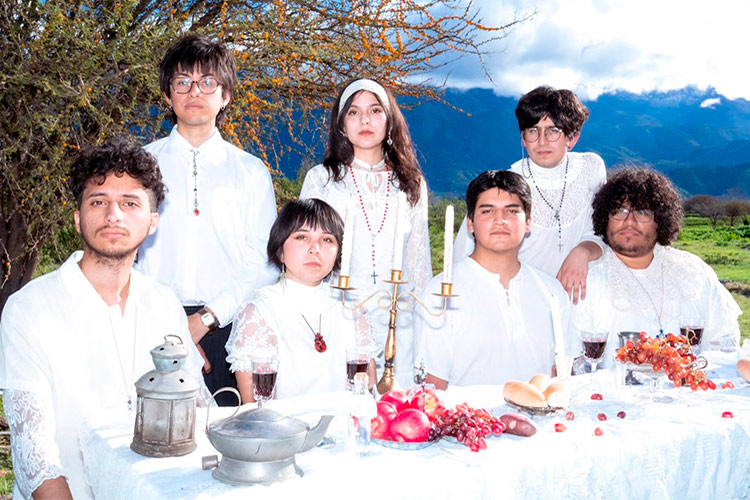
“The lyrics speak of the evident crisis of the country project that we suffer in Chile”
Before summer, Candelabra They moved us live with the songs from their second album “Desire, Flesh and Will” (Mobile Registry, 25). His forceful social criticism and impressive compositions once again place Chile at the center of alternative music in Spanish. We spoke with its vocalist Matías Ávila to discuss the success of the album inside and outside his country.
These are complicated times for Chile. Despite the protests of the social outbreak of 2019, the tense political and social situation in the country did not improve. The South American nation is experiencing strong economic inequality and political polarization, added to the arrival to the presidency of the far-right Jose Antonio Kast. Despite this pessimistic political climate, Chilean youth have known how to channel their anger and hope for a better future in one of the best alternative music scenes in Spanish of the moment. Hesse Kassel, Asia Menor and Javiera Electra are some of the Chilean names that have gained notoriety in the Spanish-speaking world.
“Desire, Flesh and Will”by the Santiago band Candelabro, is one of the most successful projects of this new wave of Chilean alternative music. The band founded in 2021 has risen to fame with its second album, inspired by the sound of the Windmill scene and the social situation of its homeland. It expresses the anger and hope of an entire generation of young people, both for the situation in the country and their own personal situation, which inspired them to write the powerful songs that make up the album. “It was a mix of fifty and fifty. One cannot ignore what is happening in one’s country, since it affects one most personally. The lyrics speak of the obvious crisis of the country’s project that we suffer in Chile,” comments Matías Ávila, vocalist of the band. The songs, written in difficult times for Candelabro, have managed to challenge many listeners. Ávila assures that knowing that his music manages to move someone shows him that they do things well, something that motivates him to continue. Regarding the political content of his music, the vocalist asserts that “I have always enjoyed art linked to personal experience and politics, so it is inevitable that this is part of our work.”
“One cannot ignore what happens in one’s country, since it affects one most personally. The lyrics speak of the obvious crisis of the country’s project that we suffer in Chile”
“Deseo, Carne y Voluntad” has become a phenomenon among Chilean youth, especially the song “Fracaso”, which calls to “get up and build and work for something better.” This powerful and emotional topic went viral among Chilean social media users when the far-right Kast won the presidential elections on November 16, 2025. Ávila remembers that moment with positivity. “It made us feel like you’re not as important as what you create. It took us as a band out of the equation, and made the moment and the people more relevant.”
Candelabro have become Chile’s representative to the world, reaching seventh position in the Rate Your Music ranking of the best albums of 2025. “Good music has been made in Chile for a long time, and on the Internet there seems to be a lot of interest in what we do here. This has helped us get our music to places that were harder to reach before,” says Ávila.
As for the album’s lyrics, they are full of Chilean cultural and political references. The chorus of the song “Domingo de Ramos”, which recites “Desalambar!”, refers to Víctor Jara, the famous singer-songwriter murdered by the Pinochet dictatorship. Ávila reflects on how “Chile is a country with a very existentialist and descriptive culture. Our geographical location makes us see things in a very intense way.” Possibly for this reason “Desire, Flesh and Will” It has become a very representative album of the social situation in Latin America.
“In Madrid we played for seven hundred people, which was something unthinkable for a band that has been around for five years. In smaller cities like Lugo three hundred people came. It’s incredible”
Considering the Chilean idiosyncrasy in music and lyrics, it is difficult to understand the success of the project outside the South American continent. Ávila argues that “they are particularly different contexts, however, there is a shared experience, since in Europe there is a history of very tragic moments.” He considers that, with these songs, we can “remove the dust and antiquity” of dynamics experienced in the past and that have not changed either in Chile or Spain. In the middle of this year, Candelabro passed through various Spanish cities presenting their acclaimed album. “In Madrid we played for seven hundred people, which was something unthinkable for a band that has been around for five years. In smaller cities like Lugo three hundred people came. It’s incredible,” Ávila celebrates.
After their first tour of Spain, sold outs in large Chilean theaters and concerts in other Latin American countries, Candelabro have their sights set on next year. Despite the departure of two of its members for personal reasons, Ávila affirms that 2027 will see their third album. “We have many songs composed and we are rehearsing, which is the important thing.” Ávila prefers not to reveal anything about the content of the album, but advances that it will come out “without singles, or advances or anything. The album directly.”