Interview with Joan S. Luna and Jordi Pastor on the occasion of their comic ‘They are four days’
The screenwriter Joan S. Luna and the artist Jordi Pastor They turn friendship and memory into literary matter in “It’s four days” (Astiberri, 26), a comic about suicide, trauma, youth… and what remains when what we have experienced stops belonging exclusively to us.
There are couples that work by contrast. Joan and Jordi operate through complicity. It is noticeable in conversation in a chic and ornate bar that has nothing to do with Sagrada Familia (their favorite cafeteria, Tokio, where they have chatted so much, is closed for vacation). It is noticeable, of course, in the pages of her comic: text and drawing seem born to marry in a story that, although born from Joan’s memories, does not remain locked in them.
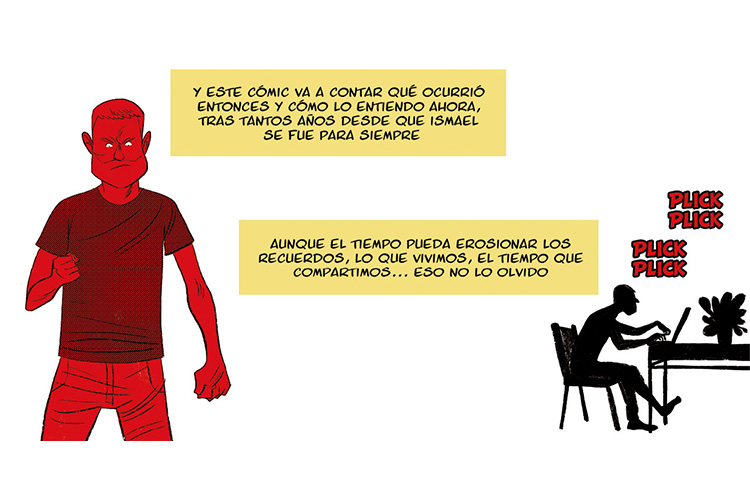
The editor-in-chief of this magazine that you have read for more than three decades, had been suspecting this story for a good handful of years. He needed time to understand what he wanted to tell and, above all, what part of what he remembered belonged to his life and should belong to the story: talking about trauma could serve everyone, even Jordi Pastorprofessor of narrative at Escola Joso, author of multiple works, among others, “Pulp” (Planeta Cómic, 21), through which they met Luna, and which has made intuitive character design, color and vignette representation a journey of great emotional depth.
“Nowadays generations talk about feelings and mental health, but my generation, X, did not go to therapy”
Because this person in the story is Joan, yes, but not only Joan S. Luna. The one of “It’s four days” It is a literary truth: youth, the search, the things that one remembers and those that one decides to turn into history. Also those of a jovial Barcelona, still pre-Olympic and that of a soundtrack that goes from The Cure to El Último de la Fila, from whom they borrow the title. Everything seems to be there, but displaced a few centimeters. Enough so that memory stops being memory and starts becoming a comic. The best gift for Ismael, a way to dignify his memory.
Do you regret having done autofiction? It’s a lot of exposure…
(Joan S. Luna) No! It has been therapy. There are people close, and not so close, who have opened up to me, who have shared their stories with me. Today’s generations talk about feelings and mental health, but my generation, X, did not go to therapy. We were going to do typing, English, but not to therapy… We kept the problems inside.
At the presentation the other day in Barcelona, dignity was experienced, what beautiful interventions from the public.
(Joan) Emma, who appears in the comic, told me that being at the presentation was a collective catharsis. That, although we wrote the book, this spoke for her.
Was a catapult like the comic needed to get all this out?
(Joan) It was going to be a book… Fortunately it was a comic thanks to Jordi. A complete success. Jordi has captured it perfectly. He understood the story, we got along great. There are many things that would not work if they were a book.
(Jordi) A good friend, owner of the Arkham bookstore, told me that it is difficult for him to read stories that deal with trauma, but the fact that it is a comic has helped him endure the emotional weight of the text.
I’m not a comic reader. But the tenderness that the format provides, I don’t know if it would exist only in words. Or only in images.
(Jordi) Joan’s sincerity and humor are great successes. The funeral scene, the escape that laughter provides at that funeral… There are so many people who praise him. There is a part of humor and hope.
(Joan) If I had only written it, it wouldn’t reach people the way it does. In a regular book I couldn’t generate that humor. It would have been something more documentary or an essay. So it has taken a different touch.
It is an agile read. And there are no great proclamations. Thank you for reading.
(Joan) There are no lessons. And yes, there is a lot of text, I talk a lot (laughs) And although I am a big reader of comics, I am not used to writing them. But most importantly, this comic is not born from complicit silences. But of conversations. I love visual comics, but also those by authors like Alison Bechdel, Étienne Davodeau, Mariko Tamaki, in which there is a lot of talking. Ah, I must say that Jordi’s color is beastly.
Jordi, how did you go about portraying Ismael? That face of “not fitting in”, very accurate.
(Jordi) I am a person who is not used to doing a big character design process. I work with first sketches. And I faced Ismael the first time he appeared in the comic, starting only from a photograph that Joan showed me. I don’t ask myself many more questions. There is not much graphic research. I have pulled from office. Fortunately, because of the reaction of the people, it has worked.
Did you think much about the color?
(Jordi) I have been using color as a narrative tool for many years. I have it in my head. It helps me work through a page quickly. The less visual information, the faster. Realistic color forces you to spend more time coloring, and may not add anything to the narrative. I am the complete opposite. The color must speak. I like that those conclusions reach the reader. I really liked that in the presentation people highlighted Ismael’s blue color, they are conscious details.
Speaking of Ismael’s blue color, were you worried that the format would give Ismael a reading that was too pigeonholed and simple?
(Joan) There is a conversation that I say that when it is “crossed” I try to stay away from Ismael… And when I spoke with all my former college classmates together they told me: yes, he was a very horny and coiled guy, and that comes out, but I didn’t want to make him very animated, he was a pessimist-pessimist, as I say in the play, there had to be a balance.
(Jordi) I accompany Joan. This is a ballroom dance. And Joan set the pace with the dialogues.
(Joan) He knew the skeleton of the story. But never the complete script. And at no time have I had to say: “Not this.”
(Jordi) We only work on the last pages at the same time. They are consensual. It was the first thing he told me, he knew how it should end. Here we meet to see how to finish the work. Working with him has been very easy (they compliment each other with their eyes).