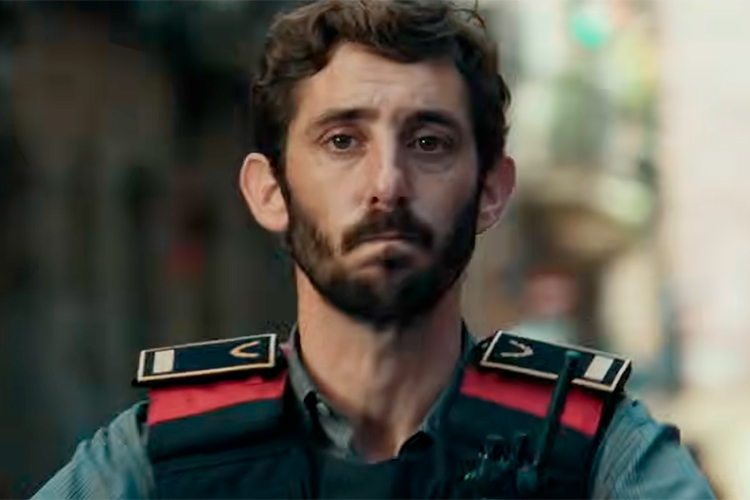
We interview Enric Auquer, protagonist of “Cronos”
Enric Auquer stars in the recently released “Chronos”of Fernando González Molinathe first feature film about the jihadist attacks of August 2017 in Catalonia and whose title is named after the police device that surrounded the terrorists. In it, he plays, for the first time in his career, a police officer.
Although Enric Auquer became known in 2019 with two characters as marked as the impulsive drug trafficker of “He who kills with iron” and young people with intellectual disabilities “Perfect life”the Empordà actor highlights his role in “Chronos” as one of the most difficult. “I am something very different from the character, who has a very firm masculinity. It is one of the ones that has cost me the most to do,” he explains, satisfied with the work done. “I wanted the challenge of playing a police officer, something I had never done before,” he adds. Auquer plays the head of operations at ground zero in Plaza Catalunya, inspired by the real deal, Jordi Rodon, who advised him.
“The film has the desire to narrate the events while at the same time distracting, a very American way of telling a tragic event”
Auquer was aware, when deciding on the project, of the responsibility that this entailed. “I went with caution in case the city was not prepared for a film about the 2017 attacks and I spoke with victims and people who were at ground zero. I realized that it could be done and that there was desire,” he reveals. The actor, politically and socially committed – when he collected his Goya for “Who kills with iron” – he vindicated anti-fascism and when he thanked Gaudí for “House in flames” called to join a demonstration against an eviction -, affirms that “the film has the desire to narrate the events as well as distract, a very American way of telling a tragic event” and recognizes that, for its part, there was “a resignation because it was not a social film that was going to explain the racism that may exist in Catalonia.” Auquer considers that “the fact that some Catalan children, of immigrant parents, but born in Catalonia, and who spoke Catalan, educated in Catalan public school, end up killing other Catalans or want to carry out an attack and become radicalized is, evidently, because Catalonia is a racist country and they have suffered racism at some point in their lives.” To this we must add that “Cronos” is one of the few Spanish films that stage a confrontation between Spain and Catalonia, on this occasion, based on the institutions. “It just happened, right? When I read it in the script I thought it was good that that was there because there was a real struggle between Mossos, Generalitat and the Spanish Government over who controlled the story and who gave the exclusive scoop on everything that was done,” reflects Auquer.
Unlike those two compositions from his beginnings, the role of “Cronos” is closer to other recent roles (“The teacher who promised the sea” or “Ravalear”), variations of the common man. Auquer agrees to everything, although he wishes they would offer him that type of roles again. “You can’t always invent. In ‘Cronos’ it wouldn’t have made sense. I want to get back to it. I don’t have preferences, but I do like the challenge of building an artifact. It’s exciting, but it’s very scary because you take a lot of risk and it can go wrong.” Gary, the young man with functional diversity from “Perfect Life” and for whom he received two Feroz awards, turned out very well. However, it is currently frowned upon for these characters to be played by actors who are not part of the group they represent. “It is a very delicate subject. It depends on the project, on its sensitivity. I am very happy to have played Gary. I learned a lot and I took it very seriously. It was one of my first characters and I never considered not doing it. I wanted to be an actor, it was a dream,” he says. And he continues: “It is nice that an actor has the possibility of getting involved and learning in bodies and perceptions of life that are different from his own. It is the greatness and beauty of my work. At the same time, I understand that it is the responsibility of this sector to see where there are people who can only play this type of characters. That must be protected, at least in the moment we are living in.”
He admits that his social commitment has led him to reject roles, although he does not want to reveal which ones. He has no qualms, however, in verbalizing his rejection of advertising. “My job is to be an actor and, as long as my children have food, I can save myself from selling products and entering this perverse circle of evil. If you defend certain things and suddenly you are hanging on a banner in the middle of Paseo de Gracia in front of certain stores, then maybe you have to keep your mouth shut a little. They have offered me a lot of money, but I feel that my job is not to sell colognes or clothing brands.”
As far as music is concerned, he confesses to having a double-edged relationship with it. “It makes me cry, a lot of things happen to me with it. For me, music is a lot of information. I listen to it in small doses. Sometimes I choose to be silent because music enters my brain, penetrates me and stimulates me too much. If I listen to music, I start doing things: it activates me, it shapes my mind.” As for tastes, he defines himself as “very folkloric” and highlights his passion for Italian music, in particular “the Genoese school like Gino Paoli and Bruno Lauzzi with those ballads that break your heart” and that “touch him to death.” “Another one I really like,” he adds, “is Ali Farka Touré; his album with Ry Cooder (“Talking Timbuktu”) is incredible.”