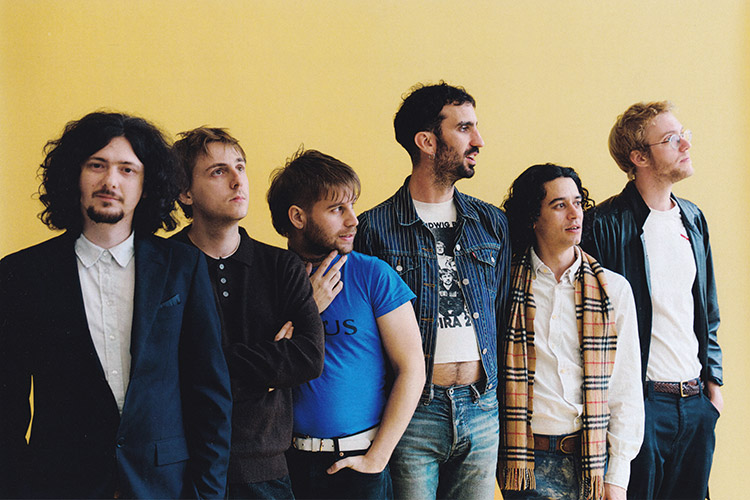
The Ludwig Band’s favorite classical music
One of the young and most solid realities of the new Catalan pop-rock, The Ludwig Band They are touring a lot this summer at various festivals to present their wonderful new studio album, titled “Pel barri is comments”.
Since the group’s name comes from Ludwig van Beethoven, we asked them about their favorite classical music. The result is an enthusiastic and masterful class taught by Pau Estevekeyboardist of the band.
Edward Elgar – Serenade for Strings, Op. 20
A conductor I once had (Diego, you’re the best!) said this was the most beautiful string piece ever written. I will not be the one to contradict him. The first movement is an introduction, and the last, a coda to the central Larghetto that articulates one of the most heartfelt works that I have had the fortune of playing and listening to. In this case, the version that is closest to my taste regarding the score would be that of the Orpheus Chamber Orchestra from 2021 (an album where other works play).
Joseph Haydn – Symphony 83 in G minor
The symphonies of Haydn and Mozart are my musical adolescence; Every summer two or three of us played in an orchestra that we made in the south of Terres de l’Ebre. It was a suitable repertoire because it was difficult enough to be played by young musicians, but, at the same time, they were mature and well-rounded works. In this case, I had to choose between many, but 83, written by an already mature Haydn, contains certain pre-romantic details that justify my choice. As a version, despite my temptation to choose Harnoncourt’s, in this case I recommend that of the Austro-Hungarian Haydn Orchestra, where all the symphonies are performed.
Arcangelo Corelli – Concerto Grosso No. 8 in G minor Op. 6
It has been difficult for me to choose something from the Baroque because it is the period that I have listened to the most for a long time, but, if I have to choose one, perhaps it would be this Concerto Grosso by Corelli, where many of the characteristics of Baroque musical rhetoric can be seen, both at a formal level and at the level of the semantic—musical—figures it uses. It’s famous for its last movement, but I think the whole thing is a masterpiece. I recommend this version, recorded with historical instruments.
Aram Khatxaturian – Concertier for violin in D minor Op. 46
I remember that, when I heard this work in Peñíscola, I returned home, looked for it and listened to it again. This concerto has a kind of hypnotic magic (perhaps its post-tonal texture, mixed with hints of Caucasian harmonies) that makes it beautiful. As for the version, although it is perhaps not the best executed, I really enjoy listening to the one by the Extremadura Symphony with Ara Malikian on violin, a compatriot of Khatxaturian and who gives it a punch that I consider goes very well with the interpretation.
Johann Sebastian Bach – Concerto for two violins in D minor BWV 1043
As an accompanist, I first played this concerto when I was 15 years old. At that time, I was already impressed by the complexity and beauty of this work, and it continues to do so now. The first movement is, for me, Bach’s best 4-voice fugue. The harmonic refinement of the work is impressive by the standards of the time. I especially recommend the 1997 Academy of Ancient Music version, which contains the other Bach concerto (the violin in A minor) that I also wanted to include on the list.
Isaac Albéniz – Spanish Suite (for piano) Op. 47
This suite is known mainly for the piece Asturias for guitar, but the original, and the one I have always heard, is for piano. I have no words to describe the beauty of these little pieces. The use of regional Iberian folklore, mixed with Albéniz’s post-impressionism, has never worked better. It is one of the classical albums that I have listened to the most in my life, and to which I keep coming back. I recommend this version by Miguel Baselga, because I have heard it so much that, whenever I hear another one, I compare it pejoratively with this one.