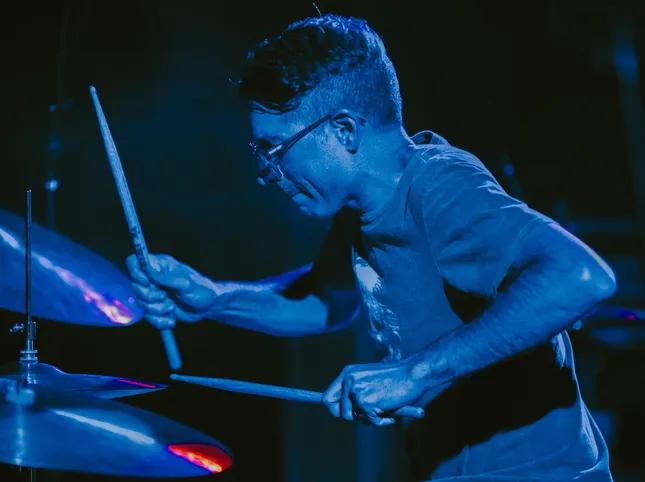
Mark Guiliana: “Working with Bowie changed me”
Defined by the “New York Times” as “a drummer around whom a true cult of admiration has formed”, Mark Guiliana he is one of the most influential and transversal figures in contemporary music. Its strength lies in a unique rhythmic vocabulary, capable of blending the acoustic complexity of traditional jazz with the surgical precision and sounds of electronic music. In addition to spearheading his own solo projects, Guiliana has become the trusted collaborator of some of the greatest sonic thinkers of our time, including Brad Mehldau, St. Vincent, Meshell Ndegeocello and, last but definitely not least, David Bowiewho chose it to give the vital beat to his will, Blackstar.
Guiliana will play in Italy at GroundUP Music Festivalscheduled from 26 to 28 June in Alberobello, in the heart of the Apulian trulli. Born in Miami nine years ago from the mind of Michael League and his band, the Snarky Puppythe festival is designed to be a musical oasis without genre boundaries. Three days of concerts, masterclasses and artistic sharing, celebrating that sense of community and experimentation that unites both the hosts Snarky Puppy and guests like Guiliana.
Your latest album, MARKis entirely solo and is the synthesis of your experiences so far, but also a new starting point. Meaning what?
I’ve been lucky enough to have so many fantastic musical experiences throughout my career, both as a session player and as a leader, and I feel like I’m constantly gathering different influences and inspirations. It just seemed like the right time to try to make a purely personal statement that included these different influences. There are like two parts of my brain that are most represented in the album: the drummer in me, which is my gateway to music, so there are a lot of drum-related elements; but over the years I also got a lot more into composing, so I wanted to include that side of my musical mind as well, and that’s where it all came together.
You worked with Bowie. What do you have left of that experience? Has it changed you?
Oh yes, it changed me in every way, it was a fantastic experience. It’s been 10 years since that album came out, and a lot of the musical relationships that have formed over the last decade were born because someone might have heard me play on that record. I feel so lucky to have been part of something with such reach, that has touched so many people. I think the main thing he left me with was… well, what I admired so much about him throughout his career, and especially in Blackstarit was his courage to realize his vision. I think he wasn’t worried about anything external to himself, whether it was how the record would be received, societal pressures, or what people thought it should be. It really felt like something he felt he needed to make, a necessary statement, without compromising in any way. I tried to use all of this as inspiration for my music from then on.
Blackstar it’s an album full of urgency, gravity and awareness. What was the atmosphere like in the studio?
I don’t think anyone could have predicted his passing so close to the album’s release. There was a certain heaviness to the music, but actually the spirit in the studio while we were recording was joyful. I don’t want to say “light”, but definitely joyful: lots of laughter, connection. It was a truly beautiful experience. So my personal memories are just uplifting memories, but yeah, the record itself certainly has an intensity and darkness that’s impossible to avoid.
Here in Italy you will be a guest of Snarky Puppy.
I’ve known these guys for a long time now, especially Michael League. I really admire the band and, today more than ever, I admire what it takes to have a band that’s always on the road. I am amazed by their journey and what they have built, it is truly inspiring to me. I’ll be there with my trio, it’s called Beat Music, and there are only three of us; and yet, even traveling around Europe in three seems like quite a challenge. So it’s pretty crazy and admirable what they can do, and the level at which they do it. Mike is a dear friend and I really appreciate our friendship, I admire him so much. I am therefore very grateful to be part of the festival and to be included in their family for the weekend.
You move from the tradition and pure dynamics of jazz to the technology of synthesizers. How do these two apparently distant worlds coexist?
Excellent question. I think both are equally important and equally inspiring to me. I love jazz, I love all types of music and I always try to represent my influences in an organic way; for me it’s all the same thing. I understand how they are different, of course, but my personal relationship with both of these genres of music is actually the same. I try to allow these influences to coexist in an attempt to ensure that there is not too much difference or too strong a contrast between the two, so that I can draw on them equally.
Have you ever received criticism from jazz purists?
Oh yes, of course, it’s part of the game. Who hasn’t received them? I think most of all, when you use the word “purist”, by definition a purist is waiting to find the thing that is not “pure”. So I feel like I don’t necessarily belong to one category, and sometimes that can be confusing, but at the same time it’s important for me, like I said, to be able to move between different styles and still play what reflects me.
Never experienced such scenes Whiplashas a drummer or as a teacher?
Personally, I didn’t even consider it a film about music. It was very dramatic. I can say that I have never had an experience like this in the music world. To me it seemed more like a sports movie or about some sort of extremely competitive field, but it’s just a movie, and maybe some people have similar experiences. For me, the reason I play is just so I don’t find myself in situations like that.
The drummer who inspired you the most?
I would say, if I had to choose one, Elvin Jones. Obviously I discovered him through his work with John Coltrane’s quartet, but it’s music I return to very, very often. And yes, it is simply a truly inexhaustible and reliable source of inspiration, creativity and energy.
Your technique is unquestionable, but what impresses most is your ability to make everything seem extremely simple and focused on composition. What have you learned – or unlearned – to become the Mark of today?
Good question. Thanks for the compliment. I think it was a mix of learning and then unlearning. Drums are obviously a very physical instrument and there is such a technical demand that you can’t escape that type of work or training. So I consider myself very lucky to have had excellent teachers who taught me the correct way to play with the correct technique. But when I was younger I thought a lot about technique and played, I think, in a more “mechanical” way, which perhaps didn’t allow me to think as much about composition or similar aspects. So I think it was unlearning, or maybe not even unlearning, but rather “letting go” of the technique and trusting that it would stay there for me. Letting go knowing that, if I focus all my attention on the compositions and on supporting the musicians around me, the technique will automatically support me, instead of thinking about the technique first hoping that it will be functional to the music.