Music is violence and poetry, in Park Chan-wook’s cinema
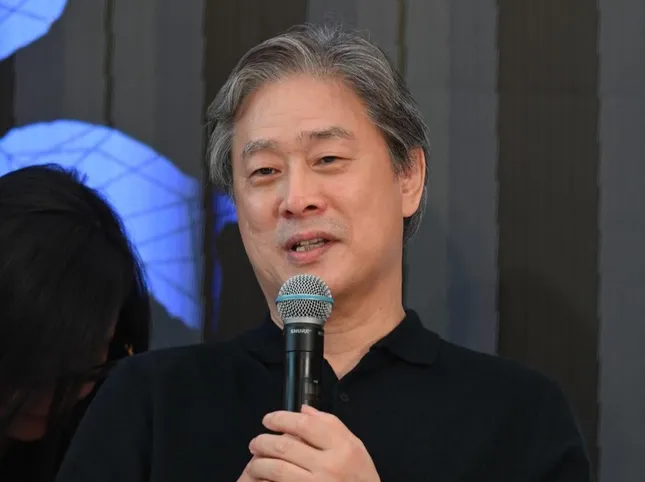
“I ask you for a little understanding, I have just arrived from Cannes and I am a little disoriented”. Park Chan-wook he joins us in Milan, in the setting of the Milanesiana, after having awarded his colleague Cristian Mungiu at the famous French Festival, as president of the jury. He also lived in Milan a few months ago to shoot a commissioned short film, but this time he is the protagonist behind the microphone. I love everything about his cinema, but – It goes without saying – I pay particular attention to the role it reserves for music.
The cinema of the South Korean director is a universe of extremes: visceral violence and poetic lyricism, ruthless revenge and impossible loves. The element of sound has always been the glue between these contrasting forces. The soundtracks of his films are famous for their profoundly eclectic and layered nature (just like the plots of his films): they range from the solemnity of classical music to the raw energy ofhip hopmixing crazy rhythms, melancholic ballads the Sixties and themes that recall the epic western or the tense atmospheres of gangster movie. So, the question is: what is the choice process? Have you ever built a scene starting from the music, or is it a component that you insert afterwards, after shooting? Here is his answer.
The approach (always different)
The process is always different. I rarely started from music.
Park Chan-wook quickly clarifies that there is no mathematical formula in his cinema. Music is not a decorative element applied in post-production with a cookie-cutter, nor is it always the driving force behind the visual action. In most cases, the director admits to proceeding in this way empirical:
Normally, when I start working on the film, along the way I find some music that coincides well with the scenes I shot, or with the story.
This field research allows the images to breathe and to suggest, during the work, which notes can enhance or subvert their meaning. However, the exceptions to this rule are fascinating and reveal much of his poetics.
The Little Drummer Girl And Decision to Leave: homesickness
The most famous and recent exception to his usual method is the award-winning one Decision to Leave (2022). In this case, the film itself sprouted around a musical suggestion, a sensation born far from South Korea. It all began in England, during the making of the television miniseries The Little Drummer Girl. Park says:
It happened when I was in London for many months filming The Little Drummer Girl: I was homesick for my home, for Korea, so I listened to a lot of songs from when I was young, from the sixties or seventies.
Among the songs listened to in that period of distance and melancholy, there was one capable of igniting one narrative spark: “One in particular inspired me, Angae (in English Misted.), because it told of a man and a woman who go for a walk and fall in love”. The musical genesis of Decision to Leave was not limited to a simple textual inspiration, because the director wanted to carry out an operation of recovery and transformation of the sound memory:
The song was originally sung by a woman, but remembering the artists I listened to in my youth in the seventies – and considering that they have aged too now – I invited them into the studio to record this song, changing it a little. Hearing the recording I was moved.
The result of this emotion was not one storyboards rigidly built on the beats of the song. On the contrary, the music acted like a perfume, permeating the entire work. In fact, Park Chan-wook specifies a fundamental detail of his aesthetic: “I didn’t translate it into the form of an image: it’s a sensation that the film absorbed naturally.”
Lady Vengeance: the Italian baroque
If Decision to Leave was born from the melancholy of a 1960s Korean pop song, Lady Vengeance (2005) — the final chapter of the famous Revenge Trilogy — found its soul in the rigor and elegance of European classical music, discovered almost by chance during production.
The protagonist, Lee Geum-ja, follows a path of revenge that takes on the contours of a religious way of the cross, a search for redemption through blood. To accompany this dichotomy between brutality and spiritual salvation, the director drew heavily from the baroque repertoire:
While producing Lady Vendetta, for example, I found the perfect match with Italian baroque music. I have heard Vivaldi many times, and a lot of the film’s music was born from Vivaldi.
The use of Antonio Vivaldi and baroque sounds (often characterized by complex counterpoints and a strong sense of dramatic inevitability) in Lady Vengeance it just elevates the earthly and gory actions of the characters to an almost level divine and theatrical. In this case, the image was already in progress, but the music provided the definitive key to understanding the work.
No Other Choice: Mozart’s tragic irony
A further evolution in the relationship between Park Chan-wook and the soundtrack is seen in his latest project, No Other Choice. Here, the use of music changes function again: it is neither a melancholy inspiration born out of nostalgia, nor a flash of inspiration that occurred during filming. This time, the musical score was already engraved in the structure of the narrative skeleton.
For the last film, No Other ChoiceI had thought about Mozart’s music from the beginning. In fact, in the first script I had drafted, I had written precisely ‘Mozart’s music begins here’, specifying the parts and minutes of the pieces I wanted to use.
Wolfgang Amadeus Mozart’s choice responds to a specification thematic need. The director uses the formal perfection, grace and presumed light-heartedness of some Mozart compositions to create a powerful effect of cognitive dissonance with what happens on the screen: “The concept of a family that seems perfect and stable but isn’t, that seems happy but is sad: well, all this went well with Mozart’s music, in my opinion.” Mozart thus becomes the mirror of appearances bourgeois: a façade of impeccable harmony and serenity which, upon closer listening (and a deeper viewing of the film), hides neurosis, instability and a deep, incurable sadness.
Which arises from a sense of estrangement and nostalgia (as in Decision to Leave), which fits together perfectly during the work, enhancing the mystical-violent tone of the image (as in Lady Vengeance), or that it is used as an instrument of bitter irony from the first drafts of the screenplay (as in No Other Choice), the soundtrack is to all intents and purposes an active character. An always different character, but always essential to give Park Chan-wook’s cinema its unmistakable and vibrant identity. He told us that the next film will follow the footsteps of Sergio Leone’s cinema, a western to tell the story of the violence inherent in American history. And we are very curious to discover the transition from Vivaldi to Morricone.