The docufilm “King Marracash” is living matter
In Italy, the music documentary has often become, in recent years, a marketing tool of very poor quality. Constructed stories, self-celebration, self-pity, almost absent depth. Often because, trivially, that story perhaps didn’t really deserve to be told. “King Marracash”, the docufilm by Pippo Mezzapesa, which will arrive at the cinema on 25, 26 and 27 May, a project on paper that is not easy to carry out, but instead it hits the mark because it is living material. A living material first of all because, as told by the director himself, the project changed as it went, it transformed compared to the initial idea of over a year ago, adapting to the paths taken by the artist.
Because Marracash is someone who doesn’t follow tracks. He doesn’t follow already written stories, he is a sculptor of his own destiny. And in fact the documentary is dedicated precisely “to those who do not give up on a story already written and rewrite it”. In “King Marracash” there are no scripts in the canonical sense of the term, there are no long and classic “sitting” interviews, talking heads that say little or nothing, but thoughtful interventions emerge that pingpong with old or new images, shot in this last year of changes and successes for the rapper. It is a one hour and forty-five minute documentary that flows extremely naturally thanks to the work of Mezzapesa and the screenplay written together with Antonella W. Gaeta, Chiara Battistini and Shadi Cioffi. A work that manages to make the story profound without giving up irony, funny moments and above all a lot of real life. There are some sequences that stick with you. Among the most interesting is the one in which Marracash crosses the Barona by car remembering his childhood, the family that moved from the South to Milan, his first home, his friends, his love for reading and music, the importance and sense of belonging to that neighborhood.
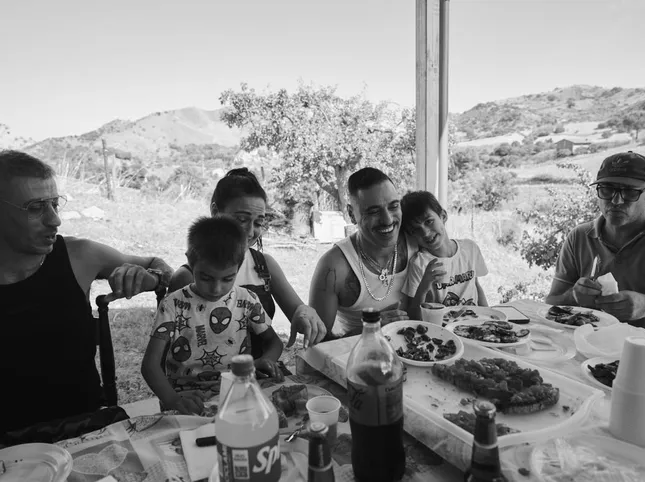
The best moment of the documentary is the trip to Nicosia, in Sicily, where among other things a cinema will reopen, after years, which will screen this work. The scenes at the table with the family convey an almost indescribable happiness, because they are authentic. A happiness that only an attentive, but never invasive, camera can truly capture. In those moments it almost feels like being inside the best cinema of Mario Monicelli or Dino Risi: the difficulties, the affections that resist, an Italianness that is not fictional, but popular and profound. The relationship with the family is central. Marracash also admits that as a boy he was a little “ashamed” of his parents’ humble origins, of their dialect, of the many jobs they had to do, but without ever letting him and his brother lack anything. Seeing him talk to them, confide in each other, let himself go into such a broad and true family dimension, makes everything extremely human.
In those scenes Marracash doesn’t win. Fabio wins. And he himself explains it very well in the documentary: Marracash exists on stage, almost as if he were a superhero. In real life, however, there is Fabio, who has to deal with fragility, with emptiness, with addictions to sleeping pills, with the struggle to stay lucid when the applause ends and the lights go out. Intimate moments of family union alternate with the gigantic ones of the stadium tour, the San Siro concert, up to the Marra Block Party. Thousands of people cheering him on. But then the night comessilence comes, and there remains a man trying to fall asleep by taking sleeping pills to keep up with the pace of one’s life, to keep things at bay anxiety and a mind that never stops kicking. The documentary here too completely avoid the trap of self-pity. His is a direct, truthful, unfiltered story.
The doc contains fundamental figures of his career, among these is the manager Paola Zukar. Beautiful night scenes in a house on the hills of Piacenza, between games of Tekken, conversations about work and reflections on the future. From different angles, Fabio and Paola pursue the same thing: leave a mark on the present. From a content point of view, the doc adds little or nothing to what the rapper has already told in recent years, but has the ability to condense it and make it visually effective. There are historical moments in his career, the Dogo Gang, the trilogy of records that changed his life, his love, his relationship with Elodie and also the clues to the Marracash to come: a return to an “old Marra” who wants to reclaim the value of music also as a game. All through the Block Party, seen as a gesture of restitution towards the neighborhood and towards one’s roots. Because if it is true that Marracash has achieved a lot, it is equally true that he has never stopped looking at where he comes from, “from the periphery of everything”. And perhaps this is precisely what makes “King Marracash” something different from most Italian music documentaries: he doesn’t forcefully build a myth, but observes it from a distance.