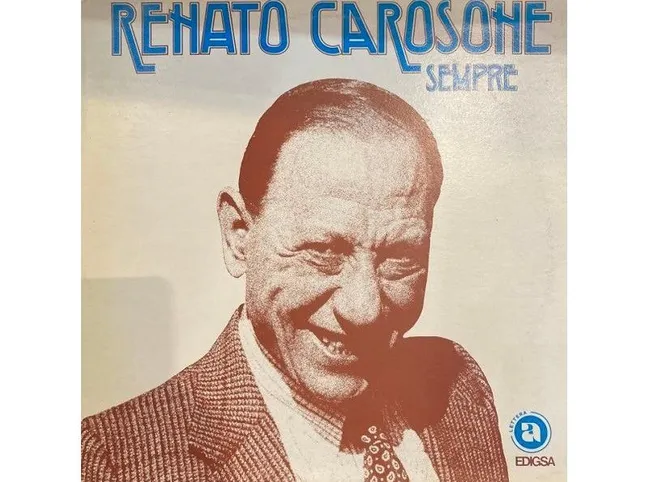
Renato Carosone, true innovator of Italian song
“There was a season of Italian pop music, the 1950s, in which very few people proposed something other than traditional and sappy melodies: and among these was Renato Carosone. The Neapolitan musician then carried out a certainly avant-garde function: that of mediating and introducing, in an Italy tired of tragedy, the frenetic and apparently unscrupulous rhythm of rhythm & blues, boogie woogie and rock’n’roll”. The profile on Renato Carosone (born Renato Carusone in Naples on 3 January 1920, passed away on 20 May 2001) written by Enrico Deregibus for the “Complete Dictionary of Italian Song” begins with these words.
Piano student at seven, professional musician already at 17, just graduated from the Conservatory, Carosone” in 1949 received the crucial offer of his life: that of forming a trio for the Shaker Club of Naples”: thus, with the guitarist Peter Van Wood and the drummer Gegè di Giacomo, the “Trio Carosone” was born. “Growing up in the great school of the nightclub, the three played everything; but Carosone, in love with jazz and be bop, accelerated the songs in the manner of Fats Waller. One evening the audience asked the group to play ‘Lo sceicco’, but faster. For Carosone it was the decisive enlightenment: that of taking very serious Neapolitan or Italian songs to change their direction, distort them with irony and rhythm. (…) From there the original, indeed very original, repertoire of Carosone (…) But the repertoire was born above all with the collaboration of a lazy and very elegant Neapolitan painter, Nicola Salerno, aka Nisa, to whom Carosone himself continuously offers ideas and ideas. Their texts have, beyond the limits permitted by the times, a ease, a disenchanted and even self-critical irony, as well as a spectacular group theatrical performance (…) and maintain a certain roguish and witty spirit unchanged, hedonistic and indolent, which is typical of Neapolitanism”.
Renato Carosone, together with Fred Buscaglione, is a true innovator of Italian song, and it is also thanks to him that the arrival on the scene of a revolutionary like Domenico Modugno was possible, who in 1958 at the Sanremo Festival would change history with “Nel blu rossa di blu”. The following year, in 1959, on 7 September, Carosone announced his retirement from the stage without any warning. He returned there with great success in 1975, and with less exciting results in 1989, taking part in the Sanremo Festival with “‘Na canzuncella doce doce”.
1954: And the boat returned alone (Fiorelli – Ruccione)
1955: The curly woman (Modugno)
1955: The pansy (Cioffi – Pisano)
1955: Malafemmena (De Curtis)
1955: ‘Stu Chinese mushroom (Carosone,R – Nisa)
1955: Three numbers in the lottery (Carosone – Fiorentini)
1956: Io, mamma and tu (Pazzaglia / Modugno)
1956: Maruzzella (Bonagura / Carosone)
1956: You liked it (Capillo – Rendine)
1956: Guaglione (Nisa / Fanciulli)
1957: Chella llà (Bertini – Di Paola – Taccani)
1957: You want to be an American (Nisa / Carosone)
1957: ‘A Casciaforte (Mangione – Valente)
1957: You wanted it (Tassi,R – Sarra)
1957: Torero (Nisa / Carosone)
1959: O Pellirossa (Nisa / Carosone)
1958: Caravan Petrol (Carosone – Nisa)
1958: ‘O Sarracino (Nisa / Carosone)
1958: Take ‘na pill (Nisa / Carosone)
1989: ‘Na canzuncella doce doce (Brick)