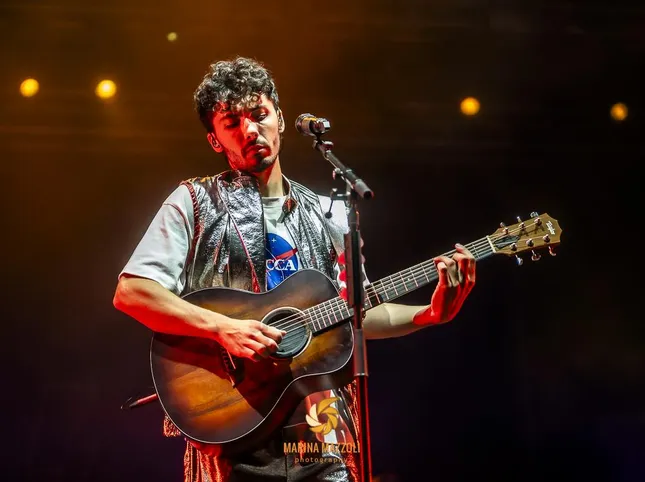
Fulminacci seems to have always been destined for sports halls
«I like music, that of the greats», sings Fulminacci in “Forte la banda”, the first song in the setlist. What the Roman singer-songwriter indulges in in front of over 7 thousand spectators at the Palazzo dello Sport in Rome, his city, where last night he kicked off his first tour of the arenas, is a declaration of intent that sounds almost programmatic. Yes, because among the “greats”, now, there is also him, who exactly seven years after his debut with “La vita truly” (the album was released on 9 April 2019), while wearing a very elegant blue suit and sporting a modern Mastroianni quiff, now seems perfectly at ease in a pop star context, but without losing that balance between lightness and depth that has made him one of the most esteemed authors of his generation. The tour, renamed “Palazzacci” (tomorrow it will be at the PalaPartenope in Naples, on 15 April at the Unipol Forum in Milan and on 18 April at the Nelson Mandela Forum in Florence), marks a new chapter in its history.
Two years after the first time ever in a sports hall – it was the same one in Rome – Fulminacci returns to the arenas with a completely different status. At the time he had zero platinum records in his palmares, but on the other hand he could boast a Targa Tenco, the one he won in 2019 with the same “La vita truly” as “Best first film”, and a participation in the Sanremo Festival, the one three years earlier with “Santa Marinella”. To the general public his name sounded familiar up to a certain point: his destiny seemed to be that of the singer-songwriter who is liked by people who like him and who collects critics’ awards. Today, after his return to Ariston with “Stupida unfortunate”, the feeling is that the journey is complete: Fulminacci has succeeded in the not always easy mission of bringing industry professionals and the general public to an agreement. «I feel like I won Sanremo. Everyone liked the song. I have received only positive comments. People discovered me. It’s a song that represents me one hundred percent, but at the same time it has a very catchy chorus and can be sung. It all worked,” he says off stage. The result is a sold out concert, with a transversal audience: children, high school students, university students, forty-year-olds and even some fifty-year-olds. A heterogeneity that speaks well of the ability of his music to speak to multiple generations, drawing a bridge between “that of the greats” and contemporary pop.
The goal of the first tour in the sports halls arrives without forcing, at the end of a long journey that began seven years ago with the release of “La vita truly”: nine songs that told the daily life of a boy from the Roman suburbs, between scooters on the Aurelia and generational ironies, in a songwriting tradition suspended between Luca Barbarossa and Daniele Silvestri. Two years later the second album “Tante dear cose” and the Sanremo debut would arrive, in an Ariston without an audience due to the pandemic. Today, seeing those images again, it seems like an era has passed: at this year’s Festival Fulminacci appeared self-confident, confident, perfectly aware of his abilities. A confidence that is also reflected on the stage of the Palazzo dello Sport, where he alternates moments of intimacy (“Le bicicleta”, “Tutto bene”, “Nothing particular”) with sudden accelerations (“Maledetto me”, “Spacca”, “Tattica”), revealing himself as a stage animal, between ballets and sketches. Accompanied by a six-piece band – Claudio Bruno on guitar, Giuseppe Panico on trumpet, Lorenzo Lupi on drums, Riccardo Nebbiosi on saxophone, Riccardo Roia on keyboards and Roberto Sanguigni on bass – the singer-songwriter alternates classics such as “Borghese in borghese”, “Tommaso”, “Aglio eolio” with the songs from the latest album “Calcinacci”, a record born from the sentimental rubble of a finished relationship and transformed into a collective work, populated by friends and travel companions, passing through a surprising cover in Italian of “A-Punk” by Vampire Weekend. «I took refuge in friends. The beauty of this album is precisely this: companions on adventures have passed through it”, he explains. «With a little help from his friends», one might say, quoting the Beatles.
A couple of these friends also join him on stage. The first is Tutti Fenomeni, which sets the stadium alight with the verses, which have become memes, of “Mitomani”: «An ascetic no is better than a worldly yes / I stay at home to watch Montalbano / I am moved at Titian’s concert / and I vomit in the Audi of Saviano’s escort». Later Franco126 also arrives, greeted by a deafening roar: together they sing “Fantasia 2000” (the song written and sung together in “Calcinacci”) and “Due ordini” (which they had recorded last year for the album “Futuri possibili” by the singer-songwriter from Trastevere). The message to read between the lines is that the Roman scene is more alive than ever: even if contracts are signed in Milan, creativity remains in Rome. «The problem with our circuit is that we are not representative: there are no events that make it clear that the Roman scene is alive. When we see each other, we do it at home, in the living rooms. Unfortunately, there are no clubs that existed in the times of Niccolò Fabi, Daniele Silvestri, Max Gazzè, Alex Britti, the Locale di vicolo del Fico or the Big Mama. Yet the city is full of talent”, he reflects. A third friend applauds him from the stands as if he were an older brother: it is Gazzelle, his labelmate, that Maciste Dischi considered one of the most important laboratories of the new Italian singer-songwriter scene.
The finale is constructed with intelligence and coherence, choosing the two songs with the most national-popular flavor of his repertoire, as if Fulminacci enjoyed playing with this new status. First “Santa Marinella”, the piece with which he made himself known to the general public in Sanremo in 2021: it is as if the public recognized in the song the beginning of a journey, the first step towards ever bigger stages. «This was the one with which I lost Sanremo: now I’ll sing you the one with which I won it instead», he jokes. The actual closing is entrusted to “Stupida unfortunate”, the song that marked the definitive popular consecration, with that immediate, liberating refrain, which Fulminacci interprets on stage with the awareness of having achieved an interesting balance: that between cult singer-songwriter and pop star capable of filling sports halls without losing authenticity.