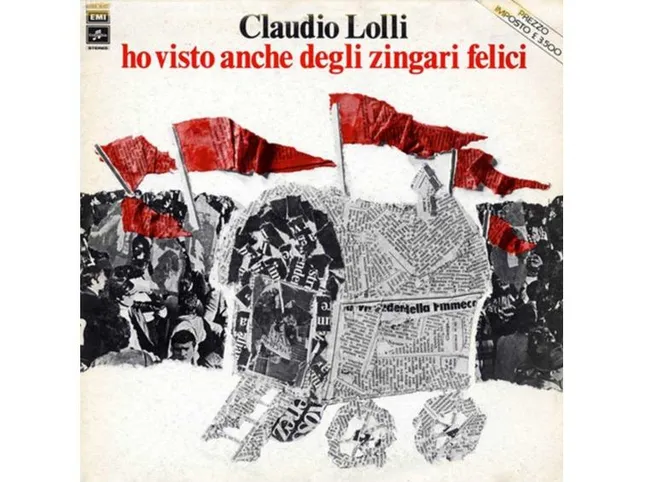
Claudio Lolli, “I also saw happy gypsies” is 50 years old
There are records that are real time machines. Works capable of going beyond the ability to transport the listener to relive the atmosphere of the times in which they were published. In some cases it goes even deeper. The needle drops on the vinyl, you close your eyes and suddenly you find yourself in another year, in another reality. You don’t just hear it with your ears but with your whole being, you are elsewhere.
One of the most striking cases in Italy is Claudio Lolli’s fourth album, the one that has never been celebrated enough “I have visto toalso dthey zingari fhelices”. It’s a moment, the music starts and we forget about 2026 and all its distortions.
With a leap you are in 1976, a rather tense period in the history of our country, years of lead, years of revolts, of crises. But also of hopes, especially on the part of the student and workers’ movement, which sees the conspicuous leap forward of the PCI in the elections as a sign of one great rebirth. There is confusion in the air but also trust, it is a great moment of collective euphoria before the collapse of utopias. You can breathe all of this in an almost tactile way while listening to the record, the images manifest themselves beyond sight, in an almost tactile way. You are there in Piazza Maggiore with Gypsies like you: young people, girls and boys, whose revolutionary spirit is pure, not tainted by extremist ideologies, nor even by violent thoughts. There is a healthy desire for change in them, and they are ready to face it with intelligence and passion. Lolli photographs them and documents them in her album. He too is a Gypsy, ready to observe everything around him: stories, characters, current events, historical and even intimate facts. Up to this moment he has been the classic singer-songwriter: guitar in hand and sharp pen, he has managed to delve deeply into his own soul and that of others. He knows the wounds of existence and has reported them in emblematic albums right from the titles: “Waiting for Godot” (1972), “A uman in cI laughed. canzoni of morte. canzoni of vita” (1973), “Songs by rhave” (1975). Albums that spare nothing and no one in their merciless portraits of malaise, of feeling out of place, of the desire for change.
Then, 50 years ago, something moved. Claudio comes out of his shell, opens up to collaborations and begins to tour his creations together with a group of members of the Collettivo Autonomo Musicisti di Bologna: Danilo Tomasetta (sax, flute), Roberto Soldati (guitars), Roberto Costa (bass) and Adriano Pedini (drums). The meeting with the ensemble is the opportunity to enrich the musical fabric of his songs with instruments and arrangements that push the music beyond the classic singer-songwriter sound, tinged with jazz and prog. In the meantime, new compositions are pouring in, especially a long ballad in which Lolli launches into describing a positive moment, of hopes, of visions. Beyond the tensions, the endless debates, the violence, there are the happy Gypsies who deserve to be immortalized.
The title of the song is inspired by the film of the same name by Yugoslavian director Aleksandar Petrović, with lyrics that line up a whole series of more or less negative emotions that humanity (workers, students, artists…) of 1976 brings with it. Certain phrases such as “It’s true that we don’t understand each other, that we never speak the same language”, “It’s true that the street often seems like hell”, or “It’s true that we drink the blood of our fathers and we hate all our women and all our friends”, are emblematic, mercilessly exposing all the discontent in the air. But happy Gypsies make love and roll on the ground. Happy Gypsies get drunk on the moon, revenge and war.
There is an unbridled passion in these words that smell of existence, of authenticity; they convey urgency, love and blood. All seasoned with a melody of incomparable beauty. Soon, thanks to new poetic ideas and the contribution of the musicians, the ballad expands, fragments into two parts and within it welcomes a whole series of stories that will form a single long piece of over forty minutes, divided into eight sections. And this is where the square comes to life. Thanks to the music and the words you can breathe the air of those days, you can visualize the protagonists and the stories, even the most dramatic ones such as the attack on the Italicus, carried out on the night between 3 and 4 August 1974 while the train was passing near Bologna, in which 12 people died.
All the inconsistencies of this bloody story are narrated in “Beautiful square pbullshit” and in “August”without sparing criticism of anyone, first of all the then President of the Republic Giovanni Leone. In “May Day of fthis” we’re talking about Vietnamin “The death of the fly” a meditation emerges on the fragility of existence: the individual’s battle turns out to be in vain, because it is consumed against forces greater than him and is dispersed in a tension that ends up turning against the men themselves. “Anne of France” it is the portrait of a woman, a revolutionary with a head on her shoulders and clear ideas. Fascinating figure, by whom the protagonist is both attracted and intimidated as he reflects on the complexity of relationships in those days. “Albana for Togliatti” uses a simple convivial scene – drinking wine together – to tell the story of the attempt to unite the old and new left after ’68. The tone is both affectionate and disenchanted: that toast represents more of a fragile illusion of unity than a real solution to divisions. From here we reach the final reprise of the title track in which Lolli urges us to overcome all discord to take back “life, the earth, the moon and abundance”.
The entire suite flows without ever getting boring, with each note in its place, in clear progressive ancestry underlined by a flute (which is very early Genesis) and by guitar and sax solos that immerse you in a highly creative construct. The singer-songwriter’s message thus rises in an open sound, which reflects the vast poetic world of the lyrics. The needle detaching from the vinyl of “I have visto toalso dthey zingari fhelices” it is the signal of a return to a reality that no longer promises some lands, moons and abundance. For this reason it is better to start the album again, to go back to traveling in a time full of contradictions but still full of future.