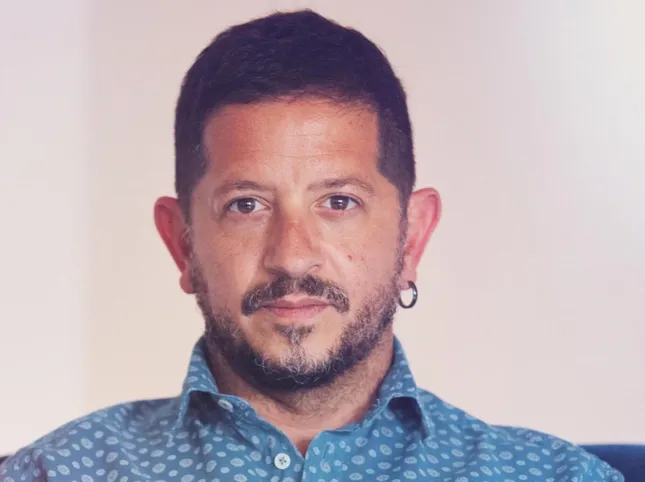
Giuseppe Anastasi’s “songs without clicks”.
Nine tracks played without a metronome: like this Giuseppe Anastasi talks about the songs from his latest album. Singer-songwriter and author of numerous successful songs, he has signed songs performed by artists such as Eros Ramazzotti, Paola Turci, Michele Bravi, Mietta, Anna Tatangelo and others. Among the most recent, “Magica favola”, brought by Arisa to the stage of the Sanremo Festival and finishing in fourth place (artist with whom she had a long romantic relationship). “Songs without clicks” is instead an intimate work, deeply linked to his personal journey and the desire to talk about himself freely through words and music. Songs born guitar and voice, in which Anastasi searches for the essential. Previewed by the single “Titoli di coda”, the album opens with “Alzati”: «A song to which I am particularly attached, a song I dedicated to myself. It tells of my apprenticeship period, when I was chasing the time to be able to work in the music world. I worked in a pet shop, I had just moved from Sicily to Rome with a dream, that of music, which always seemed to escape me.” In the song he sings: “And so I found myself crossing my thirties with nothing in my hands / with dreams of giants / There was someone who made fun of a sort of unhappy person / every time he asked me for the music he says”.
“Songs without clicks” presents itself as a manifesto of imperfection: where does this artistic choice come from?
«For many years I have been the enemy of time, while today I have chosen to make a record without a metronome, taking all the necessary space. Making an album like this was very liberating: there’s even a song that lasts six minutes. I have always loved songs that take their time and over the years I have collected many musical references that have accompanied me on this journey. These nine tracks are priceless for me: I feel free and perfectly at ease in this space.”
In a musical panorama dominated by numbers and “clicks”, what space can a proposal like yours have today?
«Maybe even none. Of course, after a year of work I hope that this album finds its place, but even if it doesn’t happen I remain happy and convinced of the path we’ve taken. We worked with our hearts and with full awareness. In a world made of numbers it may happen that you don’t reach everyone, but the satisfaction from this work remains.”
You have signed over 200 songs for major artists: what changes when you write for yourself compared to when you write for others?
«It all started at Mogol’s CET. The first time the Maestro analyzed my texts he told me: “Giuseppe, you are curious: this work could be for you”. From there I started to really believe it. When I write for others I try to empathize, to understand their vision of life, of love, of society. If you can make this connection, it becomes much easier to get to the point. It was also like this for the last Sanremo Festival with the song for Arisa: “Magica favola” is the result of a journey built together, also with the other authors and the result was very beautiful. When I write for myself, however, it’s different: sometimes I’m more demanding, but also more free.”
How does your work change? What drives an author to write one text or another? Where does inspiration come from?
«To write songs your life is not enough: you have to look around, listen, understand different points of view. Life is beautiful precisely because it belongs to everyone. We cannot limit ourselves to our own experience, we must observe what happens in the world and around us. Inspiration is something metaphysical but also very concrete. It’s not something that can be taught: the curiosity to observe the world must belong to you. We authors, in this sense, are perhaps more attentive to life than dreamers.”
Your career is also strongly linked to the Sanremo Festival: has it played a role in your artistic growth as an author?
«Absolutely yes, it had a fundamental role. Arriving in Sanremo means reaching a huge audience, difficult to access in other contexts. I’ve participated in seven festivals and, when your name is on that stage, you know that millions of people are listening to a song that you wrote. It gave me two victories and a second place, and I’m very satisfied with this. Furthermore, I am deeply attached to the event: since I was a child, in my house, it was a fixed event. I have very fond memories of those moments when we gathered in front of the television to follow him.”
You won two Sanremo Festivals with Arisa, an artist with whom you have collaborated since the beginning of her career. How has the relationship established between you changed over time?
«In such a long relationship we go through very high moments and other more difficult ones, but at the base there remains a strong affection and great mutual respect. I consider Arisa one of the greatest interpreters of Italian music: she is extraordinary and I am sure she will be remembered over time. When he sings, he manages to give weight to every word, and for an author this is something precious. Even “Magica favola” is not a simple song, but she managed to bring it to the public in a truly extraordinary way.”
Is there an artist you wrote a song for or a collaboration you dream of?
«The collaboration I dream of is perhaps unachievable, but I am a great admirer of De Gregori: being able to do something with him would truly be a dream».
Can artificial intelligence replace the work of the songwriter today?
«It is possible that summer hits, built on simple and immediate rhythms, will increasingly be the prerogative of artificial intelligence or already are. The songs that really manage to touch people, however, still remain linked to human sensitivity and experience. I always tell my students at CET, where I teach, that songs often remain in the drawer for a long time: “La notte”, for example, remained there for six years before arriving in Sanremo. You have to have patience. To emerge you need preparation: studying, knowing the records, listening to a lot of music. To write songs it is essential to have a solid musical culture. I advise my students to start from the Beatles up to Lucio Dalla, passing through albums such as Rimmel and other great records, Italian and international. It is important to listen, study and also have the courage to get involved: have your lyrics read, your songs listened to, knock on doors, even directly, as was done in the past. You need determination, but also awareness of your abilities.”
A song you wrote that you are most attached to?
«A song that I am particularly fond of is “La notte”, because it also had great success in South America and was the one that marked a turning point in my artistic life. Among the songs I care about there is also “The diary of errors” by Michele Bravi. There are many others. And then there are those who have yet to come out. The important thing is to never stop.”