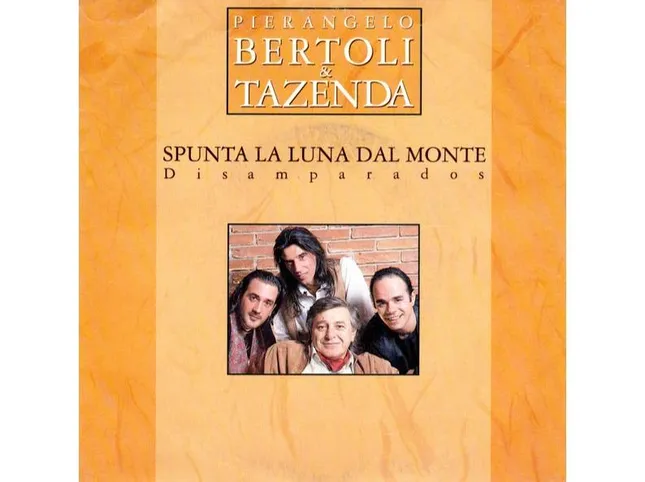
Tazenda and Pierangelo Bertoli, in Sanremo 35 years ago
Yesterday, Saturday 28 February, it was exactly 35 years since Tazenda, with Pierangelo Bertoli, opened the second evening of the 1991 Sanremo Festival, giving the audience in theaters and on television an exciting, vibrant, moving interpretation of “Spunta la luna dal monte (Disamparados)”. At the time, many of us wrote that that song, and that performance, would have deserved more than fifth place in the final ranking. After all, that Sanremo was won by Riccardo Cocciante with “If we’re together”, Renato Zero came second with “Shorts to the wall”, Marco Masini third with “Why lo fai”, Umberto Tozzi fourth with “Gli altririamo noi”, and “La Fotografia” by Enzo Jannacci – Critics’ Award – came eleventh (any comparison between these songs from seven decades ago, which we still remember very well today, and those we heard at the 2026 Festival, would ungenerous. How many will still be heard in 35 years?).
Song historian Felice Liperi dedicated a book to Tazenda, “S’istoria infinida”, recently published in the Chinaski series by Il Castello publishers (the cover at the end of the article). In Liperi I asked for a detailed playlist of the Sardinian group, which I propose below.
Carrasecare. Written by Luigi Marielli with lyrics by Piero Marras in 1988. Beyond the symbolic value linked to the meeting with Mara Maionchi, this song is important because it indelibly marks the group’s folk-rock style.
Mamoiada. A vibrant piece full of rhythm, it is a song that is exalted by its homage to deep Sardinia. It is no coincidence that Tazenda use it as an encore of concerts.
The moon rises from the mountain. A song that is a symbol of their success but also formally important for the dialogue, which seemed unlikely in 1991, between two such different voices, the powerful one of Bertoli and the angelic one of Andrea Parodi. An antiphon that celebrates the ideal meeting between the Sardinian language and Italian.
Pitzinnos in sa gherra. I find this song, presented at Sanremo 1992, particularly exciting for its poetic strength and prophetic dimension if you consider that despite having been written in 1992 in collaboration with Fabrizio De André, it anticipated the attention for the catastrophe that has engulfed Gaza in recent times. The Palestinian question had already exploded in 1992 but what happened afterwards seems like an apocalyptic event for which the pitzinnos (children) pay the most dramatic costs. Without forgetting De André’s small but brilliant intervention in the chorus: thirty, forty, etc.
My home. From 2007, it is marked by an extremely engaging melody demonstrating how a pop song – not surprisingly performed with Eros Ramazzotti – can be intertwined with the feeling of the island.
Astrolicamus. It’s a song that I really appreciate because it puts together a story of science fiction dreams on a beautiful, particularly engaging melody.
Sos ojos de sa jana. This piece is one of the most careful to pay homage to the mythical characters of Sardinia, in this case the fairies (jana), and is exalted in the version of Andrea’s sublime voice.
I can’t rest. Even though it was not a song written by the group, its version was fundamental in giving indication of a new form that set the tone for all those who performed it.
Chelu nieddu Even though I’m not a super prog fan, I like this piece because it brings together the group’s love for progressive rock bands and the story of a terrible drama for the island like the fires.
Limba. This piece is important because it consecrates the fundamental commitment of the Tazenda towards the Sardinian language, and it does so with a smooth and direct path.