
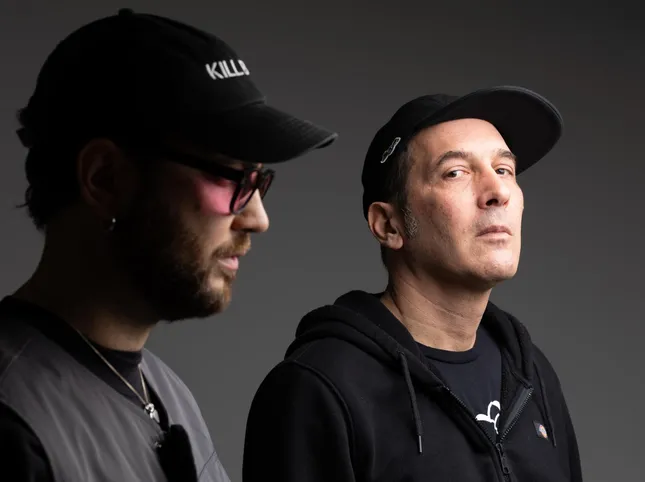
Danno: “I am inspired by Tom Waits because he is extreme like a rapper”
“I went offshore, into waters I didn’t know”. Danno indicates the cover, talks about his first solo album “Aka Danno”, entirely produced by DJ Craim, with the collaboration of Ice One and Motta, and defines it as a “necessary” project in which “I dared, I discovered”. It’s not the rhetoric that peppers the usual interviews, the founder of Colle der Fomento doesn’t wallow in that quagmire of banality, and to understand this you just need to press play and listen: a visceral album, at times crooked, crazy, stinging, moving. It is a record at the edge of the world in which everything seems to burn, except the love for music and its many faces. “Aka Danno” is a hardcore rap album rather than in style, in the experimental challenge that Simone Eleuteri launched towards himself first and then the listener.
Let’s start with the sound: this is a sonically rich album. Each song has its own warmth. Where did you start from?
When they ask me why I called the album that, it’s precisely because at a certain point I found all my colors inside. Every song is a journey, especially musical. It all started from a challenge that DJ Craim gave me during the pandemic. Around that time I started writing things, but not for me. I got in touch with Max Gazzè’s manager and, jokingly, told her: “Look, I have a song that I sing, that I wrote, which would be perfect for Max”. I really like Italian songwriting, I don’t make any differences.
How did it end?
The audition Gazzè liked it and put it in his album. Even respecting everything: he told us “I won’t change anything”. On the one hand, therefore, Craim and I started, as a joke, to try to write songs to propose as authors. I tried to write a song a little like Vinicio Capossela, one a little like De Gregori, one that in my head should have gone to Loredana Berté, written in a feminine way. Playing with various musical forms. Craim also started playing as a self-taught player: bass, piano and more. In short, it is as if we had opened, together, a window onto a new way of working.
How did it affect your record?
Craim began to offer me beats that were different from the usual canons. He sent me a folder. I chose the easiest one, the one that sounded Wu-Tang to me. I say, “I’ll take this.” I rap over a very hip hop lyric and Craim tells me: “Brother, what a drag. Always the same stuff. You chose the most banal, you’re saying things you’ve already said”. I, wounded in my pride, say to him: “Give me a day”. I take the strangest beat, the piece became “Come Blu”. That song is a sort of challenge to Craim and in fact I reply: “You want modern stuff, I still want war”. That piece perhaps made me realize that we could try to explore various worlds.
Where have you gone?
To sample a tango, “The blues of Gundabad”. At the beginning the idea was to involve Vinicio Capossela, ask him to play the tango. Then I meet Motta and he says to me: “Do you want a half-out-of-tune piano like Tom Waits? I have it.” We also lock ourselves in the studio with him and start playing pianos and percussion. Certainly the arrival of Motta in my life, with whom I had worked on “Anime Perse”, gave me new energy. This album is the result of all this.
In “Brucia Roma” you imagine yourself burning. Why?
It took me a long time to finish that piece. Partly because the base had struck me so much that I felt almost intimidated. I think the moment I really closed the verse was when I wrote “burn those like me who only know how to sing”. I, in some moments of depression, think: but what is music for? That I don’t even touch it, that it doesn’t exist, that it isn’t there, that it’s just a suggestion. I certainly wrote “Burn Rome” at a time when I wasn’t well and I had to vent. Luckily I’ll give the answer myself. Music, for those who make it, serves to exorcise a lot of demons, or in any case to train them, tame them and learn to live with them. For those who listen to it, it can have an effect that ranges from healing to giving you new ideas.
It feels like you’ve worked on yourself.
I discovered that I suffer from cyclothymia, which is nothing special: it’s a sort of super light bipolarism, it doesn’t involve anything serious. But this alternation of going up and going down began to complicate my life. The summary is in “I still feel like the number…”, but I cut it off and don’t say “one”. Because I don’t always feel like number one, on the contrary. I have learned not to be afraid to judge myself.
In “Killemall” you rap: “I don’t like everything I say. I’m scared, I feel like the enemy.”
He is inspired by Lucio Dalla. As Craim told me, I’m very unpleasant in this piece and if I hadn’t included the phrase you quote, I would have risked sounding like the angry old man who tells the industry “fuck off”. With “I don’t like what I say” instead I give another perspective, it’s as if I were saying: the problem, in part, is me.
“Tom Waits” is one of the most successful pieces. How was it born?
Tom Waits, as an artist, for me is the right combination of songwriting and hip hop. Sometimes he is so extreme in his sounds and stories that he seems like a rapper. Each rhyme in the piece is a reference to a song or something Tom Waits said or wrote. It is a visionary piece, a hymn to sliding. Tom Waits has always made me think of someone who walks crookedly. It’s music that you have to twist yourself to listen to well. It’s like saying: the world would like you to be straight, but instead there are those who limp, there are those who struggle. Rappo: “I have the sky but not the room”. It’s a hymn to getting by.
In “Distortion” you say: “As a kid I was looking for a revolution, now just a button to stop self-destruction”. Which, however, is not true, because the album is also full of energy and desire for change.
It is true. In Two sides of me coexist: one who would like to be perfect, control everything, do everything well, and then another who instead says “who the fuck cares, bro”. There is a continuous dialogue in my head between several parties, between the one that tells me “don’t smoke before going on stage” and the one that instead pushes me to fall apart. One tends to drift, the other to contain. “Distortore” was born in a moment of crisis. .
In “Jakesulring” does the more lucid part win?
It’s a song where I say nothing other than “I’m the best” and fuck everyone. After ending up in musical waters that I don’t know, I was missing the piece that took me home, more from Mc.
How do you imagine this album on the live front?
We want to do the first round of live shows in hip hop, with DJ Craim, who is much more than a DJ. We’ve already prepared the set list and what he created is beautiful: the connections between one piece and another, the idea of using old beats which then lead to new ones… it will be magical. And then there will certainly also be a tour with the musicians, a world that I have long since cleared.
Is this a risk-taking record?
I’ve learned not to worry too much about what’s around me. Then it probably went well for me, in the sense that what we did with the Colle, what I did alone… somehow always found a positive response. I made a speech to my management and said: “I’ll tell you what I want to do. You’ll tell me: eh, but this way we’ll lose the public.” And my response was: “Get ready, because I’m willing to lose if I believe in something and want to carry it forward. I don’t care.” On the other hand, it’s not that I’m against the idea of having more audiences. But I’ll tell you one thing: I think that today, in rap, at least the way I listen to it, everything is done. Pharoahe Monch, who at one point made an album with rock/metal musicians, Run The Jewels, Schoolboy Q: international rap is a constant source of inspiration.
Have you heard from any interesting young people in Italy?
Toni Zeno, I saw him live, he is very strong and has excellent writing.
