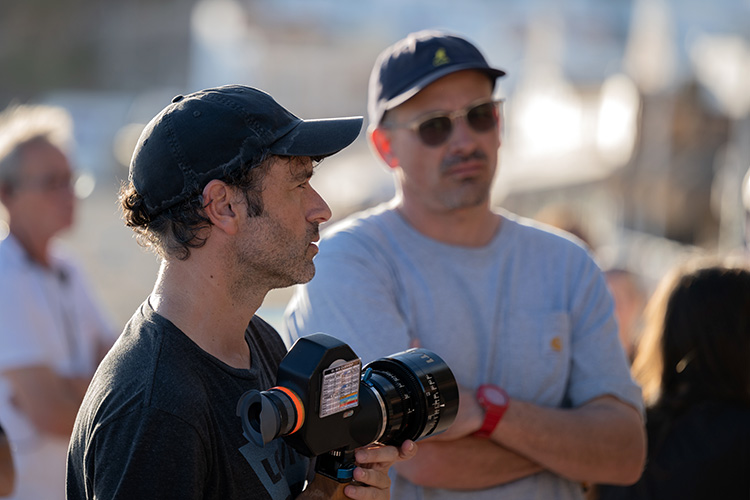
We interviewed Rodrigo Sorogoyen on the occasion of his new film ‘The loved one’
Unquestionably one of the greatest names in current Spanish cinema, Rodrigo Sorogoyen He takes risks and succeeds with his latest film. In “The loved one” The chases and plot twists are set aside to accommodate something as “simple” and actually as complex as the relationship between a father and a daughter.
A relationship that is far from idyllic, of course. We were able to see the movie in the Atlàntida Mallorca Film Fest organized by Filmin, and we had a brief chat with Sorogoyen about her, but also about his commitment to Sandra Romero (director of the wonderful “Where silence passes”) and about how he sees with distance “The Kingdom”, for whom this writes his best movie… until I have seen “The loved one”, which has just been released in our cinemas.
Much is made of the opening scene, but for me there are two even better sequences in the film. One of them is the one on the lunch set, perhaps the most tense scene in your filmography, and without any shooting or (physical) violence in it. What was it like to build that from the script with Isabel Peña, and then the complexity of filming it? Did you sense that it could cause people to talk, like with the opening scene?
It is the scene in which this man, who was said to have been a violent monster and who seemed to no longer be one, reveals himself. I don’t like the expression “taking off the mask” because deep down he doesn’t want to, and he has surely improved a lot, but he can’t help but release that violence that he has inside. We didn’t know if it was going to be talked about, but we knew it had to be the scene from the movie. We hesitated a lot about whether to tell it in real time, whether the seven takes were too long, writing it was a pain, but putting it together… I think it’s the most difficult scene I’ve ever put together. And when it comes to filming too. It was the longest, it took us five days to shoot it. It is told from many points of view, which is something that I was clear about, that we had to tell it from many points of view. Suddenly we found laughter, which added tension… It was carrying the character of Esteban, a character that we have promised is a monster, and there is the suspense of “Is he still one?”, and you screw up his life. It’s what you have to do when writing, fuck up your characters’ lives until they end up exploding (laughs) and do it in an organic way. For example, we liked that it started with what happened the night before with the daughter, and staggered it little by little, first with the actor, then it became like this duel between her and him, etc.
“Writing is screwing up the lives of your characters”
The other scene that I mentioned to you is the one in the tent, perhaps the first time I have cried with one of your films.
I’m very happy that you say that, because that is the climax of the film, and we wanted to do it differently, to play against it. At first it was “Here they finally talk and say a lot of things, very deep things, etc.”, but we were already coming from a very excessive scene, the one on the set. We thought it would be better for them to say practically nothing to each other, to do something very small, in which she calls him Dad, for the first time, where she says “Trunk, listen to me.” We liked that it was inside that tent, a very ugly place, but at the same time symbolic – The black background can tell you that there is only them, there is not even a painting behind it.
The composer of the filming is called Olivier like Olivier Arson, the director of photography is Pepa de Pablo like your Alex de Pablo. At the end there is a dedication to your father… one might think that it is autofiction, but I have already read in other interviews of yours that it was not, neither on your part nor on Isabel’s part. I understand that you wanted to wink by having the world of cinema and filming as part of the plot.
Yes, they are winks that arise organically, suddenly… Look, the editor who comes out is Alberto del Campo. Instead of looking for an actor who knew how to edit and such, I said, “Hey, do you want to?” We had to create fictitious names for all those actors who acted as the technical team, there were really two “teams”, and to avoid getting into trouble, we decided to call the characters by the names of the actors, and for the surnames we thought of those of the people on our team. The actress who acts as photo director is called Pepa, our photo director’s last name is Pablo, well that’s it, Pepa de Pablo. And with that we already knew who each of us is and what position it is. So on the one hand it was fun, but also practical. And then Olivier, who is also his own voice that appears in that audio.
Music has a special place in the film, both the times when Emilia takes refuge in it with her headphones, the game you play when Esteban hears the soundtrack while Emilia enters and then we go to her point of view, the use of the theme in the end…
We wanted to make a film with very little music, because I like films full of music less and less, but I wanted the music that appeared to have a lot of importance. We also thought about not playing extradiegetic music, that everything is playing. It’s cool that Esteban listens to the music from the movie while watching his daughter. It happens to me, sometimes Olivier sends me models and I’m doing something else. Isabel and I got to that scene very soon, and we loved it, I think it’s one of the great scenes in the movie. The process with Olivier was also very interesting, as he first made a demo, and then at the end we heard the final version, much more orchestrated. The truth is that Olivier has worked hard, he has composed beautiful music that only appears on two or three occasions and he has done it, in my opinion, great. He has done something that he has never done before, which is very far from him, with brutal chamber music. I think it gives a lot of flavor to the film. I think the final scene with that music is beautiful, how reality is mixed, the montage, what he imagines about that daughter’s life…
I also wanted to ask you about the bet with Sandra Romero, who directed episodes of “The New Years”, and then triumphed with her debut in the feature “Por donde Pasa el Silencio”, which is for me the best Spanish film of that year.
I think he is a great talent and a great asset to Spanish cinema. One of the screenwriters of “The New Years”, Paula Fabra, recommended it to me. I saw her movie, I liked it a lot, I met her for coffee, and that’s it. I took the plunge. It could have gone wrong, but it didn’t go wrong, it went very well. I really liked how I worked with her, what she has done, and look, she doesn’t stop working now.
I would ask you about your entire filmography, but for reasons of time I will stick to just one, and for me it has to be “The Kingdom.” I don’t know if it occupies that place for you too, or if it’s not as special as others. How do you remember it now in perspective?
I am very fond of all my movies, I couldn’t choose one, both because of the result of the film and because of the experience. I am very fond of “El Reino”, it was also very successful, after “As Bestas” it is the most successful. But, precisely for that reason, it may be the one that I have revisited the most; For example, “May God forgive us” and “Mother” I haven’t seen them in a long time. So, since it is the one that I have revisited the most, it is the one that I would change the most things about, the one that I find the most faults with. That doesn’t mean that I regret it or have a bad experience, that it hurts me to see it, not at all, but it is true that I analyze or criticize it more, because I see it more.