We interviewed director Álvaro Brechner on the occasion of his film ‘Fiesta Pagäna’
It has been released in cinemas “Pagan Festival”the film inspired by Wizard of Oz. The archetypal story of a rock group: some neighborhood kids united by their passion for music, starting from scratch until they become stars.
Success has its reward (fame, massive concerts, international tours…), but also its price (excesses, clashes of egos, internal fights…). The production of the film itself has been accompanied by controversy, with some members supporting the project and others rejecting it. In front of everything, Alvaro Brechner (Uruguayan filmmaker based in Madrid) has made a film worthy of the circumstances, recreating some of his most memorable concerts and playing to imagine what his adventures and misadventures were like, with a cast led by Adrián Lastra mimicking Txus di Fellatio and Adrià Mondaray taking the voice of José Andrëa. Although Brechner prefers not to talk about a biopic, but about a comedy starring a heavy metal group…
We don’t usually see many biopics of national rock groups in the cinema. How was the idea of “Pägana Festival” born? Was it your initiative, were you commissioned with the project…?
It is not a biopic. The producers called me one day and told me that they wanted to make a movie about the Wizard of Oz. It seemed like an amazing idea to me. But my idea was not a typical biopic, but a comedy about a band. I was interested in a group that starts with everyone together in a van and ends up filling stadiums, and that along the way is destroyed several times and is reborn.
“The truth is like heavy metal, it depends on who is telling it and how many beers they have had”
What was the documentation process like?
We had many meetings with band members and there was a lot of information in many places. What we quickly discovered is that there is no single version of anything. In the end we decided that that was the movie, not a problem with the movie. A director is not a notary of reality; What we considered was a leap to “what if”. That’s why the narrator, played by Roberto Álamo, says it at the beginning: some swear that it was this, others swear that it was that, “the truth is like heavy metal, it depends on who is telling it and how many beers they have had.”
Has being an unofficial film given you more freedom when writing it?
I don’t know what “an official movie” would be, but freedom doesn’t come from there. It comes from deciding from the beginning that this was fiction and that fiction is a form of truth. Reality is a point of view. I am a director: for me everything that is in the film is true, including what I imagined. The film in the end, I imagine, is a bit like the band and a bit like those of us who made it.
Did the casting determine having to embody real people?
Several actors almost changed physically to look like the real ones. The brutal case was that of Adrián Lastra, who did an incredible job. But the objective with the actors was greater. It was internal. When an actor investigates the person he is going to play, he absorbs material that helps him get out of himself, and ends up becoming a mix between the character and the real thing. That’s the most fascinating thing that can happen on a shoot. The key was not imitation, it was conviction. The big challenge was for nine actors to seem like an autonomous entity, that thing that only happens in music: nine different personalities that together form something with its own entity. They did a magnificent job there. And then there was the musical aspect: each one spent months taking control of their instrument.
Was it difficult to recreate Las Ventas or the South American tours?
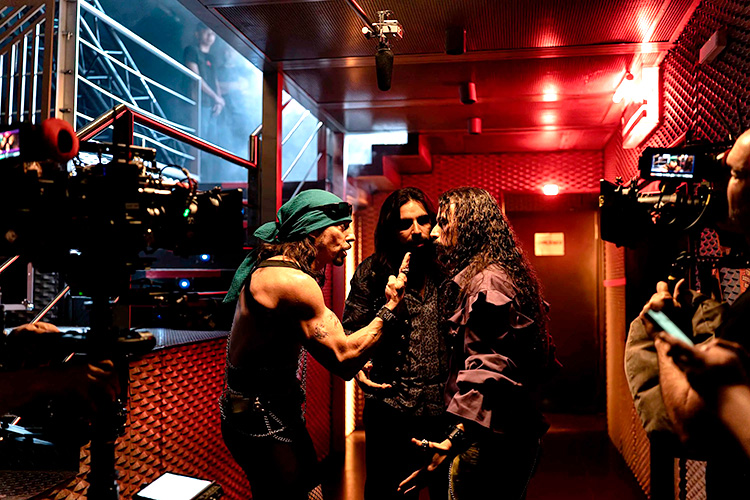
It was an enormous, productive and aesthetic challenge. We worked on a lot of archive images to emulate the real staging. And I wanted the viewer to feel that it was really happening, almost like a concert recorded live, not like a fiction. A style where fiction meets documentary, with that euphoria that only rock and heavy metal achieve.
The group supported the project and then rejected it. Was production in danger?
Several people in the group make cameos and wink at the fans: Rafa Blas, the current singer, Moha and Peri. As a director I was very close to them. What you mention was resolved by production while I was filming; I don’t know the details.
Has Peri been decisive?
Fundamental. He contributed a thousand anecdotes and, above all, the knowledge of someone who has gone through all the stages of this band, from creation to touring for entire months. That not only served to feed the script: it was essential for the actors, with whom he was in contact almost every day of filming.
Were the songs re-recorded?
Yes, all of them. Including the voice of Adría Mondaray as José Andrëa.
Have you noticed other biopics from the world of rock?
It’s impossible to say no, I’ve seen dozens, especially in recent years. But in general musical biopics are made as totems of those who speak. I was interested in what was internal: the characters, how the creative act arises, the disputes, how the greatest success of an endless tour can turn into tedium. The human, with its successes and failures. The human comedy.
Who is it addressed to?
I hope everyone. I know the band’s immense fanbase, which is the product of decades of work. But it is a film for anyone who wants to get into the drama and comedy of a human group that begins with a dream and does not know what awaits them.
What route will it have after the premiere?
That will depend on the public and our sales agent. I know that a premiere is planned almost in parallel in Mexico and the rest of Latin America.