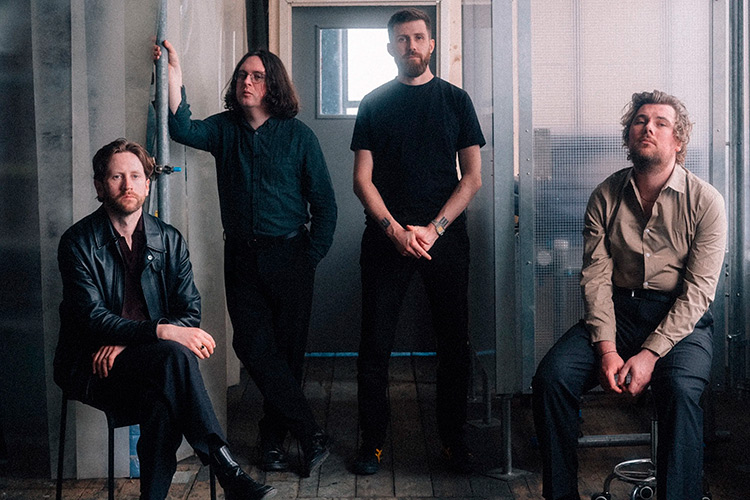
“The international success of bands like Fontaines DC is amazing”
It is almost impossible to find a greater disparity between the overwhelming brutalist aggressiveness of “Pugnello” (Rough Trade/Popstock!, 26) and the affable nature of Alan Duggan, manager, guitarist, and fourth part of Gilla Band. A formation that could be seen as a pioneer in this golden age of Irish rock in all its aspects.
The name of the Irishmen’s fourth album sounds like a bucolic Italian village, but there is nothing peaceful about a sonic assault that draws on futuristic No Wave and uncompromising industrial post-punk. And you have to have things very clear to release an album of these characteristics in times when mimicry and comfort are sought. In any case, Alan is not so clear that his proposal is so radical. “Do you know what happens? There are people who tell us that they can’t stand it, but others tell us that we don’t make extreme music at all. It depends on the perspective…”.
There is more. “I think that when it comes to making music you have two options: you can focus on the creative part, or you can take into account the marketing part. That determines what you’re going to end up doing. If we focused on the business part, we would have to think about playing a lot on the radio, or filling bigger rooms, and that would completely influence the creative part. It would screw everything up. The other option is to see what you can do with the record once it’s made, how to try to make people like it. That’s much easier. If you have an eight-minute single they’re going to tell you: ‘They’re not going to play that on the radio’ and you’re going to say: ‘Okay, let’s do something else.’he argues.
“If you don’t depend financially on this, you can last longer”
This philosophy sounds great, but it would be a bit chimerical if it weren’t for the unconditional support of a label as big as Rough Trade. “It’s very important. It takes a lot of pressure off your shoulders. If you release music on your own and you want to release vinyl and advertise, you have to advance a lot of money. We get along really well with the Rough Trade team. To the point that, when I got married ten years ago, there were people from the label at the wedding.”Alan admits.
In the four years since their previous job, they have all been very busy with different side projects. But “We hope to continue making albums. We never ask ourselves when we finish one if we are going to make another. The thing is that we have to have time. And we don’t release music to stay in the limelight.” The example I gave you of a pair of Shellacs that always went their way in every way seems very pertinent to you. “Steve Albini has been a big influence on the band, not only sonically, but philosophically. I remember a very old interview in which he said that, if you make music and art and you can manage not to depend financially on it, you will probably be in this longer. And we are at a point where we don’t live off the group.”
The curious title of the album comes from a horror story by Dara’s uncle (Kiely, the singer), who imagined the adventures of a guy who bought a laptop with a cursed (typographic) font named after a small Italian town, “Pugnello.” “It made sense because Dara talks a lot about her family, and it’s funny that an album has the title of a cursed source.”
Having overcome the deconstruction phase of rock, the quartet is increasingly motivated to play with production, as shown in the brutal single “Placeholder”, where they sound like some (more) broken Nine Inch Nails. Greater weight of electronics perhaps? “On our first EP we were already trying to obstruct this and destroy and deconstruct that, running guitar and bass through a bunch of pedals. But as the group has progressed, now it’s something we can do with the entire cut.”
Daniel Fox, bassist of the group, has immersed himself in producing groups like Lambrini Girls or Sprints, but with Gilla Band The four of them take care of the technical part. Although bands like James Chance & The Contortions, The Fall or The Birthday Party are in their DNA, “We can share Dolly Parton songs. I listen to a lot of K-Pop. The key is that it motivates us to hear things we haven’t heard before.”
In a previous interview, the band sardonically recalled how when they started Ireland was full of Arctic Monkeys imitators. Luckily they decided to take another path, and are almost pioneers in the amazing explosion of Irish bands more or less close to (post) punk and noise. “It’s fascinating and I love witnessing it. Ten years ago I was sure we were going to be nominated for the Choice Music Prize in Ireland, because we were being published internationally and had toured. Now all the artists that come out have international recognition and tour, which is crazy. It means that many artists have managed to find an audience outside. The international success of bands like Fontaines DC is mind-blowing.”. The guitarist has no explanation for this abundance, although he admits that life in Ireland has become “more and more hostile to musicians, with clubs, rehearsal spaces and studios closing, and the inability to find housing, and it makes sense that the music reflects this in some way.” Although, he clarifies, bands like Gurriers are much more explicit about this than them.