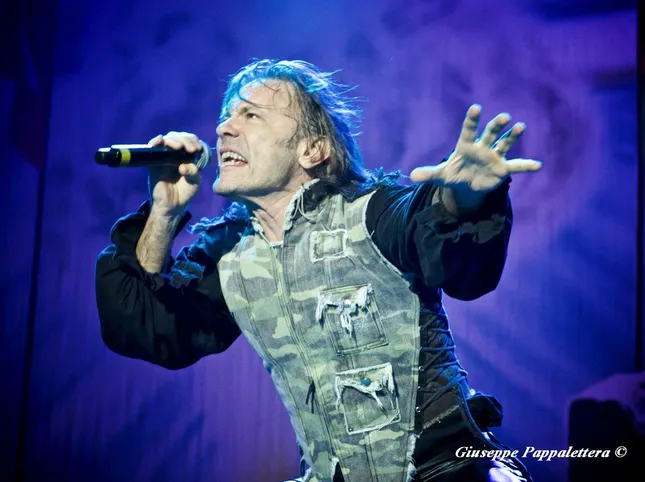
“The heart of Iron Maiden is on stage, we are old school”
When the webcam comes on, I can barely see the edges of Bruce Dickinson’s eyes. The screen has been tilted so that only the upper part of his face appears on the video call and the Iron Maiden frontman has a black cap pulled down almost over his eyes. Every aspect of the legendary metal band has in turn entered the myth, starting from the reluctance with which the members lend themselves to the gaze of the media. It is not a surprise, in short, that Dickinson is present but not fully visible, even a little cautious in his answers.
It also takes a while to find the rhythm, to get out of a loop of dry, almost abrupt answers to questions regarding the documentary “Iron Maiden: Burning Ambition”, in theaters from May 14th, which attempts to cast an intimate, personal look at the band. However, I will do it starting from the band’s fans, from their visceral loyalty towards a truly generous group in terms of the geographical and chronological extension of their tours.
I decide to start from there, from the relationship with the fans, to retrace those early years of my career in the light of today’s awareness. Dickinson immediately becomes more talkative when talking about the second part of the world tour the Run For Your Lives World Tour 2026, demonstrating that burning ambition mentioned in the title of the doc.
Shortly before, when I asked him why he chose the title of that 1980 album, I expected him to tell me that it was the first in which he had made a direct contribution. Watching the documentary, however, you get the impression that it is the common denominator that unites every member of the band: those who still play, those who are no longer there.
Dickinson cuts it short: he doesn’t remember whether it was the band members or the director Malcolm Venville who proposed it. During our interview, however, he does not shy away from the memory of the past, from the evaluation of who Iron Maiden are today, on a musical and human level.
It’s impressive how you can look to the past without nostalgia and to the future – to that concert at San Siro on June 17th which will make Iron Maiden the first metal band to conquer the historic Italian stage – without the weight of so much time spent on stage becoming anything other than energy to continue performing.
Let’s talk about the fans, since the documentary starts from their voices, mixing famous people like Jack Black with unknown enthusiasts. Yours is an extremely loyal fanbase, where the average fan follows the band for multiple dates in a single tour. How do you experience this loyalty while being on stage in an era in which social media and the internet allow a different and continuous contact between audiences and artists?
You’re right, today there are many more ways to interact with fans and also to be creative, thanks to the different media available. However, the heart of Iron Maiden has always been old school: on stage, face to face. And this will never change. If it’s an Iron Maiden show, what matters is the music played live. The fact of being on a huge stage with a giant screen behind it doesn’t change anything for us: we treat it as if it were a big club. I’m sure Steve would tell you the same. Even when we play in front of eighty thousand people, we have the same attitude as if we were in a small venue like the Cart and Horses in Stratford, the “cradle” of our band.
Those early performances in small venues in East London are also shown in the doc. What effect did it have on you, seeing you playing in that context again?
I thought we were pretty funny when we were young. I really like that enormous self-confidence that comes out from the videos, from how we play. Even what we say: even when we say some nonsense, it is clear that we really believe it. It’s what you do when you’re young, and it’s beautiful that way.
One thing that struck me about the film is the brutal honesty in chronicling the ups and downs of the band. Was it difficult or comforting to revisit those moments?
No. When we found out there was going to be a documentary, the first thing was not wanting to be involved on an editorial level. You have to have a detached approach: you want someone to look at the story from the outside and tell it. We’re not a bunch of poodles. It’s a story with all its flaws, but that’s fine: I wouldn’t change anything.
So you gave total freedom to the director, Malcolm Venville?
Yes. The first time I saw the film it was practically finished, but it wasn’t good. I’ll be honest: the problem wasn’t the content, but the editing, especially in the first third. And it wasn’t Malcolm’s fault, but the record company’s. I made some observations, which coincidentally coincided with those of Steve and art director Ben Smallwood. This allowed us to intervene and improve the narrative, without cutting content but making it more coherent. For example, in the first version our drummer Clive Burr was practically not there and I said that we needed to include him more. For those who aren’t deep fans it may not be obvious, but the bond with former members like Paul and Clive is still very strong, even though they are no longer in the band and have sadly passed away.
At the beginning of your career in Maiden you spoke of a rollercoaster journey. Is it still like this today?
No, I wouldn’t say so. Of course, when a tour starts it’s a bit like getting on a carousel, because we are still very physical on stage and we prepare ourselves for months of fatigue and pain. But you always hope that the reward is the energy of the audience and the atmosphere that is created. And yes, I think the audience really loves it.
In the documentary we see you starting from small pubs and arriving at stadiums. This summer you will play at San Siro, the first heavy metal band to do so: what does reaching such a milestone mean to you?
San Siro is interesting. I’m not a big football fan, but I understand what it represents for Italian fans, it’s almost a sporting and musical Mecca. And also for my wife, who is half Italian (laughs). When he found out we were playing there he was thrilled. Musically it’s obviously a huge achievement, as was playing in the stadiums of Madrid or Barcelona. They are places designed for incredible audience reactions, so it will be very exciting. The Italians, then, know how to sing and will make themselves heard, I’m sure of it.
Thinking back to the beginning, do you remember the moment you knew the band was going to be huge?
The first time I understood it was when I was in Samson and I saw Iron Maiden live. We were the headliners and they were the special guests of the evening. I looked at them and thought: they will become gigantic phenomena. And immediately afterwards I thought: I have to sing for them. Then when I joined the band, “The Number of the Beast” arrived. My first concert with them by the way was in Bologna, Italy. We had chosen Italy because we thought that no one would review the show: if it had gone badly, they would have sent me away without any problems. (laughs)